
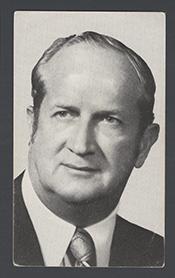
Historical · U.S. House · Kansas · District 1
Keith Sebelius
Former U.S. Representative · Kansas District 1 · 1969–1981 · Republican
Keith Sebelius represented Kansas's District 1 in the United States House of Representatives (1969–1981) for the Republican party. The page below collects sourced biographical facts, term history, committee roles, and provenance for Sebelius.
Bioguide ID: S000217
Key facts
- Full name
- Keith Sebelius
- State
- Kansas
- District
- District 1
- Party
- Republican
- House service
- 1969–1981
- First House term
- 1969
- Status
- Left office
- Current term ends
- —
- Born
- 1916
- Bioguide ID
- S000217
- Committee assignments
- —
- Dataset version
- 1.20260605
Biographical narrative
848 words · sourced from the Wikipedia REST extract
Keith G. Sebelius was an American politician who served as a Republican member of the United States House of Representatives, representing Kansas's 1st congressional district from 1969 until 1981. His political career spanned over a decade, during which he was involved in various legislative efforts and held significant positions within the House. Sebelius's tenure was marked by his engagement in key political issues of the time, including civil rights and government accountability.
Early life and career
Keith George Sebelius was born on September 10, 1916, in Norton, Kansas. He was the son of Carl and Minnie Sebelius, with his father passing away when Keith was only seven years old. Growing up in Almena, Kansas, he completed his education at Almena High School before pursuing higher education at Fort Hays State University, where he graduated in 1939. Sebelius later attended George Washington University, earning a law degree in 1942. After completing his education, he returned to Norton to practice law.
Sebelius's public service began during World War II, where he served in the United States Army. His military service included work with intelligence agencies focused on detecting German U-boats in the Caribbean. Following the war, he became active in local politics, serving as a councilor and later as the mayor of Almena. His early political involvement included roles such as secretary of the Kansas Young Republicans Club and various leadership positions within the American Legion, where he was elected commander at different levels.
In 1962, Sebelius transitioned to state politics when he was appointed to the Kansas State Senate to fill the vacancy left by William B. Ryan, who had resigned to become a district judge. During his time in the state Senate, he introduced several legislative proposals, including a notable bill aimed at changing Kansas's time zone to Central Time, although this proposal did not pass. He successfully ran for reelection in 1964, further solidifying his political presence in Kansas.
House tenure
Sebelius's journey to the U.S. House of Representatives was marked by initial setbacks. He ran unsuccessfully for the House twice, first in 1958 and again in 1960, both times losing by narrow margins. However, in 1968, he succeeded in his bid for Congress when he was elected to represent Kansas's 1st congressional district, filling the seat vacated by Bob Dole, who had left to run for the Senate.
Sebelius's congressional career began in 1969 and continued until January 3, 1981. During his time in the House, he served alongside prominent political figures and participated in significant legislative discussions. In June 1969, he temporarily filled in for House Minority Whip Leslie C. Arends, assisting Minority Leader Gerald Ford during a brief absence. His legislative efforts included a variety of issues, reflecting the political climate of the time.
Throughout his tenure, Sebelius was recognized for his contributions to Kansas and the nation. In May 1973, he was named Man of the Year for Kansas by the National Federation of Independent Business, highlighting his commitment to supporting small businesses and economic growth. He was also involved in the Watergate scandal discussions, expressing his views on the implications of President Nixon's actions and voting in favor of measures related to the impeachment inquiry.
Sebelius chose not to seek reelection in 1980, announcing his decision on April 25 of that year. His departure from Congress marked the end of a significant chapter in his political career, and he was succeeded by Pat Roberts, who had served as his aide.
Legislative focus and committees
During his time in the House of Representatives, Sebelius was involved in various legislative initiatives and served on several committees. His political positions reflected a blend of traditional Republican values and a willingness to engage with contemporary issues. He introduced a constitutional amendment in 1971 aimed at legalizing voluntary prayer in public buildings, although it did not advance in the legislative process. Sebelius also supported the lowering of the voting age, voting in favor of the Twenty-sixth Amendment to the United States Constitution.
Sebelius was vocal on issues related to civil rights, notably supporting the establishment of a holiday in honor of Martin Luther King Jr. He was critical of the Nixon administration's agricultural policies, particularly the decision to sell grain to the Soviet Union at subsidized prices, which he opposed. His legislative actions often reflected a commitment to accountability and transparency in government.
In addition to his legislative work, Sebelius's political influence extended to his family. His son, K. Gary Sebelius, married Kathleen Sebelius, who later became the governor of Kansas and served as the U.S. Secretary of Health and Human Services. This connection further entrenched the Sebelius family's legacy in Kansas politics.
Sebelius's health declined after he was diagnosed with prostate cancer in 1979. He passed away on August 5, 1982, in Norton County Hospital. His contributions to Kansas and the nation were recognized posthumously, including the renaming of the Norton reservoir to Keith Sebelius Lake in his honor. His legacy continues to be remembered in the context of Kansas political history and the broader narrative of American governance during a transformative period.
Notable legislation
Sponsored and co-sponsored legislation for Keith Sebelius is pending operator curation. The biographical narrative above carries the same provenance trail until per-bill rows are written.
Sources
- [1]https://en.wikipedia.org/wiki/Keith_SebeliusWikipedia · retrieved 2026-06-05
Notable quotes
Sourced quotes for Keith Sebelius are pending operator curation. Narrative-scope provenance remains attached below.
Sources
- [1]https://en.wikipedia.org/wiki/Keith_SebeliusWikipedia · retrieved 2026-06-05
Key positions
Curated policy positions for Keith Sebelius are pending operator review. The biographical narrative above carries the same provenance trail until per-topic positions are written.
Sources
- [1]https://en.wikipedia.org/wiki/Keith_SebeliusWikipedia · retrieved 2026-06-05
Terms served
- 1969–1971U.S. House · Term 1 · Republican
- 1971–1973U.S. House · Term 2 · Republican
- 1973–1975U.S. House · Term 3 · Republican
- 1975–1977U.S. House · Term 4 · Republican
- 1977–1979U.S. House · Term 5 · Republican
- 1979–1981U.S. House · Term 6 · Republican
Sources & provenance
Every attributable claim above carries a per-section [N] marker that resolves to the corresponding URL below. Each entry records the upstream provider, the canonical URL, and the timestamp at which the source was retrieved by the ingest pipeline.
Key facts
- https://bioguide.congress.gov/search/bio/S000217bioguide · retrieved 2026-06-05
- https://www.govtrack.us/congress/members/409722govtrack · retrieved 2026-06-05
Biographical narrative
- https://en.wikipedia.org/wiki/Keith_Sebeliuswikipedia · retrieved 2026-06-05
Find your representative
Every U.S. state elects representatives by district. Browse Kansas’s delegation, the full former-representative roster, or explore the role and term length.
Related on The Candidate
- Preceded by Howard MillerEarlier holder of the Kansas District 1 House seat · Democratic.Open
- Succeeded by Tim HuelskampLater holder of the Kansas District 1 House seat · Republican.Open
- Abel WilderFormer U.S. Representative · Kansas District 1 · RepublicanOpen
- Albert ColeFormer U.S. Representative · Kansas District 1 · RepublicanOpen
- Case BroderickFormer U.S. Representative · Kansas District 1 · RepublicanOpen
- Daniel Anthony Jr.Former U.S. Representative · Kansas District 1 · RepublicanOpen