
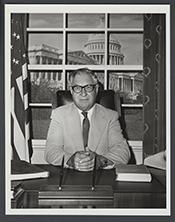
Historical · U.S. House · Kansas · District 5
Joe Skubitz
Former U.S. Representative · Kansas District 5 · 1963–1979 · Republican
Joe Skubitz represented Kansas's District 5 in the United States House of Representatives (1963–1979) for the Republican party. The page below collects sourced biographical facts, term history, committee roles, and provenance for Skubitz.
Bioguide ID: S000472
Key facts
- Full name
- Joe Skubitz
- State
- Kansas
- District
- District 5
- Party
- Republican
- House service
- 1963–1979
- First House term
- 1963
- Status
- Left office
- Current term ends
- —
- Born
- 1906
- Bioguide ID
- S000472
- Committee assignments
- —
- Dataset version
- 1.20260605
Biographical narrative
869 words · sourced from the Wikipedia REST extract
Joe Skubitz was an American politician who served as a U.S. Representative for Kansas's 5th congressional district. A member of the Republican Party, Skubitz had a long and notable career in public service, spanning over three decades in various roles, including his tenure in the U.S. House of Representatives from 1963 until his resignation in 1978. His background as a lawyer and his experience working for U.S. Senators provided him with a solid foundation for his legislative career. Skubitz's contributions to Congress were marked by his commitment to his constituents and his active participation in the legislative process.
Early life and career
Joe Skubitz was born on May 6, 1906, in Frontenac, a small town located in Crawford County, Kansas. His family background was rooted in immigration, as his parents had come to the United States from Slovenia. This heritage may have influenced his perspectives and policies during his political career. Skubitz's early education took place in Ringo, Kansas, where he attended grade school, followed by high school in Girard and Frontenac. His academic journey continued at the Kansas Teachers College of Pittsburg, now known as Pittsburg State University, where he earned a Bachelor of Science degree in 1929. He further pursued his education by obtaining a Master of Science degree in 1934.
In 1938, Skubitz began studying law at Washburn University in Topeka, Kansas. He later transferred to George Washington University in Washington, D.C., where he graduated with a Bachelor of Laws (LL.B.) in 1944. Following his graduation, he was admitted to the bar that same year, allowing him to practice law in both Kansas and the District of Columbia. This legal background would later serve him well during his time in Congress, where legal knowledge is often essential for navigating complex legislation.
Before his election to the House of Representatives, Skubitz gained significant experience in government service. He worked as an administrative assistant to U.S. Senator Clyde M. Reed from 1939 to 1949, followed by a similar role for U.S. Senator Andrew F. Schoeppel from 1949 until 1962. These positions provided him with valuable insights into the legislative process and the workings of Congress, as well as the opportunity to build a network of political connections. In 1960, he further engaged with the Republican Party by serving as a delegate to the Republican National Convention, where he participated in shaping the party's platform and selecting its presidential nominee.
House tenure
Joe Skubitz was elected to the U.S. House of Representatives as a Republican, beginning his first term on January 3, 1963. He represented Kansas's 5th congressional district, a position he held through eight consecutive terms until his resignation on December 31, 1978. Skubitz's tenure in the House was characterized by his active involvement in various legislative initiatives and his dedication to serving the interests of his constituents.
Throughout his time in Congress, Skubitz participated in numerous legislative sessions, contributing to discussions and debates on a wide range of issues. His long service allowed him to build seniority, which often translates into greater influence within the House. While specific details about the legislation he sponsored or voted on are not provided, it is common for members of Congress to engage in a variety of topics, including economic policy, education, healthcare, and infrastructure, among others.
Skubitz did not seek renomination in 1978, marking the end of his congressional career. His decision to step down from public office came after a lengthy period of service, during which he had established himself as a prominent figure in Kansas politics. Following his resignation, he continued to reside in Kansas, where he remained engaged with his community until his passing.
Legislative focus and committees
During his time in the House of Representatives, Joe Skubitz was involved in various legislative matters that reflected the interests and needs of his constituents in Kansas. While specific details about the committees he served on or the legislation he championed are not provided, it is common for members of Congress to focus on issues pertinent to their districts, such as agriculture, education, healthcare, and infrastructure development.
As a member of the Republican Party, Skubitz likely aligned with the party's platform, which traditionally emphasizes fiscal conservatism, limited government, and individual liberties. His legal background would have informed his approach to legislative matters, allowing him to analyze and understand the implications of proposed laws and policies.
Skubitz's experience as an administrative assistant to two U.S. Senators also contributed to his legislative focus. This background would have equipped him with insights into the workings of Congress and the importance of building coalitions to advance legislative goals. His participation in the Republican National Convention further suggests that he was actively engaged in shaping party policies and priorities, which would have influenced his work in the House.
After his departure from Congress, Joe Skubitz continued to be recognized for his contributions to public service. He passed away on September 11, 2000, in Wichita, Kansas, leaving behind a legacy of commitment to his constituents and the state of Kansas. His final resting place is at Old Mission Cemetery in Wichita, where he is remembered for his long-standing dedication to public service and the impact he made during his time in office.
Notable legislation
Sponsored and co-sponsored legislation for Joe Skubitz is pending operator curation. The biographical narrative above carries the same provenance trail until per-bill rows are written.
Sources
- [1]https://en.wikipedia.org/wiki/Joe_SkubitzWikipedia · retrieved 2026-06-05
Notable quotes
Sourced quotes for Joe Skubitz are pending operator curation. Narrative-scope provenance remains attached below.
Sources
- [1]https://en.wikipedia.org/wiki/Joe_SkubitzWikipedia · retrieved 2026-06-05
Key positions
Curated policy positions for Joe Skubitz are pending operator review. The biographical narrative above carries the same provenance trail until per-topic positions are written.
Sources
- [1]https://en.wikipedia.org/wiki/Joe_SkubitzWikipedia · retrieved 2026-06-05
Terms served
- 1963–1965U.S. House · Term 1 · Republican
- 1965–1967U.S. House · Term 2 · Republican
- 1967–1969U.S. House · Term 3 · Republican
- 1969–1971U.S. House · Term 4 · Republican
- 1971–1973U.S. House · Term 5 · Republican
- 1973–1975U.S. House · Term 6 · Republican
- 1975–1977U.S. House · Term 7 · Republican
- 1977–1979U.S. House · Term 8 · Republican
Sources & provenance
Every attributable claim above carries a per-section [N] marker that resolves to the corresponding URL below. Each entry records the upstream provider, the canonical URL, and the timestamp at which the source was retrieved by the ingest pipeline.
Key facts
- https://bioguide.congress.gov/search/bio/S000472bioguide · retrieved 2026-06-05
- https://www.govtrack.us/congress/members/409962govtrack · retrieved 2026-06-05
Biographical narrative
- https://en.wikipedia.org/wiki/Joe_Skubitzwikipedia · retrieved 2026-06-05
Find your representative
Every U.S. state elects representatives by district. Browse Kansas’s delegation, the full former-representative roster, or explore the role and term length.
Related on The Candidate
- Preceded by James BreedingEarlier holder of the Kansas District 5 House seat · Democratic.Open
- Succeeded by Robert WhittakerLater holder of the Kansas District 5 House seat · Republican.Open
- Abel WilderFormer U.S. Representative · Kansas District 1 · RepublicanOpen
- Albert ColeFormer U.S. Representative · Kansas District 1 · RepublicanOpen
- Case BroderickFormer U.S. Representative · Kansas District 1 · RepublicanOpen
- Daniel Anthony Jr.Former U.S. Representative · Kansas District 1 · RepublicanOpen