
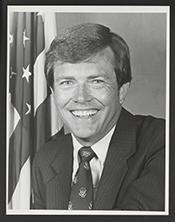
Historical · U.S. House · Kansas · District 5
Robert Whittaker
Former U.S. Representative · Kansas District 5 · 1979–1991 · Republican
Robert Whittaker represented Kansas's District 5 in the United States House of Representatives (1979–1991) for the Republican party. The page below collects sourced biographical facts, term history, committee roles, and provenance for Whittaker.
Bioguide ID: W000426
Key facts
- Full name
- Robert Whittaker
- State
- Kansas
- District
- District 5
- Party
- Republican
- House service
- 1979–1991
- First House term
- 1979
- Status
- Left office
- Current term ends
- —
- Born
- 1939
- Bioguide ID
- W000426
- Committee assignments
- —
- Dataset version
- 1.20260605
Biographical narrative
867 words · sourced from the Wikipedia REST extract
Robert Russell Whittaker, commonly known as Bob Whittaker, is a former U.S. Representative who served the state of Kansas in the House of Representatives for six consecutive terms from 1979 until 1991. A member of the Republican Party, Whittaker's political career was marked by his background in healthcare, specifically optometry, which informed his legislative priorities and interests during his time in Congress. Following his departure from the House, he transitioned into a role as a senior legislative analyst in the private sector.
Early life and career
Bob Whittaker was born on September 18, 1939, in Eureka, Kansas. Growing up in a small town, he received his early education in the public schools of Greenwood County. His academic journey took him to the University of Kansas, where he studied from 1957 to 1959, followed by a summer at Emporia State University in 1959. Whittaker pursued a career in optometry, earning his Doctor of Optometry degree from the Illinois College of Optometry in 1962. This educational background laid the foundation for his future career as an optometrist.
After completing his education, Whittaker began his professional career in optometry, establishing himself as a healthcare provider. In 1973, he became the clinic director for the Kansas Low Vision Clinic, where he worked to assist individuals with visual impairments. His experience in the healthcare field not only shaped his professional identity but also influenced his later political career, particularly in his focus on health-related issues.
Whittaker's entry into politics began at the local level, where he served as a precinct committeeman and participated in the city planning commission from 1970 to 1974. These roles provided him with foundational experience in governance and community planning, which he later expanded upon during his tenure in the Kansas House of Representatives from 1974 to 1977. His involvement in state politics helped him build a network and gain the necessary experience to pursue a higher office.
House tenure
Whittaker's congressional career began when he was elected as a Republican to the Ninety-sixth Congress, which commenced on January 3, 1979. He successfully won re-election to five subsequent Congresses, serving a total of six terms in the U.S. House of Representatives. His tenure in Congress lasted until January 3, 1991, when he chose not to seek renomination for the One Hundred Second Congress.
During his time in the House, Whittaker represented Kansas's 5th congressional district. His election to Congress came during a period of significant political change in the United States, as the country was navigating various domestic and international challenges. Whittaker's legislative work was influenced by the political climate of the late 1970s and 1980s, a time characterized by economic concerns, social issues, and evolving foreign policy.
As a member of Congress, Whittaker participated in numerous debates and discussions that shaped national policy. His background in healthcare likely informed his contributions to legislative discussions, particularly those related to health care and public health issues. While specific details of his legislative initiatives and voting record are not provided, it can be inferred that his professional expertise would have played a significant role in his approach to policymaking.
Whittaker's decision not to seek re-election in 1990 marked the end of his formal political career in the House. His departure from Congress came at a time when many representatives were reassessing their political futures, and it allowed him to transition into new professional opportunities outside of elected office.
Legislative focus and committees
Throughout his six terms in Congress, Bob Whittaker's legislative focus was likely influenced by his background in optometry and healthcare. Although specific details regarding the committees on which he served are not available, members of Congress typically align themselves with committees that reflect their professional expertise and the interests of their constituents. Given Whittaker's experience in healthcare, it is reasonable to assume that he may have been involved in committees related to health, education, and welfare, where he could advocate for policies that aligned with his professional background.
In addition to health-related issues, Whittaker's legislative agenda may have included a range of topics pertinent to his constituents in Kansas. Representatives often engage with issues such as agriculture, education, infrastructure, and economic development, reflecting the diverse needs of their districts. Whittaker's focus on these areas would have been essential in addressing the concerns of his constituents, particularly in a state where agriculture plays a significant role in the economy.
Following his departure from Congress, Whittaker continued to engage in public policy as a senior legislative analyst at Fleishman-Hillard, a Washington, D.C.-based lobbying and public relations firm. This role allowed him to leverage his experience and knowledge gained during his time in Congress, providing insights into the legislative process and helping to shape policy discussions from a different vantage point.
In summary, Bob Whittaker's career as a U.S. Representative was marked by his commitment to public service, informed by his background in healthcare and his experiences at various levels of government. His tenure in Congress spanned over a decade, during which he contributed to the legislative process and represented the interests of his constituents in Kansas. After leaving office, he transitioned to a role in the private sector, continuing to influence public policy beyond his congressional service.
Notable legislation
Sponsored and co-sponsored legislation for Robert Whittaker is pending operator curation. The biographical narrative above carries the same provenance trail until per-bill rows are written.
Sources
- [1]https://en.wikipedia.org/wiki/Bob_WhittakerWikipedia · retrieved 2026-06-05
Notable quotes
Sourced quotes for Robert Whittaker are pending operator curation. Narrative-scope provenance remains attached below.
Sources
- [1]https://en.wikipedia.org/wiki/Bob_WhittakerWikipedia · retrieved 2026-06-05
Key positions
Curated policy positions for Robert Whittaker are pending operator review. The biographical narrative above carries the same provenance trail until per-topic positions are written.
Sources
- [1]https://en.wikipedia.org/wiki/Bob_WhittakerWikipedia · retrieved 2026-06-05
Terms served
- 1979–1981U.S. House · Term 1 · Republican
- 1981–1983U.S. House · Term 2 · Republican
- 1983–1985U.S. House · Term 3 · Republican
- 1985–1987U.S. House · Term 4 · Republican
- 1987–1989U.S. House · Term 5 · Republican
- 1989–1991U.S. House · Term 6 · Republican
Sources & provenance
Every attributable claim above carries a per-section [N] marker that resolves to the corresponding URL below. Each entry records the upstream provider, the canonical URL, and the timestamp at which the source was retrieved by the ingest pipeline.
Key facts
- https://bioguide.congress.gov/search/bio/W000426bioguide · retrieved 2026-06-05
- https://www.govtrack.us/congress/members/411585govtrack · retrieved 2026-06-05
Biographical narrative
- https://en.wikipedia.org/wiki/Bob_Whittakerwikipedia · retrieved 2026-06-05
Find your representative
Every U.S. state elects representatives by district. Browse Kansas’s delegation, the full former-representative roster, or explore the role and term length.
Related on The Candidate
- Preceded by Joe SkubitzEarlier holder of the Kansas District 5 House seat · Republican.Open
- Succeeded by Richard NicholsLater holder of the Kansas District 5 House seat · Republican.Open
- Abel WilderFormer U.S. Representative · Kansas District 1 · RepublicanOpen
- Albert ColeFormer U.S. Representative · Kansas District 1 · RepublicanOpen
- Case BroderickFormer U.S. Representative · Kansas District 1 · RepublicanOpen
- Daniel Anthony Jr.Former U.S. Representative · Kansas District 1 · RepublicanOpen