
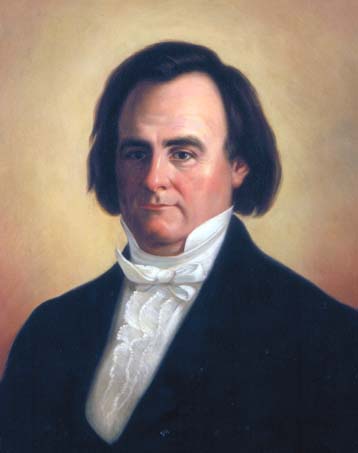
Historical · U.S. House · Kentucky · District 5
Charles Wickliffe
Former U.S. Representative · Kentucky District 5 · 1823–1863 · Unionist
Charles Wickliffe represented Kentucky's District 5 in the United States House of Representatives (1823–1863) for the Unionist party. The page below collects sourced biographical facts, term history, committee roles, and provenance for Wickliffe.
Bioguide ID: W000442
Key facts
- Full name
- Charles Wickliffe
- State
- Kentucky
- District
- District 5
- Party
- Unionist
- House service
- 1823–1863
- First House term
- 1823
- Status
- Left office
- Current term ends
- —
- Born
- 1788
- Bioguide ID
- W000442
- Committee assignments
- —
- Dataset version
- 1.20260606
Biographical narrative
837 words · sourced from the Wikipedia REST extract
Charles Wickliffe was a prominent American politician who served as a U.S. Representative from Kentucky's 5th congressional district. A member of the Unionist Party, Wickliffe's political career spanned several decades, during which he held various significant positions, including serving as the 11th U.S. Postmaster General and the 14th Governor of Kentucky. His tenure in the U.S. House of Representatives lasted from 1823 until 1863, marking a notable period during which he engaged in various legislative activities and political events that shaped the state and the nation.
Early life and career
Charles Anderson Wickliffe was born on June 8, 1788, in a log cabin near Springfield, Kentucky. He was the youngest of nine children born to Charles and Lydia Wickliffe, who had emigrated from Virginia to Kentucky in 1784. Wickliffe's early education took place in local schools in Springfield, followed by attendance at Wilson's Academy in Bardstown. He furthered his studies through private instruction from James Blythe, who was the acting president of Transylvania University, and later read law under the guidance of Martin D. Hardin, a cousin on his mother's side. Wickliffe was admitted to the bar in 1809 and began his legal practice in Bardstown.
In addition to his legal career, Wickliffe was involved in social and intellectual pursuits. He was a member of a debate club known as The Pleiades Club, which included several notable lawyers of the time. Despite his accomplishments, Wickliffe was known for his gambling habits, which his friends deemed excessive. A humorous incident involving a scheme devised by his friends to curb his gambling ultimately resulted in Wickliffe winning their money instead, leading him to agree to abandon the vice.
Wickliffe married Margaret Cripps in 1813, and the couple had eight children, including Robert, who later became the Governor of Louisiana. The family resided in a home called "Wickland," designed by architect John Rogers, which would later be recognized as the residence of three governors, including Wickliffe himself.
Wickliffe's political career began in earnest when he was elected to represent Nelson County in the Kentucky House of Representatives in 1812. He was a vigorous supporter of the War of 1812, serving as an aide-de-camp to General Joseph Winlock and later to General Samuel Caldwell during the Battle of the Thames. After the war, he continued his public service, becoming the Commonwealth's Attorney for Nelson County in 1816.
House tenure
Wickliffe's first election to the U.S. House of Representatives occurred in 1823, marking the beginning of a significant legislative career. He served five consecutive terms in the House, during which he was involved in various legislative matters and political controversies. His initial tenure coincided with a tumultuous period in Kentucky's history, marked by the Old Court-New Court controversy. This conflict arose from the financial Panic of 1819, which led to widespread demands for debt relief among the state's citizens. Wickliffe aligned himself with the "Old Court," which ultimately prevailed in the legal disputes surrounding the issue.
In 1833, Wickliffe returned to the Kentucky House of Representatives, where he continued to influence state politics. He was elected the tenth lieutenant governor of Kentucky in 1836. Following the death of Governor James Clark in 1839, Wickliffe assumed the governorship for the remaining months of Clark's term. His political career further expanded when President John Tyler appointed him as the U.S. Postmaster General, a position he held from 1841 to 1845.
Throughout his political journey, Wickliffe maintained a complex relationship with the Whig Party, often identifying with its principles while also expressing independent views. His political stance sometimes put him at odds with prominent Whig figures, including Henry Clay, a fellow Kentuckian and the party's founder.
Legislative focus and committees
During his time in the U.S. House of Representatives, Wickliffe's legislative focus was shaped by the political climate of the early to mid-19th century. He was involved in significant national issues, including debates surrounding the expansion of the United States and the implications of the Civil War. His participation in the 1861 Peace Conference and the Border States Convention reflected his attempts to mediate tensions leading up to the Civil War. Despite his efforts to avert conflict, Wickliffe ultimately sided with the Union once the war commenced.
In 1861, Wickliffe was elected to the House again, serving a single term during a critical period in American history. His legislative activities during this time were influenced by the challenges posed by the Civil War and the need for national unity. In 1863, he sought to return to the governorship but faced interference from federal military forces during the election process, which ultimately resulted in a decisive victory for his opponent.
Wickliffe's later years were marked by personal challenges, including a carriage accident that left him crippled and subsequent blindness. He passed away on October 31, 1869, while visiting his daughter in Maryland. His life and career reflect the complexities of American politics during a transformative era, characterized by his commitment to public service and his engagement in the significant issues of his time.
Notable legislation
Sponsored and co-sponsored legislation for Charles Wickliffe is pending operator curation. The biographical narrative above carries the same provenance trail until per-bill rows are written.
Sources
- [1]https://en.wikipedia.org/wiki/Charles_A._WickliffeWikipedia · retrieved 2026-06-06
Notable quotes
Sourced quotes for Charles Wickliffe are pending operator curation. Narrative-scope provenance remains attached below.
Sources
- [1]https://en.wikipedia.org/wiki/Charles_A._WickliffeWikipedia · retrieved 2026-06-06
Key positions
Curated policy positions for Charles Wickliffe are pending operator review. The biographical narrative above carries the same provenance trail until per-topic positions are written.
Sources
- [1]https://en.wikipedia.org/wiki/Charles_A._WickliffeWikipedia · retrieved 2026-06-06
Terms served
- 1823–1825U.S. House · Term 1 · Jacksonian
- 1825–1827U.S. House · Term 2 · Jackson
- 1827–1829U.S. House · Term 3 · Jackson
- 1829–1831U.S. House · Term 4 · Jackson
- 1831–1833U.S. House · Term 5 · Jackson
- 1861–1863U.S. House · Term 6 · Unionist
Sources & provenance
Every attributable claim above carries a per-section [N] marker that resolves to the corresponding URL below. Each entry records the upstream provider, the canonical URL, and the timestamp at which the source was retrieved by the ingest pipeline.
Key facts
- https://bioguide.congress.gov/search/bio/W000442bioguide · retrieved 2026-06-06
- https://www.govtrack.us/congress/members/411600govtrack · retrieved 2026-06-06
Biographical narrative
- https://en.wikipedia.org/wiki/Charles_A._Wickliffewikipedia · retrieved 2026-06-06
Find your representative
Every U.S. state elects representatives by district. Browse Kentucky’s delegation, the full former-representative roster, or explore the role and term length.
Related on The Candidate
- Preceded by Anthony NewEarlier holder of the Kentucky District 5 House seat · Republican.Open
- Succeeded by Lovell RousseauLater holder of the Kentucky District 5 House seat · Unconditional Unionist.Open
- Andrew BooneFormer U.S. Representative · Kentucky District 1 · DemocraticOpen
- Carroll Hubbard Jr.Former U.S. Representative · Kentucky District 1 · DemocraticOpen
- Charles WheelerFormer U.S. Representative · Kentucky District 1 · DemocraticOpen
- Chittenden LyonFormer U.S. Representative · Kentucky District 1 · JacksonOpen