
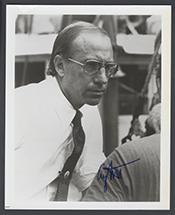
Historical · U.S. House · Massachusetts · District 10
Gerry Studds
Former U.S. Representative · Massachusetts District 10 · 1973–1997 · Democratic
Gerry Studds represented Massachusetts's District 10 in the United States House of Representatives (1973–1997) for the Democratic party. The page below collects sourced biographical facts, term history, committee roles, and provenance for Studds.
Bioguide ID: S001040
Key facts
- Full name
- Gerry Studds
- State
- Massachusetts
- District
- District 10
- Party
- Democratic
- House service
- 1973–1997
- First House term
- 1973
- Status
- Left office
- Current term ends
- —
- Born
- 1937
- Bioguide ID
- S001040
- Committee assignments
- —
- Dataset version
- 1.20260605
Biographical narrative
990 words · sourced from the Wikipedia REST extract
Gerry E. Studds was an American politician who served as a Democratic member of the United States House of Representatives from Massachusetts's 10th congressional district from 1973 until 1997. He is notable for being the first openly gay member of Congress, a distinction he achieved during a tumultuous period in his political career. Studds's tenure in Congress was marked by significant legislative activity, as well as a high-profile scandal that led to his censure by the House of Representatives.
Early life and career
Gerry Studds was born on May 12, 1937, in Mineola, New York. He was the son of Elbridge Gerry Eastman Studds, an architect known for his work on the FDR Drive in New York City, and Beatrice Murphy. He had two siblings, a brother named Colin and a sister named Gaynor. Studds was a descendant of Elbridge Gerry, who served as vice president of the United States and governor of Massachusetts in the early 19th century.
Studds's academic journey began with a full scholarship to Yale University, where he pursued a bachelor's degree in history, graduating in 1959. He continued his education at Yale, earning a master's degree in 1961. During his time at Yale, he was a member of St. Anthony Hall, a literary and arts society. Following his graduation, Studds entered the United States Foreign Service and worked in the Kennedy White House, contributing to the development of the Peace Corps, an initiative aimed at promoting international service and cooperation.
From 1965 to 1969, Studds transitioned into education, teaching history and politics at St. Paul's School, a prestigious preparatory school in New Hampshire. His tenure at St. Paul's was characterized by his progressive teaching style, which resonated with many students. He became known for his advocacy for student rights and reforms, leading to significant changes in school policies, including the de-emphasis of athletics and the eventual admission of female students. However, his time at the school ended in 1969 under circumstances that remain somewhat unclear, although the school provided financial support for him to attend the Harvard Graduate School of Education.
Studds's political involvement began to take shape during the Vietnam War era. In 1968, he played a pivotal role in persuading anti-war candidate Eugene McCarthy to challenge incumbent President Lyndon Johnson in the New Hampshire primary. Despite the school's refusal to grant him a leave of absence to focus on the campaign, Studds managed McCarthy's New Hampshire operation, which ultimately contributed to Johnson's decision to withdraw from the presidential race.
House tenure
Gerry Studds's congressional career began in earnest when he ran for the House of Representatives in 1970, seeking election in Massachusetts's 12th congressional district. Although he narrowly lost to the Republican incumbent Hastings Keith, redistricting in 1972 created an opportunity for Studds to secure a seat in Congress. He won the election against Republican William D. Weeks by a margin of just over 1,100 votes, marking the beginning of his twelve terms in the House.
Throughout his time in Congress, Studds represented Massachusetts's 10th congressional district after another round of redistricting in 1983. His political career was characterized by a commitment to progressive causes and a focus on issues relevant to his constituents. Despite facing challenges, including rumors regarding his sexual orientation during the 1978 campaign, Studds managed to maintain his position and was re-elected multiple times.
However, Studds's career was not without controversy. In 1983, he became embroiled in a scandal involving inappropriate relationships with congressional pages. Alongside Representative Dan Crane, Studds was censured by the House for his conduct, which included a sexual relationship with a 17-year-old male page. This incident marked a significant moment in Studds's career, as he publicly acknowledged his homosexuality, becoming the first openly gay member of Congress. The House Ethics Committee's investigation into the matter revealed that Studds had made sexual advances toward other pages as well.
Despite the scandal's impact on his career, Studds's political influence remained significant. The House initially recommended a reprimand for his actions, but the full House voted to censure him, a decision that resulted in the loss of his subcommittee chairmanship on the Committee on Merchant Marine and Fisheries. Nevertheless, Studds continued to serve in Congress until 1997, demonstrating resilience in the face of adversity.
Legislative focus and committees
During his tenure in Congress, Gerry Studds was actively involved in various legislative initiatives and served on several committees. His work often reflected his commitment to progressive values, particularly in areas such as environmental protection, transportation, and maritime affairs. As a member of the Committee on Merchant Marine and Fisheries, Studds played a crucial role in shaping policies related to the maritime industry and the protection of marine resources.
Studds's legislative focus included advocating for the interests of his constituents in Massachusetts, particularly those related to the fishing industry, which was vital to the region's economy. He worked to ensure that the concerns of local fishermen and maritime workers were addressed in federal policies. His efforts in this area were indicative of his broader commitment to supporting the working class and promoting economic opportunities.
In addition to his committee work, Studds was known for his engagement with constituents and his willingness to address their concerns. He maintained a visible presence in his district and was often involved in community events and discussions. This approach helped him to build a strong rapport with his constituents, contributing to his electoral success over the years.
Studds's legacy is complex, marked by both his groundbreaking role as an openly gay politician and the challenges he faced during his career. His contributions to the legislative process and his advocacy for progressive causes remain significant aspects of his time in office. After leaving Congress in 1997, Studds continued to be involved in public life until his passing on October 14, 2006. His career serves as a notable chapter in the history of American politics, particularly regarding the representation of LGBTQ+ individuals in government.
Notable legislation
Sponsored and co-sponsored legislation for Gerry Studds is pending operator curation. The biographical narrative above carries the same provenance trail until per-bill rows are written.
Sources
- [1]https://en.wikipedia.org/wiki/Gerry_StuddsWikipedia · retrieved 2026-06-05
Notable quotes
Sourced quotes for Gerry Studds are pending operator curation. Narrative-scope provenance remains attached below.
Sources
- [1]https://en.wikipedia.org/wiki/Gerry_StuddsWikipedia · retrieved 2026-06-05
Key positions
Curated policy positions for Gerry Studds are pending operator review. The biographical narrative above carries the same provenance trail until per-topic positions are written.
Sources
- [1]https://en.wikipedia.org/wiki/Gerry_StuddsWikipedia · retrieved 2026-06-05
Terms served
- 1973–1975U.S. House · Term 1 · Democratic
- 1975–1977U.S. House · Term 2 · Democratic
- 1977–1979U.S. House · Term 3 · Democratic
- 1979–1981U.S. House · Term 4 · Democratic
- 1981–1983U.S. House · Term 5 · Democratic
- 1983–1985U.S. House · Term 6 · Democratic
- 1985–1987U.S. House · Term 7 · Democratic
- 1987–1989U.S. House · Term 8 · Democratic
- 1989–1991U.S. House · Term 9 · Democratic
- 1991–1993U.S. House · Term 10 · Democratic
- 1993–1995U.S. House · Term 11 · Democratic
- 1995–1997U.S. House · Term 12 · Democratic
Sources & provenance
Every attributable claim above carries a per-section [N] marker that resolves to the corresponding URL below. Each entry records the upstream provider, the canonical URL, and the timestamp at which the source was retrieved by the ingest pipeline.
Key facts
- https://bioguide.congress.gov/search/bio/S001040bioguide · retrieved 2026-06-05
- https://www.govtrack.us/congress/members/410496govtrack · retrieved 2026-06-05
Biographical narrative
- https://en.wikipedia.org/wiki/Gerry_Studdswikipedia · retrieved 2026-06-05
Find your representative
Every U.S. state elects representatives by district. Browse Massachusetts’s delegation, the full former-representative roster, or explore the role and term length.
Related on The Candidate
- Preceded by Joseph Martin Jr.Earlier holder of the Massachusetts District 10 House seat · Republican.Open
- Succeeded by Bill DelahuntLater holder of the Massachusetts District 10 House seat · Democratic.Open
- Abbott LawrenceFormer U.S. Representative · Massachusetts District 1 · WhigOpen
- Allen TreadwayFormer U.S. Representative · Massachusetts District 1 · RepublicanOpen
- Artemas Ward Jr.Former U.S. Representative · Massachusetts District 1 · FederalistOpen
- Ashley WrightFormer U.S. Representative · Massachusetts District 1 · RepublicanOpen