
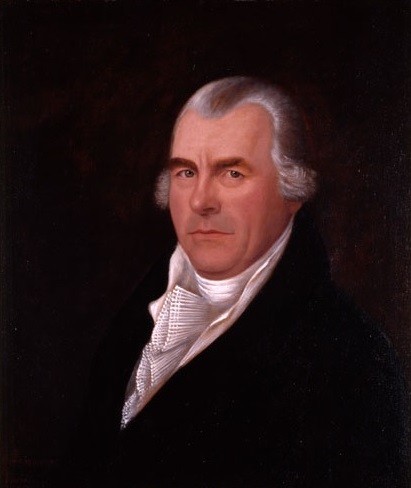
Historical · U.S. House · Massachusetts · District 11
Elijah Brigham
Former U.S. Representative · Massachusetts District 11 · 1811–1817 · Federalist
Elijah Brigham represented Massachusetts's District 11 in the United States House of Representatives (1811–1817) for the Federalist party. The page below collects sourced biographical facts, term history, committee roles, and provenance for Brigham.
Bioguide ID: B000833
Key facts
- Full name
- Elijah Brigham
- State
- Massachusetts
- District
- District 11
- Party
- Federalist
- House service
- 1811–1817
- First House term
- 1811
- Status
- Left office
- Current term ends
- —
- Born
- 1751
- Bioguide ID
- B000833
- Committee assignments
- —
- Dataset version
- 1.20260606
Biographical narrative
863 words · sourced from the Wikipedia REST extract
Elijah Brigham was a U.S. Representative from Massachusetts, serving as a member of the Federalist Party. His congressional career spanned from 1811 until his death in 1816, during which he represented the 11th congressional district. Brigham's early life was marked by his education and involvement in local governance, which laid the foundation for his later political career. He was known for his contributions to state politics before transitioning to the national stage, where he participated in significant legislative activities during his time in Congress.
Early life and career
Elijah Brigham was born on July 7, 1751, in Westborough, which is now part of Northborough, Massachusetts. He was the son of Colonel Levi Brigham and Susanna Grout Brigham, and he descended from early immigrants to the Massachusetts Bay Colony, specifically Thomas Brigham and Edmund Rice. This lineage connected him to the early colonial history of New England, which may have influenced his later civic engagements.
Brigham pursued higher education at Dartmouth College in Hanover, New Hampshire, graduating in 1778. Following his graduation, he studied law; however, he did not enter the legal profession. Instead, he engaged in mercantile activities in Westborough, where he built a career in commerce. His involvement in local business likely provided him with insights into the economic issues facing his community, which would later inform his political decisions.
In addition to his mercantile pursuits, Brigham was active in local governance. He served in the Massachusetts State House of Representatives from 1791 to 1793, where he began to establish his political presence. His commitment to public service continued as he held various judicial and legislative roles. He was appointed as a justice of the court of common pleas, serving from 1795 until 1811, and he participated in the Massachusetts State Senate during several sessions, including 1796, 1798, and from 1801 to 1805, as well as 1807 to 1810. Furthermore, Brigham served as a state councilor in 1799, 1800, and 1806, showcasing his continued involvement in the governance of Massachusetts.
Brigham's political career was characterized by his alignment with the Federalist Party, which was prominent during the early years of the United States. His experience in state politics and his understanding of local issues positioned him well for a transition to national politics.
House tenure
Elijah Brigham was elected to the United States House of Representatives as a Federalist, beginning his first term on March 4, 1811. He served in the Twelfth, Thirteenth, and Fourteenth Congresses, representing Massachusetts's 11th congressional district. His tenure in Congress coincided with a period of significant national challenges, including the War of 1812, which had profound implications for the United States and its political landscape.
During his time in the House, Brigham participated in legislative discussions and decisions that shaped the direction of the nation. His experience in state governance likely provided him with valuable insights into the legislative process at the federal level. As a member of the Federalist Party, he was part of a political group that often found itself at odds with the dominant Democratic-Republican Party during this era. This dynamic influenced the nature of his legislative work and the issues he prioritized.
Brigham's congressional career was cut short by his death on February 22, 1816, while he was still in office. His passing marked the end of his contributions to the legislative process, and he was interred in the Congressional Cemetery in Washington, D.C. His service in the House of Representatives was notable for its alignment with the Federalist ideals of the time, and he left behind a legacy tied to the early development of American governance.
Legislative focus and committees
While specific details about the bills and legislative initiatives Brigham supported during his time in Congress are not extensively documented, his affiliation with the Federalist Party suggests that he likely focused on issues aligned with the party's principles. The Federalists were known for advocating a strong central government, a robust national defense, and economic policies that favored commerce and industry. Given his background in mercantile activities, Brigham may have been particularly interested in legislation that promoted economic growth and stability.
During his tenure, Brigham would have participated in various committees that addressed a range of issues pertinent to the nation at that time. These issues included matters related to trade, defense, and the administration of federal policies. His experience in state governance and as a justice likely informed his perspectives on legal and economic matters, contributing to his effectiveness as a legislator.
Brigham's election to the American Antiquarian Society in 1813 further indicates his engagement with historical and cultural issues, reflecting a broader interest in the preservation of American heritage. This involvement may have influenced his legislative priorities and perspectives on national identity during his time in Congress.
In summary, Elijah Brigham's career as a U.S. Representative was marked by his early life in Massachusetts, his commitment to public service, and his alignment with the Federalist Party. His contributions to the House of Representatives during a formative period in American history reflect the complexities of governance and the challenges faced by the nation. His legacy continues to be recognized as part of the historical narrative of early American politics.
Notable legislation
Sponsored and co-sponsored legislation for Elijah Brigham is pending operator curation. The biographical narrative above carries the same provenance trail until per-bill rows are written.
Sources
- [1]https://en.wikipedia.org/wiki/Elijah_BrighamWikipedia · retrieved 2026-06-06
Notable quotes
Sourced quotes for Elijah Brigham are pending operator curation. Narrative-scope provenance remains attached below.
Sources
- [1]https://en.wikipedia.org/wiki/Elijah_BrighamWikipedia · retrieved 2026-06-06
Key positions
Curated policy positions for Elijah Brigham are pending operator review. The biographical narrative above carries the same provenance trail until per-topic positions are written.
Sources
- [1]https://en.wikipedia.org/wiki/Elijah_BrighamWikipedia · retrieved 2026-06-06
Terms served
- 1811–1813U.S. House · Term 1 · Federalist
- 1813–1815U.S. House · Term 2 · Federalist
- 1815–1817U.S. House · Term 3 · Federalist
Sources & provenance
Every attributable claim above carries a per-section [N] marker that resolves to the corresponding URL below. Each entry records the upstream provider, the canonical URL, and the timestamp at which the source was retrieved by the ingest pipeline.
Key facts
- https://bioguide.congress.gov/search/bio/B000833bioguide · retrieved 2026-06-06
- https://www.govtrack.us/congress/members/401790govtrack · retrieved 2026-06-06
Biographical narrative
- https://en.wikipedia.org/wiki/Elijah_Brighamwikipedia · retrieved 2026-06-06
Find your representative
Every U.S. state elects representatives by district. Browse Massachusetts’s delegation, the full former-representative roster, or explore the role and term length.
Related on The Candidate
- Preceded by William StedmanEarlier holder of the Massachusetts District 11 House seat · Federalist.Open
- Succeeded by Aaron HobartLater holder of the Massachusetts District 11 House seat · Adams.Open
- Abbott LawrenceFormer U.S. Representative · Massachusetts District 1 · WhigOpen
- Allen TreadwayFormer U.S. Representative · Massachusetts District 1 · RepublicanOpen
- Artemas Ward Jr.Former U.S. Representative · Massachusetts District 1 · FederalistOpen
- Ashley WrightFormer U.S. Representative · Massachusetts District 1 · RepublicanOpen