
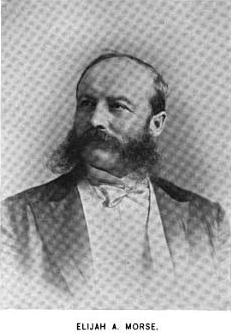
Historical · U.S. House · Massachusetts · District 12
Elijah Morse
Former U.S. Representative · Massachusetts District 12 · 1889–1897 · Republican
Elijah Morse represented Massachusetts's District 12 in the United States House of Representatives (1889–1897) for the Republican party. The page below collects sourced biographical facts, term history, committee roles, and provenance for Morse.
Bioguide ID: M001007
Key facts
- Full name
- Elijah Morse
- State
- Massachusetts
- District
- District 12
- Party
- Republican
- House service
- 1889–1897
- First House term
- 1889
- Status
- Left office
- Current term ends
- —
- Born
- 1841
- Bioguide ID
- M001007
- Committee assignments
- —
- Dataset version
- 1.20260606
Biographical narrative
854 words · sourced from the Wikipedia REST extract
Elijah Morse was a U.S. Representative from Massachusetts, serving in the House of Representatives from 1889 to 1897. A member of the Republican Party, Morse's political career was marked by his involvement in various legislative roles, including his chairmanship of the Committee on Alcohol Liquor Traffic during his tenure in Congress. Before entering politics, Morse had a diverse background that included military service and entrepreneurship.
Early life and career
Elijah Adams Morse was born on May 25, 1841, in South Bend, St. Joseph County, Indiana. In 1852, when he was approximately eleven years old, his family relocated to Massachusetts, settling in Boston. His education took place in local public schools, as well as at the Boylston School in Boston and Onondaga Academy in New York. These formative years in Massachusetts would later play a significant role in shaping his political career.
Morse's early adulthood was marked by his enlistment in the Union Army during the Civil War. He joined the Fourth Regiment of the Massachusetts Volunteers, where he served for a total of approximately one year. His military service included three months under the command of General Butler in Virginia and an additional year under General Banks in Louisiana. During his time in the military, Morse achieved the rank of corporal, reflecting his dedication and commitment to his service.
After the war, Morse transitioned into the business sector, becoming a manufacturer of stove polish in Canton, Massachusetts. This entrepreneurial endeavor provided him with a foundation for his later political career. His business experience likely contributed to his understanding of economic issues and the needs of his constituents.
Morse's political career began at the state level. He was elected to the Massachusetts House of Representatives in 1876, where he began to establish his presence in local politics. Following this, he ran as a candidate for lieutenant governor in 1877 under the Prohibition Party, although he was not successful in this endeavor. His political journey continued as he served in the Massachusetts State Senate during the years 1886 and 1887. In 1888, he was appointed to the Governor's Council, further solidifying his role in state governance.
House tenure
Elijah Morse's tenure in the U.S. House of Representatives began on March 4, 1889, when he was elected as a Republican to the Fifty-first Congress. He successfully secured re-election to three subsequent Congresses, serving a total of four terms until March 3, 1897. His election to the House came during a time of significant political and social change in the United States, and he played a role in the legislative processes of the era.
During his time in Congress, Morse was involved in various legislative activities and discussions. His experience in state politics likely informed his approach to national issues. As a member of the House, he participated in debates and contributed to the formulation of policies that affected his constituents and the nation as a whole.
Morse's role in Congress included his position as chairman of the Committee on Alcohol Liquor Traffic during the Fifty-fourth Congress. This committee was responsible for overseeing legislation related to alcohol regulation, a significant issue during a period when temperance movements were gaining momentum across the country. His leadership in this committee indicates his engagement with the social issues of his time, particularly those related to public health and morality.
Despite his active involvement in Congress, Morse did not seek renomination in 1896, marking the end of his congressional career. Following his departure from the House, he returned to his manufacturing activities, continuing his work in the private sector.
Legislative focus and committees
Throughout his congressional career, Elijah Morse's legislative focus reflected both his personal interests and the concerns of his constituents. His chairmanship of the Committee on Alcohol Liquor Traffic suggests a commitment to addressing issues related to alcohol consumption and its societal impacts. This focus aligned with the broader temperance movement that was prevalent during the late 19th century, which sought to reduce or eliminate the consumption of alcoholic beverages.
Morse's legislative activities would have included participation in discussions and debates on various bills and resolutions, as well as collaboration with fellow lawmakers on issues of mutual concern. His background in manufacturing may have influenced his perspectives on economic policies, labor issues, and business regulations, although specific legislative initiatives he championed are not detailed in the available records.
In addition to his work on the Committee on Alcohol Liquor Traffic, Morse's overall contributions to the House included engaging with constituents and advocating for their needs. His experience in state politics likely provided him with insights into the challenges faced by local communities, which he could address at the federal level.
After concluding his congressional service, Morse returned to Canton, Massachusetts, where he continued his manufacturing endeavors. He passed away on June 5, 1898, and was interred in Canton Cemetery, marking the end of a life that spanned significant historical events, including the Civil War and the rise of the temperance movement in America. His legacy as a public servant is reflected in his contributions to both state and national politics during a transformative period in U.S. history.
Notable legislation
Sponsored and co-sponsored legislation for Elijah Morse is pending operator curation. The biographical narrative above carries the same provenance trail until per-bill rows are written.
Sources
- [1]https://en.wikipedia.org/wiki/Elijah_A._MorseWikipedia · retrieved 2026-06-06
Notable quotes
Sourced quotes for Elijah Morse are pending operator curation. Narrative-scope provenance remains attached below.
Sources
- [1]https://en.wikipedia.org/wiki/Elijah_A._MorseWikipedia · retrieved 2026-06-06
Key positions
Curated policy positions for Elijah Morse are pending operator review. The biographical narrative above carries the same provenance trail until per-topic positions are written.
Sources
- [1]https://en.wikipedia.org/wiki/Elijah_A._MorseWikipedia · retrieved 2026-06-06
Terms served
- 1889–1891U.S. House · Term 1 · Republican
- 1891–1893U.S. House · Term 2 · Republican
- 1893–1895U.S. House · Term 3 · Republican
- 1895–1897U.S. House · Term 4 · Republican
Sources & provenance
Every attributable claim above carries a per-section [N] marker that resolves to the corresponding URL below. Each entry records the upstream provider, the canonical URL, and the timestamp at which the source was retrieved by the ingest pipeline.
Key facts
- https://bioguide.congress.gov/search/bio/M001007bioguide · retrieved 2026-06-06
- https://www.govtrack.us/congress/members/407974govtrack · retrieved 2026-06-06
Biographical narrative
- https://en.wikipedia.org/wiki/Elijah_A._Morsewikipedia · retrieved 2026-06-06
Find your representative
Every U.S. state elects representatives by district. Browse Massachusetts’s delegation, the full former-representative roster, or explore the role and term length.
Related on The Candidate
- Preceded by George RobinsonEarlier holder of the Massachusetts District 12 House seat · Republican.Open
- Succeeded by Samuel PowersLater holder of the Massachusetts District 12 House seat · Republican.Open
- Abbott LawrenceFormer U.S. Representative · Massachusetts District 1 · WhigOpen
- Allen TreadwayFormer U.S. Representative · Massachusetts District 1 · RepublicanOpen
- Artemas Ward Jr.Former U.S. Representative · Massachusetts District 1 · FederalistOpen
- Ashley WrightFormer U.S. Representative · Massachusetts District 1 · RepublicanOpen