
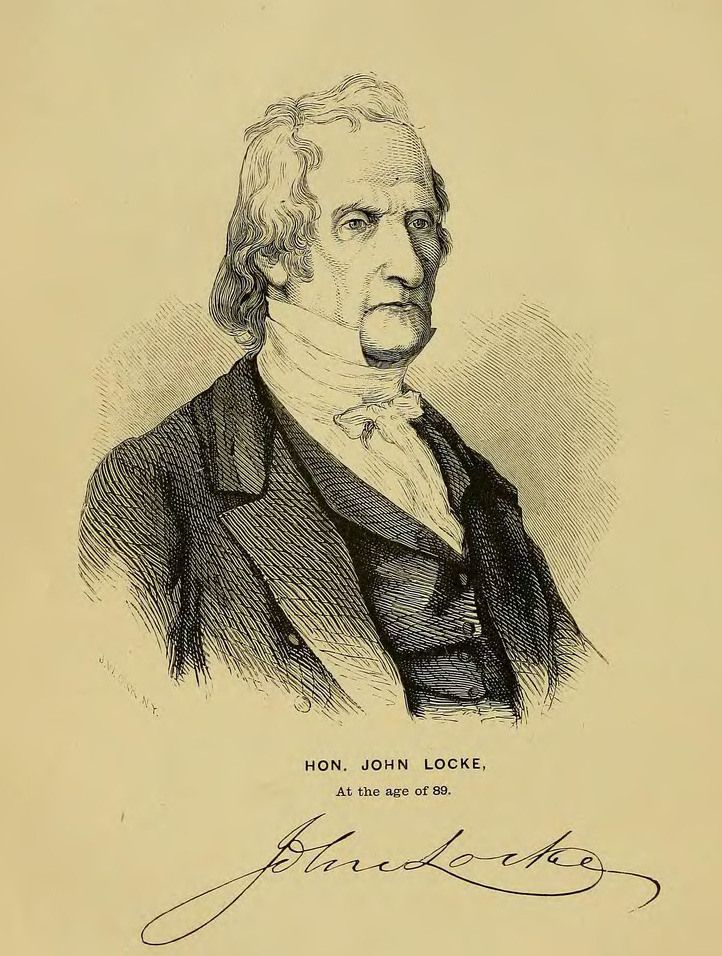
Historical · U.S. House · Massachusetts · District 6
John Locke
Former U.S. Representative · Massachusetts District 6 · 1823–1829 · Adams
John Locke represented Massachusetts's District 6 in the United States House of Representatives (1823–1829) for the Adams party. The page below collects sourced biographical facts, term history, committee roles, and provenance for Locke.
Bioguide ID: L000388
Key facts
- Full name
- John Locke
- State
- Massachusetts
- District
- District 6
- Party
- Adams
- House service
- 1823–1829
- First House term
- 1823
- Status
- Left office
- Current term ends
- —
- Born
- 1764
- Bioguide ID
- L000388
- Committee assignments
- —
- Dataset version
- 1.20260606
Biographical narrative
818 words · sourced from the Wikipedia REST extract
John Locke was an American politician and lawyer who served as a U.S. Representative for Massachusetts's 6th congressional district from 1823 to 1829. A member of the Adams Party, he had a notable career in both state and federal politics, contributing to legislative processes during a formative period in American history. Locke's background in law and his involvement in various levels of government reflect his commitment to public service and civic engagement.
Early life and career
John Locke was born on February 14, 1764, in Hopkinton, which was part of the Massachusetts Bay Colony. His early education included attendance at Andover Academy, a well-regarded preparatory school, where he likely developed a strong academic foundation. Locke continued his education at Dartmouth College before ultimately graduating from Harvard University in 1792. This educational background provided him with the skills and knowledge that would later aid him in his legal and political endeavors.
After completing his studies, Locke was admitted to the Massachusetts bar in 1796, marking the beginning of his legal career. He began practicing law in Ashby, Massachusetts, where he established himself as a competent attorney. His legal expertise would later inform his political activities and legislative priorities. In addition to his legal practice, Locke engaged in public service, reflecting an early commitment to his community and the governance of his state.
Locke's political career began in earnest when he was elected to the Massachusetts House of Representatives in the early 1800s. He served multiple terms in this legislative body, specifically in the years 1804, 1805, 1813, and 1823. His repeated elections to the state legislature indicate a level of trust and support from his constituents. Furthermore, Locke was a delegate to the Massachusetts Constitutional Convention of 1820–1821, where he contributed to discussions that shaped the state's governance framework.
House tenure
Locke's tenure in the U.S. House of Representatives began on March 4, 1823, when he was elected to the Eighteenth Congress. He continued to serve in the Nineteenth and Twentieth Congresses, with his congressional service concluding on March 3, 1829. During his time in the House, Locke participated in the legislative process during a period marked by significant national developments, including discussions surrounding economic policy, territorial expansion, and the evolving political landscape of the early republic.
As a member of the Adams Party, Locke was part of a political faction that emerged in opposition to the Jacksonian Democrats. The Adams Party, named after President John Quincy Adams, focused on issues such as internal improvements, education, and a strong federal government. Locke's alignment with this party likely influenced his legislative priorities and the types of policies he supported during his congressional service.
Locke chose not to seek renomination in 1828, concluding his time in the House after three terms. His decision to step away from federal office may have been influenced by various factors, including personal considerations or a desire to focus on his legal career. After leaving Congress, Locke continued to be active in state politics, serving in the Massachusetts State Senate in 1830 and as a member of the state executive council in 1831. During this period, he resumed his legal practice, demonstrating his ongoing commitment to public service and the law.
Legislative focus and committees
While specific details about Locke's legislative focus and committee assignments during his time in the House are not extensively documented, it can be inferred that his background as a lawyer and his experience in state government informed his contributions to legislative discussions. Given the political context of his tenure, Locke likely engaged with issues pertinent to his constituents in Massachusetts, including economic development, infrastructure, and education.
The early 19th century was a time of significant change in the United States, characterized by debates over federal versus state authority, the expansion of the nation, and the role of government in the economy. As a member of the Adams Party, Locke would have been involved in discussions that aligned with the party's platform, which emphasized a proactive role for the federal government in promoting national growth and stability.
Locke's involvement in the Massachusetts Constitutional Convention also suggests that he had a strong interest in governance and the legal frameworks that underpin political institutions. His participation in this convention likely provided him with insights that he could apply to his work in Congress, particularly in areas related to state-federal relations and the development of laws that would benefit his constituents.
Throughout his career, Locke's legal background and political experience positioned him as a knowledgeable figure in the legislative arena. His contributions to both state and federal government reflect a commitment to public service that spanned several decades. After concluding his congressional service, Locke continued to engage in public affairs until his death on March 29, 1855, in Boston, Massachusetts. He is interred in Lowell Cemetery in Lowell, Massachusetts, marking the end of a life dedicated to the law and public service.
Notable legislation
Sponsored and co-sponsored legislation for John Locke is pending operator curation. The biographical narrative above carries the same provenance trail until per-bill rows are written.
Sources
- [1]https://en.wikipedia.org/wiki/John_Locke_(Massachusetts_politician)Wikipedia · retrieved 2026-06-06
Notable quotes
Sourced quotes for John Locke are pending operator curation. Narrative-scope provenance remains attached below.
Sources
- [1]https://en.wikipedia.org/wiki/John_Locke_(Massachusetts_politician)Wikipedia · retrieved 2026-06-06
Key positions
Curated policy positions for John Locke are pending operator review. The biographical narrative above carries the same provenance trail until per-topic positions are written.
Sources
- [1]https://en.wikipedia.org/wiki/John_Locke_(Massachusetts_politician)Wikipedia · retrieved 2026-06-06
Terms served
- 1823–1825U.S. House · Term 1
- 1825–1827U.S. House · Term 2 · Adams
- 1827–1829U.S. House · Term 3 · Adams
Sources & provenance
Every attributable claim above carries a per-section [N] marker that resolves to the corresponding URL below. Each entry records the upstream provider, the canonical URL, and the timestamp at which the source was retrieved by the ingest pipeline.
Key facts
- https://bioguide.congress.gov/search/bio/L000388bioguide · retrieved 2026-06-06
- https://www.govtrack.us/congress/members/406880govtrack · retrieved 2026-06-06
Biographical narrative
- https://en.wikipedia.org/wiki/John_Locke_(Massachusetts_politician)wikipedia · retrieved 2026-06-06
Find your representative
Every U.S. state elects representatives by district. Browse Massachusetts’s delegation, the full former-representative roster, or explore the role and term length.
Related on The Candidate
- Preceded by Samuel TaggartEarlier holder of the Massachusetts District 6 House seat · Federalist.Open
- Succeeded by George Grennell Jr.Later holder of the Massachusetts District 6 House seat · Whig.Open
- Abbott LawrenceFormer U.S. Representative · Massachusetts District 1 · WhigOpen
- Allen TreadwayFormer U.S. Representative · Massachusetts District 1 · RepublicanOpen
- Artemas Ward Jr.Former U.S. Representative · Massachusetts District 1 · FederalistOpen
- Ashley WrightFormer U.S. Representative · Massachusetts District 1 · RepublicanOpen