
Historical · U.S. House · Massachusetts · District 7
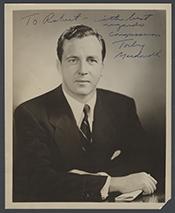
Torbert Macdonald
Former U.S. Representative · Massachusetts District 7 · 1955–1977 · Democratic
Torbert Macdonald represented Massachusetts's District 7 in the United States House of Representatives (1955–1977) for the Democratic party. The page below collects sourced biographical facts, term history, committee roles, and provenance for Macdonald.
Bioguide ID: M000005
Key facts
- Full name
- Torbert Macdonald
- State
- Massachusetts
- District
- District 7
- Party
- Democratic
- House service
- 1955–1977
- First House term
- 1955
- Status
- Left office
- Current term ends
- —
- Born
- 1917
- Bioguide ID
- M000005
- Committee assignments
- —
- Dataset version
- 1.20260605
Biographical narrative
980 words · sourced from the Wikipedia REST extract
Torbert H. Macdonald was an American politician who served as a Democratic member of the U.S. House of Representatives from Massachusetts's 7th congressional district. His tenure in Congress lasted from 1955 until his death in 1976, marking a significant period during which he became known for his legislative contributions and close political ties to prominent figures, including President John F. Kennedy. Macdonald's career was characterized by his commitment to public service, advocacy for broadcasting reform, and attention to the needs of his constituents.
Early life and career
Torbert Hart Macdonald was born on June 6, 1917, in Everett, Massachusetts, to Harriet Hart and John MacDonald. He spent his formative years in Malden, Massachusetts, where he attended local public schools. Macdonald's educational journey took a significant turn when he enrolled at Phillips Academy in Andover, a prestigious preparatory school. Following his time at Phillips Academy, he pursued higher education at Harvard University. At Harvard, he distinguished himself not only academically but also athletically, serving as the captain of the university's football team. During his college years, he formed a close friendship with fellow student John F. Kennedy, which would later influence both their political careers.
After graduating with a Bachelor of Arts degree in 1940, Macdonald continued his education at Harvard Law School, where he earned his Bachelor of Laws in 1946. His academic achievements were complemented by his military service during World War II. Macdonald served in the United States Navy as a commander of a PT boat in the Southwest Pacific theater from 1942 to 1944. His service was marked by bravery, earning him several commendations, including the Silver Star and the Purple Heart. After the war, he was admitted to the bar and began practicing law in Boston, becoming a partner in the firm of Stoneman, Macdonald & Chandler.
In addition to his legal career, Macdonald was appointed as a member of the National Labor Relations Board for the New England area, serving from 1948 to 1952. His involvement in politics deepened as he participated as a delegate in the Democratic National Conventions in 1960, 1964, and 1968, further solidifying his commitment to the Democratic Party.
House tenure
Macdonald's political career in the U.S. House of Representatives began when he was elected as a Democrat to the 84th Congress in 1954. He represented the northern suburbs of Boston, including his hometown of Malden, and quickly established himself as a prominent member of the House. Over the course of his eleven terms, Macdonald became known for his legislative effectiveness and dedication to his constituents. He served in various leadership roles, including as the majority Whip, which positioned him as a key figure in the Democratic leadership.
Throughout his tenure, Macdonald was recognized for his ability to navigate complex legislative issues and build bipartisan coalitions. His legislative efforts included significant contributions to the Public Broadcasting Act of 1967, which aimed to enhance public broadcasting services across the nation. This initiative earned him the nickname "Father of Public Broadcasting," reflecting his pivotal role in shaping media policy.
In addition to his work in public broadcasting, Macdonald was instrumental in advocating for the "sports blackout bill," which allowed for the broadcast of local sporting events that had sold out. His legislative agenda also focused on reforming campaign broadcasting practices, as he sought to address concerns about the influence of money in politics and ensure that competent candidates could compete fairly for public office.
Macdonald's commitment to his constituents was evident in his approach to constituent services. He was known for his responsiveness to individual concerns and problems, which earned him a reputation as a dedicated public servant. His sharp wit and sense of humor made him a well-liked figure among his colleagues, and he was affectionately referred to as "The Needle" in recognition of his engaging personality.
Despite his political achievements, Macdonald's life was cut short when he passed away on May 21, 1976, while still in office. His death occurred at Bethesda Naval Hospital in Maryland, where he had made the decision to remove life-support systems. He was 58 years old at the time of his passing.
Legislative focus and committees
During his long tenure in the House of Representatives, Macdonald's legislative focus encompassed a range of issues, reflecting both his personal interests and the needs of his constituents. His work on the Public Broadcasting Act of 1967 was particularly significant, as it laid the foundation for the development of public television and radio in the United States. This legislation aimed to provide educational and cultural programming, ensuring access to diverse content for audiences across the nation.
Macdonald's role as the ranking Democrat on the House Committee on Interstate and Foreign Commerce allowed him to influence a variety of issues related to commerce, telecommunications, and transportation. His advocacy for the sports blackout bill demonstrated his commitment to ensuring that local communities could access sporting events, fostering a sense of community engagement and support for local teams.
In addition to his legislative accomplishments, Macdonald's work on campaign broadcasting reform highlighted his concern for the integrity of the electoral process. He recognized the challenges posed by the rising costs of campaigning and sought to create a more equitable environment for candidates. This focus on reform was indicative of his broader commitment to democratic principles and the belief that all individuals should have the opportunity to participate in the political process.
Macdonald's legacy extends beyond his legislative achievements. He was a devoted family man, married to actress Phyllis Brooks, with whom he had four children. His eldest son, Torbert Hart Macdonald Jr., was notably the godson of President Kennedy, further illustrating the deep connections Macdonald maintained within political circles. After his death, he was interred in Holy Cross Cemetery in Malden, Massachusetts, where he is remembered for his contributions to public service and his enduring impact on the community he represented.
Notable legislation
Sponsored and co-sponsored legislation for Torbert Macdonald is pending operator curation. The biographical narrative above carries the same provenance trail until per-bill rows are written.
Sources
- [1]https://en.wikipedia.org/wiki/Torbert_MacdonaldWikipedia · retrieved 2026-06-05
Notable quotes
Sourced quotes for Torbert Macdonald are pending operator curation. Narrative-scope provenance remains attached below.
Sources
- [1]https://en.wikipedia.org/wiki/Torbert_MacdonaldWikipedia · retrieved 2026-06-05
Key positions
Curated policy positions for Torbert Macdonald are pending operator review. The biographical narrative above carries the same provenance trail until per-topic positions are written.
Sources
- [1]https://en.wikipedia.org/wiki/Torbert_MacdonaldWikipedia · retrieved 2026-06-05
Terms served
- 1955–1957U.S. House · Term 1 · Democratic
- 1957–1959U.S. House · Term 2 · Democratic
- 1959–1961U.S. House · Term 3 · Democratic
- 1961–1963U.S. House · Term 4 · Democratic
- 1963–1965U.S. House · Term 5 · Democratic
- 1965–1967U.S. House · Term 6 · Democratic
- 1967–1969U.S. House · Term 7 · Democratic
- 1969–1971U.S. House · Term 8 · Democratic
- 1971–1973U.S. House · Term 9 · Democratic
- 1973–1975U.S. House · Term 10 · Democratic
- 1975–1977U.S. House · Term 11 · Democratic
Sources & provenance
Every attributable claim above carries a per-section [N] marker that resolves to the corresponding URL below. Each entry records the upstream provider, the canonical URL, and the timestamp at which the source was retrieved by the ingest pipeline.
Key facts
- https://bioguide.congress.gov/search/bio/M000005bioguide · retrieved 2026-06-05
- https://www.govtrack.us/congress/members/407035govtrack · retrieved 2026-06-05
Biographical narrative
- https://en.wikipedia.org/wiki/Torbert_Macdonaldwikipedia · retrieved 2026-06-05
Find your representative
Every U.S. state elects representatives by district. Browse Massachusetts’s delegation, the full former-representative roster, or explore the role and term length.
Related on The Candidate
- Preceded by Lawrence ConneryEarlier holder of the Massachusetts District 7 House seat · Democratic.Open
- Succeeded by Michael CapuanoLater holder of the Massachusetts District 7 House seat · Democratic.Open
- Abbott LawrenceFormer U.S. Representative · Massachusetts District 1 · WhigOpen
- Allen TreadwayFormer U.S. Representative · Massachusetts District 1 · RepublicanOpen
- Artemas Ward Jr.Former U.S. Representative · Massachusetts District 1 · FederalistOpen
- Ashley WrightFormer U.S. Representative · Massachusetts District 1 · RepublicanOpen