
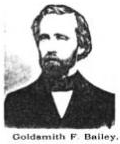
Historical · U.S. House · Massachusetts · District 9
Goldsmith Bailey
Former U.S. Representative · Massachusetts District 9 · 1861–1863 · Republican
Goldsmith Bailey represented Massachusetts's District 9 in the United States House of Representatives (1861–1863) for the Republican party. The page below collects sourced biographical facts, term history, committee roles, and provenance for Bailey.
Bioguide ID: B000038
Key facts
- Full name
- Goldsmith Bailey
- State
- Massachusetts
- District
- District 9
- Party
- Republican
- House service
- 1861–1863
- First House term
- 1861
- Status
- Left office
- Current term ends
- —
- Born
- 1823
- Bioguide ID
- B000038
- Committee assignments
- —
- Dataset version
- 1.20260606
Biographical narrative
854 words · sourced from the Wikipedia REST extract
Goldsmith Bailey was a U.S. Representative from Massachusetts, serving in the House of Representatives during the early 1860s as a member of the Republican Party. His tenure was marked by his commitment to public service, which began at the local level and culminated in his election to Congress. Bailey's life was characterized by his legal career, his involvement in local governance, and his dedication to education and civic duties.
Early life and career
Goldsmith Bailey was born on July 17, 1823, in East Westmoreland, New Hampshire. At the age of three, following the death of his father, his widowed mother relocated the family to Fitchburg, Massachusetts. This move played a significant role in shaping Bailey's future, as Fitchburg became the community where he would establish his career and public service.
Bailey received his education in the public schools of Fitchburg, where he laid the foundation for his future endeavors. At the age of 17, he began his professional journey as an apprentice at the Bellows Falls Gazette, a local newspaper. His dedication and skill in journalism led him to become the editor and publisher of the Gazette by 1844, marking the beginning of his active engagement in the community and public discourse.
In 1845, Bailey transitioned from journalism to law, beginning his legal studies under the guidance of William C. Bradley in Westminster, Vermont. He later continued his legal education with the law firm of Torrey and Wood in Fitchburg. After successfully completing his studies, Bailey was admitted to the bar in 1848 and began practicing law in Fitchburg as a partner in the firm of N. Wood & Co. His legal career further established his reputation in the community.
Bailey's commitment to public service was evident early in his career. He served on the Fitchburg school committee from 1849 to 1854, contributing to the development of local education policies. His dedication to civic duty continued when he was appointed postmaster of Fitchburg on May 3, 1851, a position he held until May 4, 1853. This role allowed him to further engage with the community and understand the needs of his constituents.
In 1857, Bailey expanded his political involvement by serving as a member of the Massachusetts House of Representatives. His legislative experience continued to grow when he served in the Massachusetts State Senate from 1858 to 1860. These positions provided him with valuable insights into state governance and the legislative process, preparing him for his future role in Congress.
House tenure
Goldsmith Bailey's political career reached a significant milestone when he was selected as the Republican candidate for Massachusetts' ninth congressional district in the 1860 election. His election to the Thirty-seventh Congress marked the culmination of his years of public service and political engagement. Bailey officially took office on March 4, 1861, representing his constituents during a tumultuous period in American history, which included the Civil War.
Bailey's time in the House of Representatives was relatively brief, as he served until his death on May 8, 1862. His tenure was characterized by the challenges of a nation divided by conflict, and he participated in the legislative discussions and decisions that shaped the direction of the country during this critical time. Although his congressional career was cut short, Bailey's contributions to the legislative process and his representation of Massachusetts were significant.
Following his death, Bailey was interred in Laurel Hill Cemetery in Fitchburg. Additionally, a cenotaph was established in his honor at the Congressional Cemetery, recognizing his service and commitment to the nation.
Legislative focus and committees
While specific details regarding the legislative focus and committee assignments during Goldsmith Bailey's time in Congress are not extensively documented, it is important to note that he served during a period marked by significant national issues, particularly the Civil War. As a member of the Republican Party, Bailey would have aligned with the party's platform, which included support for the Union and various measures aimed at addressing the challenges posed by the war.
During his brief time in office, Bailey likely engaged in discussions surrounding military funding, civil rights, and the preservation of the Union, which were central themes of the legislative agenda during the early 1860s. The Republican Party at the time was focused on issues such as the abolition of slavery and the promotion of civil liberties, reflecting the broader societal changes occurring in the United States.
Bailey's prior experience in the Massachusetts State Senate and his involvement in local governance would have informed his legislative approach and priorities. His background in law and public service likely contributed to his understanding of the legal implications of the policies being debated in Congress.
In summary, Goldsmith Bailey's life and career exemplify the journey of a dedicated public servant who transitioned from local governance to national representation. His contributions to the legal field, education, and civic engagement laid the groundwork for his role in Congress, where he served during a pivotal moment in American history. Although his time in the House of Representatives was brief, his legacy as a representative of Massachusetts remains a part of the historical narrative of the United States Congress.
Notable legislation
Sponsored and co-sponsored legislation for Goldsmith Bailey is pending operator curation. The biographical narrative above carries the same provenance trail until per-bill rows are written.
Sources
- [1]https://en.wikipedia.org/wiki/Goldsmith_BaileyWikipedia · retrieved 2026-06-06
Notable quotes
Sourced quotes for Goldsmith Bailey are pending operator curation. Narrative-scope provenance remains attached below.
Sources
- [1]https://en.wikipedia.org/wiki/Goldsmith_BaileyWikipedia · retrieved 2026-06-06
Key positions
Curated policy positions for Goldsmith Bailey are pending operator review. The biographical narrative above carries the same provenance trail until per-topic positions are written.
Sources
- [1]https://en.wikipedia.org/wiki/Goldsmith_BaileyWikipedia · retrieved 2026-06-06
Terms served
- 1861–1863U.S. House · Term 1 · Republican
Sources & provenance
Every attributable claim above carries a per-section [N] marker that resolves to the corresponding URL below. Each entry records the upstream provider, the canonical URL, and the timestamp at which the source was retrieved by the ingest pipeline.
Key facts
- https://bioguide.congress.gov/search/bio/B000038bioguide · retrieved 2026-06-06
- https://www.govtrack.us/congress/members/401043govtrack · retrieved 2026-06-06
Biographical narrative
- https://en.wikipedia.org/wiki/Goldsmith_Baileywikipedia · retrieved 2026-06-06
Find your representative
Every U.S. state elects representatives by district. Browse Massachusetts’s delegation, the full former-representative roster, or explore the role and term length.
Related on The Candidate
- Preceded by Eli ThayerEarlier holder of the Massachusetts District 9 House seat · Republican.Open
- Succeeded by John CandlerLater holder of the Massachusetts District 9 House seat · Republican.Open
- Abbott LawrenceFormer U.S. Representative · Massachusetts District 1 · WhigOpen
- Allen TreadwayFormer U.S. Representative · Massachusetts District 1 · RepublicanOpen
- Artemas Ward Jr.Former U.S. Representative · Massachusetts District 1 · FederalistOpen
- Ashley WrightFormer U.S. Representative · Massachusetts District 1 · RepublicanOpen