
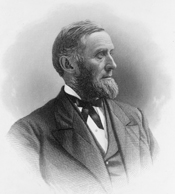
Historical · U.S. House · Maryland · District 5
Charles Coffin
Former U.S. Representative · Maryland District 5 · 1893–1897 · Republican
Charles Coffin represented Maryland's District 5 in the United States House of Representatives (1893–1897) for the Republican party. The page below collects sourced biographical facts, term history, committee roles, and provenance for Coffin.
Bioguide ID: C000588
Key facts
- Full name
- Charles Coffin
- State
- Maryland
- District
- District 5
- Party
- Republican
- House service
- 1893–1897
- First House term
- 1893
- Status
- Left office
- Current term ends
- —
- Born
- 1841
- Bioguide ID
- C000588
- Committee assignments
- —
- Dataset version
- 1.20260606
Biographical narrative
1,025 words · sourced from the Wikipedia REST extract
Charles Coffin was a prominent American industrialist and politician who served as a U.S. Representative for Maryland's 5th congressional district. A member of the Republican Party, Coffin's political career spanned several years, during which he held various positions in both state and federal government. His tenure in the U.S. House of Representatives lasted from 1894 to 1897, and he is remembered for his contributions to Maryland's political landscape during a transformative period in American history. Born into a well-established family in Boston, Massachusetts, Coffin's early life and career were marked by significant developments that would shape his future in public service and industry.
Early life and career
Charles Edward Coffin was born on July 18, 1841, in Boston, Massachusetts, into a family with deep roots in New England's elite society. His educational background included attendance at local grammar and high schools, where he likely received a foundational education that would serve him well in his future endeavors. In 1863, during the tumultuous years of the American Civil War, Coffin made a significant decision to relocate to Maryland. He settled in Muirkirk, a community in Prince George's County, where he purchased a tract of land that would become central to his career.
Upon acquiring the land, Coffin discovered iron ore deposits, which prompted him to establish ironworks to exploit this natural resource. His decision to enter the iron industry was timely, as the Civil War created a high demand for iron products. The federal government recognized the strategic importance of Coffin's ironworks and contracted with him to ensure that the facilities did not fall into Confederate hands. This arrangement not only solidified Coffin's role as a key industrial player in the region but also positioned him as a significant contributor to the war effort.
Coffin's Muirkirk Foundry Company initially produced pig iron, a raw material essential for various manufacturing processes. Over time, the company upgraded its operations to include blast furnaces, enhancing its production capabilities. The ironworks became a vital economic engine for the area, employing many local residents, including freedmen who had been liberated during the war. This influx of labor contributed to the establishment of a vibrant black community in the vicinity, known informally as Rossville or "Swampoodle," which included significant cultural landmarks such as Queen's Chapel and Burial Ground, established in 1868.
Coffin's industrial success did not deter him from engaging in public service. His political career began in earnest when he was elected to the Maryland House of Delegates in 1884. He served in this capacity until 1886, gaining valuable experience in legislative processes and governance. Following his tenure in the House of Delegates, Coffin continued his political journey by winning a seat in the Maryland State Senate in 1890, where he served until 1894. His involvement in state politics culminated in his role as a delegate to the Republican National Convention in 1892, further solidifying his status within the party.
House tenure
In 1894, Coffin's political career took a significant turn when he was elected to the United States House of Representatives, representing Maryland's 5th congressional district. He won this election as a Republican, filling a vacancy created by the resignation of Democrat Barnes Compton. Coffin's election to the Fifty-third Congress marked the beginning of his federal legislative career, which would last until March 3, 1897. During his time in the House, Coffin was re-elected to the Fifty-fourth Congress, reflecting the support he garnered from his constituents.
Coffin's tenure in the House of Representatives occurred during a period of considerable change in the United States, characterized by economic expansion, social reform movements, and the evolving role of government in American life. While specific details regarding the legislation he supported or opposed during his time in office are not provided, it is clear that Coffin was an active participant in the political discourse of his era. His background as an industrialist likely informed his perspectives on issues related to commerce, labor, and economic development, which were central to the national conversation at the time.
Throughout his congressional career, Coffin maintained his ties to the industrial sector, continuing to serve as president of the Muirkirk Foundry Company until his death. This dual role as both a businessman and a legislator may have influenced his approach to policy-making, as he sought to balance the interests of his constituents with the realities of the industrial economy.
Legislative focus and committees
While specific details about Coffin's committee assignments and legislative focus during his time in the House of Representatives are not documented, it is reasonable to infer that his background in industry and his experience in state politics would have shaped his priorities as a legislator. Given the economic context of the late 19th century, issues such as infrastructure development, labor relations, and economic policy would likely have been significant areas of interest for Coffin.
His role as a Republican representative during this period also suggests that he may have been involved in discussions related to party platforms and initiatives aimed at promoting economic growth and stability. The Republican Party at the time was associated with pro-business policies, and Coffin's industrial experience would have positioned him as a knowledgeable voice on matters affecting the economy.
Coffin's legislative contributions, while not explicitly detailed, would have been influenced by the broader political landscape, including the challenges and opportunities presented by the post-Civil War reconstruction era. His engagement in the political process, combined with his industrial background, likely allowed him to advocate for policies that aligned with the interests of both his constituents and the business community.
In summary, Charles Coffin's life and career reflect a blend of industrial achievement and public service. His early years in Boston, followed by his relocation to Maryland and subsequent political career, illustrate a commitment to both economic development and civic engagement. Coffin's legacy as a U.S. Representative is marked by his contributions to Maryland's political landscape during a pivotal time in American history. He passed away on May 24, 1912, in Muirkirk, Maryland, and was interred in St. John's Episcopal Church Cemetery in Beltsville, Maryland, leaving behind a legacy intertwined with the industrial and political evolution of his time.
Notable legislation
Sponsored and co-sponsored legislation for Charles Coffin is pending operator curation. The biographical narrative above carries the same provenance trail until per-bill rows are written.
Sources
- [1]https://en.wikipedia.org/wiki/Charles_E._CoffinWikipedia · retrieved 2026-06-06
Notable quotes
Sourced quotes for Charles Coffin are pending operator curation. Narrative-scope provenance remains attached below.
Sources
- [1]https://en.wikipedia.org/wiki/Charles_E._CoffinWikipedia · retrieved 2026-06-06
Key positions
Curated policy positions for Charles Coffin are pending operator review. The biographical narrative above carries the same provenance trail until per-topic positions are written.
Sources
- [1]https://en.wikipedia.org/wiki/Charles_E._CoffinWikipedia · retrieved 2026-06-06
Terms served
- 1893–1895U.S. House · Term 1 · Republican
- 1895–1897U.S. House · Term 2 · Republican
Sources & provenance
Every attributable claim above carries a per-section [N] marker that resolves to the corresponding URL below. Each entry records the upstream provider, the canonical URL, and the timestamp at which the source was retrieved by the ingest pipeline.
Key facts
- https://bioguide.congress.gov/search/bio/C000588bioguide · retrieved 2026-06-06
- https://www.govtrack.us/congress/members/402717govtrack · retrieved 2026-06-06
Biographical narrative
- https://en.wikipedia.org/wiki/Charles_E._Coffinwikipedia · retrieved 2026-06-06
Find your representative
Every U.S. state elects representatives by district. Browse Maryland’s delegation, the full former-representative roster, or explore the role and term length.
Related on The Candidate
- Preceded by Hart HoltonEarlier holder of the Maryland District 5 House seat · Republican.Open
- Succeeded by Thomas ParranLater holder of the Maryland District 5 House seat · Republican.Open
- Clement DorseyFormer U.S. Representative · Maryland District 1Open
- Daniel HenryFormer U.S. Representative · Maryland District 1 · DemocraticOpen
- David WardFormer U.S. Representative · Maryland District 1 · DemocraticOpen
- Dudley RoeFormer U.S. Representative · Maryland District 1 · DemocraticOpen