
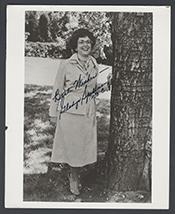
Historical · U.S. House · Maryland · District 5
Gladys Spellman
Former U.S. Representative · Maryland District 5 · 1975–1981 · Democratic
Gladys Spellman represented Maryland's District 5 in the United States House of Representatives (1975–1981) for the Democratic party. The page below collects sourced biographical facts, term history, committee roles, and provenance for Spellman.
Bioguide ID: S000716
Key facts
- Full name
- Gladys Spellman
- State
- Maryland
- District
- District 5
- Party
- Democratic
- House service
- 1975–1981
- First House term
- 1975
- Status
- Left office
- Current term ends
- —
- Born
- 1918
- Bioguide ID
- S000716
- Committee assignments
- —
- Dataset version
- 1.20260605
Biographical narrative
1,050 words · sourced from the Wikipedia REST extract
Gladys Noon Spellman was an American educator and politician who served as a U.S. Representative for Maryland's 5th congressional district from January 3, 1975, until her seat was declared vacant on February 24, 1981. A member of the Democratic Party, Spellman was known for her significant contributions to local governance and her advocacy for federal employees during her time in Congress. Her career was marked by a commitment to public service, which began in education and extended into various political roles at the local and national levels.
Early life and career
Gladys Noon Spellman was born Gladys Blossom Noon on March 1, 1918, in New York City. She received her early education at Eastern High School and Roosevelt High School in Washington, D.C. Following her high school education, she attended George Washington University, where she completed her undergraduate studies. Additionally, she pursued further education at the graduate school within the United States Department of Agriculture, which laid the groundwork for her career in education.
Spellman's professional journey began as an elementary school teacher in Prince George's County, Maryland. Her role as an educator was complemented by her active involvement in the community, particularly as a parent and civic association leader. During the 1950s and 1960s, she served as the president of the Parent-Teacher Association (PTA) at Happy Acres Elementary School, which was later renamed in her honor as the Gladys Noon Spellman Elementary School in 1991. Her engagement in local education and community issues positioned her as a prominent figure among the new suburban residents of Prince George's County, who had moved there in the post-World War II era.
As a dedicated community activist, Spellman played a significant role in the reform movement that emerged in Prince George's County during the 1960s. This movement sought to challenge the long-standing Democratic organization that had dominated local politics. Spellman's efforts were instrumental in advocating for a home rule charter for the county, which aimed to enhance local governance. In 1962, she successfully ran for a position on the Prince George's County Board of Commissioners, where she served until 1970, including a two-year term as chairman, effectively leading the county's government. Following the establishment of the County Council, she was elected as a councilwoman at large from 1971 to 1974.
In recognition of her leadership and contributions, Spellman was appointed by President Lyndon B. Johnson to the Advisory Commission on Intergovernmental Relations in 1967. Her influence in local governance was further acknowledged when she became the first woman to be elected president of the National Association of Counties in 1972, an honor that underscored her commitment to public service and her role in shaping county policies.
House tenure
Gladys Noon Spellman entered the U.S. House of Representatives after winning the Democratic primary nomination for Maryland's 5th congressional district in September 1974. She subsequently defeated her Republican opponent, John B. Burcham, Jr., in the general election. Spellman's tenure in Congress began on January 3, 1975, and she served three terms until her seat was declared vacant in early 1981 due to health issues.
During her time in Congress, Spellman was a member of several important committees, including the Committee on Banking, Currency and Housing, the Democratic Steering and Policy Committee, and the Committee on Post Office and Civil Service. She also chaired the Subcommittee on Compensation and Employee Benefits, reflecting her focus on issues affecting federal employees. Notably, her congressional district had a significant number of federal employees, making up nearly 40 percent of the local workforce, the highest percentage of any congressional district in the United States at that time.
Spellman was known for her support of various legislative initiatives aimed at improving the welfare of her constituents and the broader public. In 1977, she advocated for legislation that would establish a bank to provide loans to cooperatives owned by consumers. Additionally, she supported the extension of the federal revenue-sharing program and voted in favor of a substantial proposal to authorize loan guarantees for New York City during a financial crisis. Spellman also opposed restrictions on the hiring and promotion of federal employees and resisted reforms to the civil service system proposed by President Jimmy Carter in 1978.
Despite her active legislative role, Spellman's congressional career was abruptly affected by health complications. On October 31, 1980, she suffered a heart attack while judging a Halloween costume contest. Although she was re-elected shortly thereafter, it became evident that she would not recover from her incapacitating condition. The House of Representatives took the unprecedented step of declaring her seat vacant due to medical reasons, a situation that had not occurred before in congressional history.
Legislative focus and committees
Throughout her congressional career, Gladys Noon Spellman focused on issues pertinent to her constituents, particularly those related to federal employment and local governance. Her background as an educator and local politician informed her legislative priorities, which included advocating for the rights and benefits of federal employees, a significant demographic in her district.
Spellman's involvement in the Committee on Banking, Currency and Housing allowed her to engage with issues related to economic development and housing, which were critical to her constituents. Her work on the Committee on Post Office and Civil Service further highlighted her commitment to federal employees, as she sought to ensure fair treatment and adequate benefits for those working in government positions.
In addition to her committee work, Spellman was active in legislative efforts that aimed to address broader social and economic challenges. Her support for consumer cooperatives and federal revenue-sharing initiatives demonstrated her belief in the importance of community-driven economic solutions. By advocating for these measures, she sought to empower local communities and enhance their economic stability.
Spellman's legacy extends beyond her legislative accomplishments. She was recognized for her contributions to public service through various honors, including her induction into the Maryland Women's Hall of Fame in 1985 and the dedication of the Baltimore–Washington Parkway in her name. Her commitment to education and community service continues to be remembered, particularly through the school named in her honor.
Gladys Noon Spellman passed away on June 19, 1988, after spending nearly eight years in a coma. Her contributions to education, local governance, and federal policy remain a significant part of her legacy, reflecting her dedication to public service and the communities she represented.
Notable legislation
Sponsored and co-sponsored legislation for Gladys Spellman is pending operator curation. The biographical narrative above carries the same provenance trail until per-bill rows are written.
Sources
- [1]https://en.wikipedia.org/wiki/Gladys_SpellmanWikipedia · retrieved 2026-06-05
Notable quotes
Sourced quotes for Gladys Spellman are pending operator curation. Narrative-scope provenance remains attached below.
Sources
- [1]https://en.wikipedia.org/wiki/Gladys_SpellmanWikipedia · retrieved 2026-06-05
Key positions
Curated policy positions for Gladys Spellman are pending operator review. The biographical narrative above carries the same provenance trail until per-topic positions are written.
Sources
- [1]https://en.wikipedia.org/wiki/Gladys_SpellmanWikipedia · retrieved 2026-06-05
Terms served
- 1975–1977U.S. House · Term 1 · Democratic
- 1977–1979U.S. House · Term 2 · Democratic
- 1979–1981U.S. House · Term 3 · Democratic
Sources & provenance
Every attributable claim above carries a per-section [N] marker that resolves to the corresponding URL below. Each entry records the upstream provider, the canonical URL, and the timestamp at which the source was retrieved by the ingest pipeline.
Key facts
- https://bioguide.congress.gov/search/bio/S000716bioguide · retrieved 2026-06-05
- https://www.govtrack.us/congress/members/410186govtrack · retrieved 2026-06-05
Biographical narrative
- https://en.wikipedia.org/wiki/Gladys_Spellmanwikipedia · retrieved 2026-06-05
Find your representative
Every U.S. state elects representatives by district. Browse Maryland’s delegation, the full former-representative roster, or explore the role and term length.
Related on The Candidate
- Preceded by Lawrence HoganEarlier holder of the Maryland District 5 House seat · Republican.Open
- Clement DorseyFormer U.S. Representative · Maryland District 1Open
- Daniel HenryFormer U.S. Representative · Maryland District 1 · DemocraticOpen
- David WardFormer U.S. Representative · Maryland District 1 · DemocraticOpen
- Dudley RoeFormer U.S. Representative · Maryland District 1 · DemocraticOpen
- Democratic PartyFederal candidates and office holders on the Democratic line.Open