
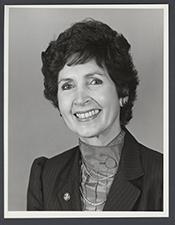
Historical · U.S. House · Maryland · District 8
Constance Morella
Former U.S. Representative · Maryland District 8 · 1987–2003 · Republican
Constance Morella represented Maryland's District 8 in the United States House of Representatives (1987–2003) for the Republican party. The page below collects sourced biographical facts, term history, committee roles, and provenance for Morella.
Bioguide ID: M000941
Key facts
- Full name
- Constance Morella
- State
- Maryland
- District
- District 8
- Party
- Republican
- House service
- 1987–2003
- First House term
- 1987
- Status
- Left office
- Current term ends
- —
- Born
- 1931
- Bioguide ID
- M000941
- Committee assignments
- —
- Dataset version
- 1.20260605
Biographical narrative
1,081 words · sourced from the Wikipedia REST extract
Constance A. Morella is a former American politician and diplomat who served as a U.S. Representative for Maryland's 8th congressional district from 1987 until 2003. A member of the Republican Party, Morella was notable for her moderate positions on various social issues, which distinguished her within her party and contributed to her electoral success in a predominantly Democratic area. After her congressional tenure, she continued her public service as the U.S. Permanent Representative to the Organisation for Economic Co-operation and Development (OECD) and has held academic roles, including a position as an Ambassador in Residence at American University.
Early life and career
Constance Albanese was born on February 12, 1931, in Somerville, Massachusetts. She completed her secondary education at Somerville High School, graduating in 1948. Morella pursued higher education at Boston University, where she earned an Associate of Arts degree in 1950 and a Bachelor of Arts degree in 1954. Raised in a family that traditionally supported the Democratic Party, she shifted her political affiliation to the Republican Party after marrying Anthony C. Morella, who had connections with several liberal Republican figures.
Following their marriage, the Morellas relocated to Bethesda, Maryland. The couple faced personal challenges when Connie's sister passed away from cancer, leading them to adopt her six children, adding to their own three children. Morella began her professional career as a secondary school teacher in the Montgomery County Public Schools, serving from 1957 to 1961. She later earned a Master of Arts degree from American University in 1967 and transitioned into academia, first as an instructor and then as a professor at Montgomery College in Rockville, Maryland, where she taught until 1985.
Morella's political engagement began in earnest in the early 1970s when she was appointed as a founding member of the Montgomery County Commission for Women, an advisory body focused on women's advocacy. She served as the commission's president in 1973 and became actively involved in the League of Women Voters. Her initial foray into electoral politics came in 1974 when she ran for the Maryland House of Delegates from the 16th District but was unsuccessful. However, she persevered and won a seat in the Maryland House of Delegates in 1978, receiving more votes than the three incumbents running for re-election.
House tenure
In 1986, Morella launched her campaign for the U.S. House of Representatives, seeking to fill the seat in Maryland's 8th congressional district that was being vacated by Democrat Michael Barnes, who was pursuing a Senate nomination. Her opponent in the general election was State Senator Stewart Bainum, a wealthy businessman who initially led in the polls. A significant turning point in her campaign occurred when she received endorsements from major publications, which helped bolster her visibility and support. Morella became the first woman to represent the district and successfully navigated the challenges of being a Republican in a region that had shifted toward the Democratic Party.
During her time in Congress, Morella was re-elected multiple times, serving a total of eight terms until her departure from the House in January 2003. Her tenure was marked by a commitment to her constituents, and she maintained a notable level of popularity despite the political landscape of her district. Morella's political positions often diverged from those of her party, particularly on social issues such as abortion, gun control, and environmental policies. She supported government funding for contraceptives and needle exchange programs, advocated for the legalization of medical marijuana, and received backing from organized labor.
Throughout her congressional career, Morella was known for her independent stance on various issues. She opposed many of her party's positions, including voting against President Clinton's 1993 budget and the proposal to declare English the official language of the United States. She was also one of the few Republicans to vote against the Cuban Liberty and Democratic Solidarity Act in 1996 and against renaming Washington National Airport after Ronald Reagan in 1998. Notably, she was the only Republican to oppose the use of military force in Iraq during both the 1991 and 2002 votes.
Morella was actively engaged in issues related to human rights, women's health, and domestic violence. She served on the Science Committee and the Government Reform Committee, where she worked on legislation aimed at addressing domestic violence and supporting women's rights. Among her notable legislative efforts was the Battered Women's Testimony Act, which provided funding for expert testimony in domestic abuse cases, and the Judicial Training Act, which focused on educating judges about domestic violence issues.
Despite her electoral successes, Morella faced increasing challenges as the political climate shifted. After the Republican Party gained control of the House in 1994, she found herself under pressure to align more closely with the party leadership. Although she initially supported the Contract with America, her relationship with the Republican majority became more complicated over time. In 1997, she voted "present" for the Speaker of the House instead of supporting the incumbent, Newt Gingrich. During the impeachment proceedings against President Clinton, she was one of only four Republicans to oppose all articles of impeachment.
Legislative focus and committees
Throughout her congressional career, Morella's legislative focus encompassed a range of issues, particularly those affecting women and families. She was a prominent advocate for women's rights and health, participating in significant international conferences such as the 1994 U.N. International Conference on Population and Development in Cairo and co-chairing the Congressional delegation to the 1995 U.N. Fourth World Conference on Women in Beijing. Her involvement in these global discussions underscored her commitment to addressing women's issues on both a national and international scale.
In addition to her work on women's issues, Morella was involved in various committees during her time in the House. For the 107th Congress, she served on the Committee on Government Reform, where she was a member of the Subcommittee on Civil Service and Agency Organization. Her committee assignments allowed her to influence policy and legislative initiatives related to government operations and reform.
After leaving Congress, Morella continued her public service as the U.S. Permanent Representative to the OECD from 2003 to 2007, where she contributed to discussions on economic cooperation and development. Additionally, she has remained active in academia, serving as an Ambassador in Residence at American University’s Women & Politics Institute, where she engages with students and promotes the importance of women's representation in politics. In 2010, she was appointed by President Barack Obama to the American Battle Monuments Commission, further extending her commitment to public service and civic engagement.
Notable legislation
Sponsored and co-sponsored legislation for Constance Morella is pending operator curation. The biographical narrative above carries the same provenance trail until per-bill rows are written.
Sources
- [1]https://en.wikipedia.org/wiki/Connie_MorellaWikipedia · retrieved 2026-06-05
Notable quotes
Sourced quotes for Constance Morella are pending operator curation. Narrative-scope provenance remains attached below.
Sources
- [1]https://en.wikipedia.org/wiki/Connie_MorellaWikipedia · retrieved 2026-06-05
Key positions
Curated policy positions for Constance Morella are pending operator review. The biographical narrative above carries the same provenance trail until per-topic positions are written.
Sources
- [1]https://en.wikipedia.org/wiki/Connie_MorellaWikipedia · retrieved 2026-06-05
Terms served
- 1987–1989U.S. House · Term 1 · Republican
- 1989–1991U.S. House · Term 2 · Republican
- 1991–1993U.S. House · Term 3 · Republican
- 1993–1995U.S. House · Term 4 · Republican
- 1995–1997U.S. House · Term 5 · Republican
- 1997–1999U.S. House · Term 6 · Republican
- 1999–2001U.S. House · Term 7 · Republican
- 2001–2003U.S. House · Term 8 · Republican
Sources & provenance
Every attributable claim above carries a per-section [N] marker that resolves to the corresponding URL below. Each entry records the upstream provider, the canonical URL, and the timestamp at which the source was retrieved by the ingest pipeline.
Key facts
- https://bioguide.congress.gov/search/bio/M000941bioguide · retrieved 2026-06-05
- https://www.govtrack.us/congress/members/400524govtrack · retrieved 2026-06-05
Biographical narrative
- https://en.wikipedia.org/wiki/Connie_Morellawikipedia · retrieved 2026-06-05
Find your representative
Every U.S. state elects representatives by district. Browse Maryland’s delegation, the full former-representative roster, or explore the role and term length.
Related on The Candidate
- Preceded by Michael BarnesEarlier holder of the Maryland District 8 House seat · Democratic.Open
- Clement DorseyFormer U.S. Representative · Maryland District 1Open
- Daniel HenryFormer U.S. Representative · Maryland District 1 · DemocraticOpen
- David WardFormer U.S. Representative · Maryland District 1 · DemocraticOpen
- Dudley RoeFormer U.S. Representative · Maryland District 1 · DemocraticOpen
- Republican PartyFederal candidates and office holders on the Republican line.Open