
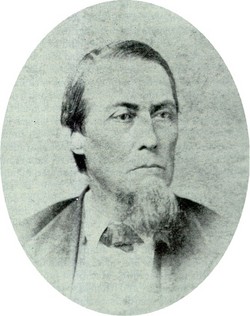
Historical · U.S. House · Mississippi · District 4
Jason Niles
Former U.S. Representative · Mississippi District 4 · 1873–1875 · Republican
Jason Niles represented Mississippi's District 4 in the United States House of Representatives (1873–1875) for the Republican party. The page below collects sourced biographical facts, term history, committee roles, and provenance for Niles.
Bioguide ID: N000107
Key facts
- Full name
- Jason Niles
- State
- Mississippi
- District
- District 4
- Party
- Republican
- House service
- 1873–1875
- First House term
- 1873
- Status
- Left office
- Current term ends
- —
- Born
- 1814
- Bioguide ID
- N000107
- Committee assignments
- —
- Dataset version
- 1.20260606
Biographical narrative
886 words · sourced from the Wikipedia REST extract
Jason Niles was a prominent figure in 19th-century American politics, serving as a U.S. Representative for Mississippi's 4th congressional district during a tumultuous period in the nation's history. A member of the Republican Party, Niles held office from 1873 to 1875, following a career that included roles as a lawyer, newspaper editor, and local politician. His life and career were marked by significant events, including his staunch support for the Union during the American Civil War and his involvement in various political and legal capacities in Mississippi.
Early life and career
Born on December 19, 1814, in Burlington, Vermont, Jason Niles was the son of Daniel Swift Niles and Alice Reed, both of whom hailed from New Hampshire. He received his early education in local schools before pursuing higher education at the University of Vermont, where he earned a bachelor's degree in 1836. Niles continued his academic pursuits and obtained a master's degree in 1846. His educational background laid a foundation for his future endeavors in law and politics.
After completing his studies, Niles embarked on a career in education, teaching in various locations, including Quebec, Ohio, and Tennessee. During this time, he also began to study law, which would eventually become his primary profession. Niles was admitted to the bar in 1851 and established a legal practice in Kosciusko, Mississippi. His legal career coincided with a period of significant political change in the United States, particularly in the South, where issues surrounding secession and civil rights were becoming increasingly contentious.
Niles's political involvement began to take shape when he served as an anti-secession delegate at Mississippi's 1851 constitutional convention. His commitment to the Union was evident even before the Civil War, as he actively opposed the secessionist sentiment that was gaining traction in the state. This stance would later define his actions during the war and his post-war political career.
House tenure
Jason Niles's tenure in the U.S. House of Representatives began on March 4, 1873, after he was elected as a Republican to the 43rd Congress. His time in office was characterized by the challenges of the Reconstruction era, a period marked by significant political and social upheaval in the Southern states following the Civil War. Niles's election came at a time when the Republican Party was working to establish itself in the South, where it faced opposition from the resurgent Democratic Party.
During his term, which lasted until March 3, 1875, Niles participated in the legislative processes of the House, contributing to discussions and decisions that would shape the future of the nation. However, his time in Congress was relatively brief, as he faced the realities of a shifting political landscape. The Democratic Party regained control in Mississippi, which limited the Republican Party's influence and led to Niles's unsuccessful bid for re-election in 1874. His defeat marked the end of his congressional career, but it did not signify the end of his involvement in public life.
Following his departure from Congress, Niles continued to engage with his community and the political landscape of Mississippi. From 1876 to 1880, he served as the editor of the Kosciusko Chronicle, a local newspaper, where he likely continued to advocate for his political beliefs and engage with the issues of the day. After his editorial role, he returned to practicing law, demonstrating his commitment to his profession and the community he served.
Legislative focus and committees
While specific details regarding Niles's legislative focus and committee assignments during his time in the House of Representatives are not extensively documented, it is important to contextualize his role within the broader framework of the Reconstruction era. As a member of the Republican Party, Niles would have been involved in discussions surrounding civil rights, economic recovery, and the reintegration of Southern states into the Union. The period was marked by efforts to address the challenges faced by newly freed African Americans and to rebuild the Southern economy, which had been devastated by the war.
Niles's background as a lawyer and his previous political experiences likely informed his approach to legislation and governance. His commitment to the Union during the Civil War and his active participation in post-war constitutional conventions suggest that he was focused on issues of governance, civil rights, and the rule of law. These themes were central to the Republican agenda during Reconstruction, as the party sought to establish a new social order in the South.
In addition to his legislative work, Niles's role as a community leader and editor of a local newspaper would have provided him with a platform to influence public opinion and advocate for policies that aligned with his values. His experiences as a mayor and a member of the Mississippi House of Representatives further illustrate his deep engagement with local governance and the issues affecting his constituents.
Jason Niles's life came to an end on July 7, 1894, in Kosciusko, Mississippi, where he was laid to rest in the City Cemetery. His legacy as a politician, lawyer, and community leader reflects the complexities of a nation grappling with the aftermath of civil conflict and the challenges of rebuilding a fractured society. Niles's contributions to Mississippi's political landscape during a pivotal time in American history remain a testament to his commitment to public service and the principles he upheld throughout his life.
Notable legislation
Sponsored and co-sponsored legislation for Jason Niles is pending operator curation. The biographical narrative above carries the same provenance trail until per-bill rows are written.
Sources
- [1]https://en.wikipedia.org/wiki/Jason_NilesWikipedia · retrieved 2026-06-06
Notable quotes
Sourced quotes for Jason Niles are pending operator curation. Narrative-scope provenance remains attached below.
Sources
- [1]https://en.wikipedia.org/wiki/Jason_NilesWikipedia · retrieved 2026-06-06
Key positions
Curated policy positions for Jason Niles are pending operator review. The biographical narrative above carries the same provenance trail until per-topic positions are written.
Sources
- [1]https://en.wikipedia.org/wiki/Jason_NilesWikipedia · retrieved 2026-06-06
Terms served
- 1873–1875U.S. House · Term 1 · Republican
Sources & provenance
Every attributable claim above carries a per-section [N] marker that resolves to the corresponding URL below. Each entry records the upstream provider, the canonical URL, and the timestamp at which the source was retrieved by the ingest pipeline.
Key facts
- https://bioguide.congress.gov/search/bio/N000107bioguide · retrieved 2026-06-06
- https://www.govtrack.us/congress/members/408191govtrack · retrieved 2026-06-06
Biographical narrative
- https://en.wikipedia.org/wiki/Jason_Nileswikipedia · retrieved 2026-06-06
Find your representative
Every U.S. state elects representatives by district. Browse Mississippi’s delegation, the full former-representative roster, or explore the role and term length.
Related on The Candidate
- Preceded by William LakeEarlier holder of the Mississippi District 4 House seat · American.Open
- Succeeded by Frederick BarryLater holder of the Mississippi District 4 House seat · Democratic.Open
- Alan NunneleeFormer U.S. Representative · Mississippi District 1 · RepublicanOpen
- Benjamin NabersFormer U.S. Representative · Mississippi District 1 · UnionistOpen
- Christopher RankinFormer U.S. Representative · Mississippi District 1 · JacksonOpen
- Daniel WrightFormer U.S. Representative · Mississippi District 1 · DemocraticOpen