
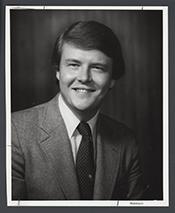
Historical · U.S. House · Mississippi · District 4
Jon Hinson
Former U.S. Representative · Mississippi District 4 · 1979–1983 · Republican
Jon Hinson represented Mississippi's District 4 in the United States House of Representatives (1979–1983) for the Republican party. The page below collects sourced biographical facts, term history, committee roles, and provenance for Hinson.
Bioguide ID: H000641
Key facts
- Full name
- Jon Hinson
- State
- Mississippi
- District
- District 4
- Party
- Republican
- House service
- 1979–1983
- First House term
- 1979
- Status
- Left office
- Current term ends
- —
- Born
- 1942
- Bioguide ID
- H000641
- Committee assignments
- —
- Dataset version
- 1.20260605
Biographical narrative
866 words · sourced from the Wikipedia REST extract
Jon C. Hinson was an American politician who served as a Republican U.S. Representative for Mississippi's 4th congressional district from 1979 until his resignation in 1981. His tenure in Congress was marked by personal challenges and controversies, particularly related to his sexual orientation, which ultimately led him to become an advocate for gay rights after leaving office. Hinson's life and career reflect a complex intersection of political service, personal struggles, and activism.
Early life and career
Jon C. Hinson was born on March 16, 1942, in Tylertown, Mississippi. He was the son of Clifton Ford Hinson and Lyndell Newman. Hinson's early exposure to politics began in 1959 when he worked as a page for Democratic U.S. Representative John Bell Williams, who later served as governor of Mississippi. This experience likely influenced Hinson's future political ambitions.
Hinson pursued higher education at the University of Mississippi, where he graduated in 1964. Following his graduation, he joined the United States Marine Corps Reserve, serving until 1970. His military service provided him with discipline and a sense of duty, which would later inform his political career.
In 1967, Hinson began working on the staff of the U.S. House of Representatives as a doorman. He subsequently held positions on the staffs of Representatives Charles H. Griffin, a Democrat, and Thad Cochran, a Republican. Hinson's work in Congress allowed him to gain valuable insights into legislative processes and the workings of federal government, setting the stage for his own electoral ambitions.
In 1978, after Cochran successfully ran for the United States Senate, Hinson sought to fill the vacancy in the House of Representatives. He campaigned for the 4th congressional district seat and won with 51.6 percent of the vote, defeating Democrat John H. Stennis, the son of long-serving U.S. Senator John C. Stennis. Hinson's victory marked the beginning of his congressional career, which would span two terms.
House tenure
Hinson's first term in the House of Representatives began in 1979. His time in office was characterized by a blend of legislative activity and personal challenges. In 1980, he faced significant scrutiny when he publicly acknowledged a past incident in which he had been arrested for engaging in an obscene act. This incident occurred in 1976 while he was serving as an aide to Thad Cochran, and it involved exposure to an undercover policeman at the Iwo Jima Memorial. Hinson attributed his troubles to alcoholism and denied being homosexual, asserting that he had reformed.
Despite the controversy, Hinson was reelected in November 1980, securing a plurality of 39 percent of the vote against independent candidate Leslie B. McLemore and Democrat Britt Singletary. However, his second term was marred by further legal issues. In February 1981, Hinson was arrested again, this time charged with attempted sodomy after an incident involving a male employee of the Library of Congress in a restroom of the Longworth House Office Building. At the time, homosexual acts were criminal offenses in Washington, D.C., and the charges against him were serious, potentially resulting in significant penalties.
Following his arrest, Hinson pleaded not guilty and was released without bail pending trial. He sought professional help for his issues and later received a suspended sentence and probation. However, the mounting pressure from the legal situation and public scrutiny led Hinson to resign from Congress on April 13, 1981, just three months into his second term. He described his resignation as one of the most painful decisions of his life.
After Hinson's resignation, Democrat Wayne Dowdy won the special election to succeed him. Hinson's departure from Congress marked a significant turning point in his life, leading him to reassess his identity and public persona.
Legislative focus and committees
During his time in the House, Hinson's legislative focus and committee assignments are not extensively documented in the available records. However, his background in the Marine Corps and his experience working with various congressional representatives likely influenced his approach to issues related to defense, veterans, and military policy. His tenure coincided with a period of significant political and social change in the United States, including the evolving attitudes toward LGBTQ+ rights.
Following his resignation, Hinson publicly acknowledged his sexual orientation and transitioned into a role as a gay rights activist. He became involved in organizing lobbying efforts and advocating against the ban on gays in the military. His activism was significant during a time when LGBTQ+ issues were gaining visibility in American society, and Hinson's experiences as a former congressman provided him with a unique platform to advocate for change.
Hinson's later life was spent primarily in Alexandria, Virginia, and Silver Spring, Maryland, where he continued his advocacy work. He faced personal health challenges, ultimately succumbing to respiratory failure due to AIDS on July 21, 1995, at the age of fifty-three. His remains were cremated, and his ashes were interred in his hometown of Tylertown, Mississippi.
Hinson's life and career reflect the complexities of navigating personal identity within the public sphere, particularly during a time when societal attitudes toward homosexuality were markedly different from those of today. His transition from a congressional representative to a gay rights activist illustrates the evolving nature of political engagement and personal advocacy in the United States.
Notable legislation
Sponsored and co-sponsored legislation for Jon Hinson is pending operator curation. The biographical narrative above carries the same provenance trail until per-bill rows are written.
Sources
- [1]https://en.wikipedia.org/wiki/Jon_HinsonWikipedia · retrieved 2026-06-05
Notable quotes
Sourced quotes for Jon Hinson are pending operator curation. Narrative-scope provenance remains attached below.
Sources
- [1]https://en.wikipedia.org/wiki/Jon_HinsonWikipedia · retrieved 2026-06-05
Key positions
Curated policy positions for Jon Hinson are pending operator review. The biographical narrative above carries the same provenance trail until per-topic positions are written.
Sources
- [1]https://en.wikipedia.org/wiki/Jon_HinsonWikipedia · retrieved 2026-06-05
Terms served
- 1979–1981U.S. House · Term 1 · Republican
- 1981–1983U.S. House · Term 2 · Republican
Sources & provenance
Every attributable claim above carries a per-section [N] marker that resolves to the corresponding URL below. Each entry records the upstream provider, the canonical URL, and the timestamp at which the source was retrieved by the ingest pipeline.
Key facts
- https://bioguide.congress.gov/search/bio/H000641bioguide · retrieved 2026-06-05
- https://www.govtrack.us/congress/members/405496govtrack · retrieved 2026-06-05
Biographical narrative
- https://en.wikipedia.org/wiki/Jon_Hinsonwikipedia · retrieved 2026-06-05
Find your representative
Every U.S. state elects representatives by district. Browse Mississippi’s delegation, the full former-representative roster, or explore the role and term length.
Related on The Candidate
- Preceded by Prentiss WalkerEarlier holder of the Mississippi District 4 House seat · Republican.Open
- Succeeded by Gene TaylorLater holder of the Mississippi District 4 House seat · Democratic.Open
- Alan NunneleeFormer U.S. Representative · Mississippi District 1 · RepublicanOpen
- Benjamin NabersFormer U.S. Representative · Mississippi District 1 · UnionistOpen
- Christopher RankinFormer U.S. Representative · Mississippi District 1 · JacksonOpen
- Daniel WrightFormer U.S. Representative · Mississippi District 1 · DemocraticOpen