
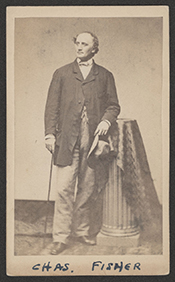
Historical · U.S. House · North Carolina · District 10
Charles Fisher
Former U.S. Representative · North Carolina District 10 · 1817–1841 · Democratic
Charles Fisher represented North Carolina's District 10 in the United States House of Representatives (1817–1841) for the Democratic party. The page below collects sourced biographical facts, term history, committee roles, and provenance for Fisher.
Bioguide ID: F000144
Key facts
- Full name
- Charles Fisher
- State
- North Carolina
- District
- District 10
- Party
- Democratic
- House service
- 1817–1841
- First House term
- 1817
- Status
- Left office
- Current term ends
- —
- Born
- 1789
- Bioguide ID
- F000144
- Committee assignments
- —
- Dataset version
- 1.20260606
Biographical narrative
911 words · sourced from the Wikipedia REST extract
Charles Fisher was an American politician who served as a U.S. Representative from North Carolina's 10th congressional district during the early 19th century. A member of the Democratic-Republican Party, Fisher's political career spanned several years, during which he was involved in both federal and state legislatures. He is noted for his contributions to the political landscape of North Carolina and for his role in the U.S. Congress during a formative period in American history. Fisher's legislative service included three terms in the House of Representatives, where he engaged in the political issues of his time before concluding his congressional career in 1841.
Early life and career
Charles Fisher was born on October 20, 1789, near Salisbury, North Carolina. His early education was facilitated by private tutors, which was a common practice for families seeking quality education in that era. Fisher's academic pursuits led him to study law, and he successfully gained admission to the bar. However, he did not extensively practice law, which was not uncommon for individuals who transitioned into political careers during this period.
Fisher's political involvement began at the state level when he was elected to the North Carolina Senate in 1818. His entry into politics coincided with a time of significant change and development in the United States, as the nation was still in its early years following independence. Fisher's experience in the state legislature provided him with a foundation in governance and public service, which would later serve him well in his congressional career.
In 1818, Fisher was elected as a Democratic-Republican to the Fifteenth Congress, filling a vacancy created by the death of George Mumford. This marked the beginning of his tenure in the U.S. House of Representatives. Fisher's first term began in February 1819 and lasted until March 3, 1821. After serving in this capacity, he chose not to seek renomination in 1820, opting instead to return to state politics.
Upon his return to North Carolina, Fisher was elected to the State House of Commons from the Salisbury District in 1821. He served in this role until 1836, with a notable period from 1822 to 1825 representing Rowan County. His leadership abilities were recognized when he was elected Speaker of the North Carolina House of Commons during the 1830-1831 and 1831-1832 sessions. Additionally, Fisher participated in the state constitutional convention in 1835, contributing to the shaping of North Carolina's governance.
House tenure
Fisher's return to the U.S. Congress came with his election to the Twenty-sixth Congress, where he served from March 4, 1839, until March 3, 1841. This time, he represented North Carolina as a member of the Democratic Party, reflecting the political shifts of the era. His tenure in the House of Representatives was marked by the challenges and debates characteristic of the time, including issues related to state rights, economic development, and the expansion of the United States.
During his time in Congress, Fisher was involved in discussions that shaped national policies and addressed the concerns of his constituents in North Carolina. His experiences in both the federal and state legislatures provided him with a unique perspective on governance and the needs of his district. However, after completing his term in 1841, Fisher chose not to seek renomination in 1840, indicating a shift in his political ambitions.
Despite stepping back from congressional duties, Fisher remained engaged in political activities. He was an unsuccessful candidate for election in 1844 to the Twenty-ninth Congress, demonstrating his continued interest in public service and the political landscape of North Carolina.
Legislative focus and committees
Throughout his congressional career, Charles Fisher's legislative focus was shaped by the pressing issues of his time, particularly those affecting North Carolina and the broader Southern states. As a member of the Democratic-Republican Party, Fisher aligned himself with the party's principles, which included a commitment to agrarian interests, states' rights, and a cautious approach to federal power.
Fisher's involvement in the U.S. House of Representatives coincided with a period of significant national growth and tension, particularly regarding issues such as westward expansion, slavery, and economic development. While specific details about his committee assignments and legislative initiatives are not extensively documented, it can be inferred that his background and experiences would have influenced his contributions to discussions on these critical topics.
In the state legislature, Fisher's role as Speaker of the House of Commons and his participation in the constitutional convention suggest that he was actively engaged in shaping policy and governance at both the state and federal levels. His leadership positions would have provided him with insights into legislative processes and the importance of collaboration among lawmakers.
Fisher's political career was also marked by his connections to other political figures and his family's involvement in public service. His son, Charles Frederick Fisher, became a notable political figure in Rowan County and is remembered for his service during the Civil War, particularly for his role in the First Battle of Bull Run. This familial connection to political life illustrates the broader context of political engagement in North Carolina during the 19th century.
Charles Fisher passed away on May 7, 1849, in Hillsboro, Mississippi, during a visit. His legacy as a politician and public servant is reflected in his contributions to the political landscape of North Carolina and the United States during a pivotal time in American history. His career highlights the interconnectedness of state and federal politics and the evolving nature of governance in the early years of the republic.
Notable legislation
Sponsored and co-sponsored legislation for Charles Fisher is pending operator curation. The biographical narrative above carries the same provenance trail until per-bill rows are written.
Sources
- [1]https://en.wikipedia.org/wiki/Charles_Fisher_(congressman)Wikipedia · retrieved 2026-06-06
Notable quotes
Sourced quotes for Charles Fisher are pending operator curation. Narrative-scope provenance remains attached below.
Sources
- [1]https://en.wikipedia.org/wiki/Charles_Fisher_(congressman)Wikipedia · retrieved 2026-06-06
Key positions
Curated policy positions for Charles Fisher are pending operator review. The biographical narrative above carries the same provenance trail until per-topic positions are written.
Sources
- [1]https://en.wikipedia.org/wiki/Charles_Fisher_(congressman)Wikipedia · retrieved 2026-06-06
Terms served
- 1817–1819U.S. House · Term 1 · Republican
- 1819–1821U.S. House · Term 2 · Republican
- 1839–1841U.S. House · Term 3 · Democratic
Sources & provenance
Every attributable claim above carries a per-section [N] marker that resolves to the corresponding URL below. Each entry records the upstream provider, the canonical URL, and the timestamp at which the source was retrieved by the ingest pipeline.
Key facts
- https://bioguide.congress.gov/search/bio/F000144bioguide · retrieved 2026-06-06
- https://www.govtrack.us/congress/members/404099govtrack · retrieved 2026-06-06
Biographical narrative
- https://en.wikipedia.org/wiki/Charles_Fisher_(congressman)wikipedia · retrieved 2026-06-06
Find your representative
Every U.S. state elects representatives by district. Browse North Carolina’s delegation, the full former-representative roster, or explore the role and term length.
Related on The Candidate
- Preceded by William LoveEarlier holder of the North Carolina District 10 House seat · Republican.Open
- Succeeded by William CrawfordLater holder of the North Carolina District 10 House seat · Democratic.Open
- Alfred GatlinFormer U.S. Representative · North Carolina District 1 · Crawford RepublicanOpen
- Clinton CobbFormer U.S. Representative · North Carolina District 1 · RepublicanOpen
- Eva ClaytonFormer U.S. Representative · North Carolina District 1 · DemocraticOpen
- Frank Ballance Jr.Former U.S. Representative · North Carolina District 1 · DemocraticOpen