
Historical · U.S. House · North Carolina · District 5
Thomas Kenan
Former U.S. Representative · North Carolina District 5 · 1805–1811 · Republican
Thomas Kenan represented North Carolina's District 5 in the United States House of Representatives (1805–1811) for the Republican party. The page below collects sourced biographical facts, term history, committee roles, and provenance for Kenan.
Bioguide ID: K000089
Key facts
- Full name
- Thomas Kenan
- State
- North Carolina
- District
- District 5
- Party
- Republican
- House service
- 1805–1811
- First House term
- 1805
- Status
- Left office
- Current term ends
- —
- Born
- 1771
- Bioguide ID
- K000089
- Committee assignments
- —
- Dataset version
- 1.20260606
Biographical narrative
881 words · sourced from the Wikipedia REST extract
Thomas Kenan was a prominent political figure in early American history, serving as a U.S. Representative for North Carolina's 5th congressional district. A member of the Republican Party, Kenan's congressional career spanned from 1805 to 1811. He was born on February 26, 1771, in Kenansville, North Carolina, into a family with a notable legacy, being the son of Revolutionary War General James Kenan. His life and career were marked by his involvement in both state and national politics, as well as his contributions to agriculture and community development.
Early life and career
Thomas Kenan was born in Kenansville, North Carolina, where he received his early education through private tutors. This educational background was typical for individuals of his social standing during that period, as formal schooling was often limited to those who could afford private instruction. Kenan's upbringing in a prominent family, with his father being a significant figure in the Revolutionary War, likely influenced his later political aspirations.
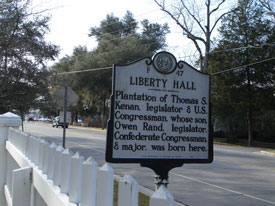
In 1800, Kenan married Mary Rand Kenan, with whom he would have a large family, ultimately raising ten children. Shortly after their marriage, the couple oversaw the construction of the second Liberty Hall, a significant structure in Kenansville, which replaced the original building that had been lost to fire. Liberty Hall served not only as a family residence but also as a symbol of the Kenan family's status in the community.
Kenan's political career began at the state level, where he served as a member of the North Carolina House of Commons, representing Duplin County from 1798 to 1799. His experience in state politics laid the groundwork for his subsequent election to the North Carolina Senate, where he served from 1799 until 1803. This early involvement in local governance provided Kenan with valuable insights into the political landscape of North Carolina and helped him build a network of influence that would be beneficial in his later congressional career.
House tenure
In 1804, Thomas Kenan was elected to the 9th United States Congress, marking the beginning of his tenure in the U.S. House of Representatives. He was subsequently reelected to the 10th and 11th Congresses, serving from March 4, 1805, until March 3, 1811. During his time in Congress, Kenan participated in the legislative process during a formative period in American history, which included significant events such as the War of 1812 and the expansion of the United States' territorial boundaries.
Kenan's decision not to seek reelection in 1810 marked the end of his congressional career. This choice may have been influenced by personal or political considerations, as he had already established a substantial legacy through his service. Following his departure from Congress, Kenan relocated his family to Selma, Alabama, in March 1811, where he sought to establish a new plantation and continue his agricultural pursuits.
Legislative focus and committees
While specific details regarding the legislative focus and committee assignments of Thomas Kenan during his congressional tenure are not extensively documented, it is known that he was active in the political landscape of his time. As a member of the Republican Party, Kenan would have aligned with the party's principles, which included advocating for agrarian interests and supporting the rights of states. Given his background as a plantation owner and his involvement in agriculture, it is likely that Kenan's legislative priorities reflected the interests of his constituents, particularly those related to land use, farming, and economic development.
Kenan's political career was not limited to his time in Congress. After moving to Alabama, he continued to engage in public service by serving in the Alabama House of Representatives for several years. This transition from federal to state politics illustrates Kenan's ongoing commitment to governance and community involvement, as he adapted to the changing political landscape of the South.
Throughout his life, Kenan's contributions extended beyond politics. He was involved in the establishment of his plantation in Alabama, where he engaged in agricultural practices that were vital to the economy of the region. This focus on agriculture was consistent with the lifestyle of many Southern politicians of the time, who often relied on farming as a primary source of income and influence.
Kenan's legacy is also tied to his family, as he left behind a significant lineage, with his oldest son, Owen Rand Kenan, remaining in North Carolina to manage the Liberty Hall Plantation. This decision reflects the importance of family and land in the Kenan family tradition, as well as the continuity of their influence in the region.
Thomas Kenan passed away on October 22, 1843, near Selma, Alabama, at the age of 72. He was laid to rest in Valley Creek Cemetery, where he and his wife, Mary Rand Kenan, were interred. His life spanned a period of significant change in the United States, and his contributions to both North Carolina and Alabama reflect the interconnectedness of regional and national politics during the early 19th century.
In summary, Thomas Kenan's life and career illustrate the complexities of early American political life, characterized by a blend of personal ambition, family legacy, and public service. His tenure as a U.S. Representative and subsequent involvement in state politics highlight the important role that individuals like Kenan played in shaping the governance and development of their communities during a pivotal era in American history.
Notable legislation
Sponsored and co-sponsored legislation for Thomas Kenan is pending operator curation. The biographical narrative above carries the same provenance trail until per-bill rows are written.
Sources
- [1]https://en.wikipedia.org/wiki/Thomas_S._KenanWikipedia · retrieved 2026-06-06
Notable quotes
Sourced quotes for Thomas Kenan are pending operator curation. Narrative-scope provenance remains attached below.
Sources
- [1]https://en.wikipedia.org/wiki/Thomas_S._KenanWikipedia · retrieved 2026-06-06
Key positions
Curated policy positions for Thomas Kenan are pending operator review. The biographical narrative above carries the same provenance trail until per-topic positions are written.
Sources
- [1]https://en.wikipedia.org/wiki/Thomas_S._KenanWikipedia · retrieved 2026-06-06
Terms served
- 1805–1807U.S. House · Term 1 · Republican
- 1807–1809U.S. House · Term 2 · Republican
- 1809–1811U.S. House · Term 3 · Republican
Sources & provenance
Every attributable claim above carries a per-section [N] marker that resolves to the corresponding URL below. Each entry records the upstream provider, the canonical URL, and the timestamp at which the source was retrieved by the ingest pipeline.
Key facts
- https://bioguide.congress.gov/search/bio/K000089bioguide · retrieved 2026-06-06
- https://www.govtrack.us/congress/members/406257govtrack · retrieved 2026-06-06
Biographical narrative
- https://en.wikipedia.org/wiki/Thomas_S._Kenanwikipedia · retrieved 2026-06-06
Find your representative
Every U.S. state elects representatives by district. Browse North Carolina’s delegation, the full former-representative roster, or explore the role and term length.
Related on The Candidate
- Preceded by James GillespieEarlier holder of the North Carolina District 5 House seat · Republican.Open
- Succeeded by Charles HooksLater holder of the North Carolina District 5 House seat · Republican.Open
- Alfred GatlinFormer U.S. Representative · North Carolina District 1 · Crawford RepublicanOpen
- Clinton CobbFormer U.S. Representative · North Carolina District 1 · RepublicanOpen
- Eva ClaytonFormer U.S. Representative · North Carolina District 1 · DemocraticOpen
- Frank Ballance Jr.Former U.S. Representative · North Carolina District 1 · DemocraticOpen