
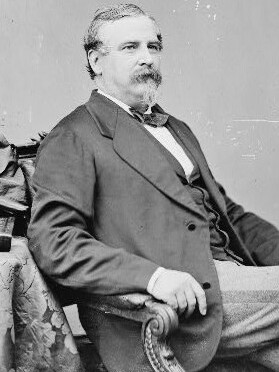
Historical · U.S. House · North Carolina · District 6
Francis Shober
Former U.S. Representative · North Carolina District 6 · 1869–1873 · Democratic
Francis Shober represented North Carolina's District 6 in the United States House of Representatives (1869–1873) for the Democratic party. The page below collects sourced biographical facts, term history, committee roles, and provenance for Shober.
Bioguide ID: S000372
Key facts
- Full name
- Francis Shober
- State
- North Carolina
- District
- District 6
- Party
- Democratic
- House service
- 1869–1873
- First House term
- 1869
- Status
- Left office
- Current term ends
- —
- Born
- 1831
- Bioguide ID
- S000372
- Committee assignments
- —
- Dataset version
- 1.20260606
Biographical narrative
830 words · sourced from the Wikipedia REST extract
Francis Shober was an American politician who served as a U.S. Representative for North Carolina's 6th congressional district. A member of the Democratic Party, Shober's congressional career spanned two terms from 1869 to 1873. In addition to his role in the House of Representatives, he held various positions in state and federal government, including serving as secretary of the United States Senate and as a county judge. His contributions to North Carolina's political landscape were significant during the post-Civil War era.
Early life and career
Francis Edwin Shober was born on March 12, 1831, in Salem, North Carolina, which is now part of Winston-Salem. His early education took place in common schools and at the Moravian School in Bethlehem, Pennsylvania. After completing his studies, he graduated from the University of North Carolina at Chapel Hill in 1851. Following his graduation, Shober pursued a legal career, reading law and gaining admission to the bar in 1853. He began practicing law in Salisbury, North Carolina, in 1854.
Shober's political career began in the early 1860s when he became involved in the North Carolina General Assembly. He served in the House of Commons from 1862 to 1864 and later in the State Senate in 1865 and 1866. His involvement in state politics during this period coincided with the tumultuous years of the Civil War and its aftermath, which shaped the political landscape of the South.
In addition to his legislative roles, Shober's career included various other positions. He was a delegate to the State constitutional convention in 1875, where he contributed to the shaping of North Carolina's governance in the post-war period. He also served as a county judge for Rowan County in 1877 and 1878, further establishing his reputation in the legal and political arenas of North Carolina.
House tenure
Francis Shober was elected to the U.S. House of Representatives as a Democrat, beginning his first term on March 4, 1869. He served in the Forty-first and Forty-second Congresses, where he represented North Carolina's 6th congressional district. His tenure in the House lasted until March 3, 1873, when he concluded his second term. During his time in Congress, Shober participated in the legislative processes of the Reconstruction era, a period marked by significant changes and challenges in the Southern states.
Shober chose not to seek renomination in 1872, concluding his congressional career after two terms. His decision not to run again may have been influenced by the shifting political dynamics of the time, as well as his growing involvement in other governmental roles.
Legislative focus and committees
During his time in the U.S. House of Representatives, Shober's legislative focus reflected the interests and concerns of his constituents in North Carolina. While specific details about the bills he sponsored or supported are not documented, it is known that he was active in discussions pertinent to the Reconstruction era, which included issues related to civil rights, economic recovery, and the reintegration of Southern states into the Union.
After leaving Congress, Shober continued to engage in public service. He was appointed Chief Clerk of the United States Senate during the 45th Congress. Following the death of Secretary John C. Burch in the 47th Congress, Shober was appointed Acting Secretary of the Senate, serving from October 24, 1881, to December 18, 1883. His experience in these roles contributed to his understanding of federal legislative processes and governance.
In addition to his work in Congress and the Senate, Shober remained active in North Carolina politics. He served as a delegate to the Democratic National Conventions in 1880 and 1884, where he participated in the broader political discourse of the Democratic Party during that era. His involvement in state politics continued when he returned to the North Carolina Senate in 1887, further solidifying his role as a prominent figure in the state's political landscape.
Shober's career was marked by a blend of legal practice and public service, reflecting the interconnected nature of law and politics in the 19th century. He resumed his legal practice after his various governmental roles, continuing to contribute to his community until his death on May 29, 1896, in Salisbury, North Carolina. He was interred in Oakdale Cemetery in Wilmington.
Shober's legacy includes not only his contributions to North Carolina's legislative history but also his familial connections. He was the father of Francis Emanuel Shober, who became notable in his own right. Additionally, evidence suggests that Shober had a son, James Francis Shober, with an enslaved woman named Betsy Ann Waugh. James Francis Shober went on to become the first documented African American physician in North Carolina, highlighting the complex social dynamics of the time.
Overall, Francis Shober's life and career reflect the challenges and transformations of American society during the 19th century, particularly in the context of the Reconstruction era and the evolving political landscape of North Carolina. His roles in both state and federal government illustrate the multifaceted nature of public service during a critical period in U.S. history.
Notable legislation
Sponsored and co-sponsored legislation for Francis Shober is pending operator curation. The biographical narrative above carries the same provenance trail until per-bill rows are written.
Sources
- [1]https://en.wikipedia.org/wiki/Francis_Edwin_ShoberWikipedia · retrieved 2026-06-06
Notable quotes
Sourced quotes for Francis Shober are pending operator curation. Narrative-scope provenance remains attached below.
Sources
- [1]https://en.wikipedia.org/wiki/Francis_Edwin_ShoberWikipedia · retrieved 2026-06-06
Key positions
Curated policy positions for Francis Shober are pending operator review. The biographical narrative above carries the same provenance trail until per-topic positions are written.
Sources
- [1]https://en.wikipedia.org/wiki/Francis_Edwin_ShoberWikipedia · retrieved 2026-06-06
Terms served
- 1869–1871U.S. House · Term 1 · Democratic
- 1871–1873U.S. House · Term 2 · Democratic
Sources & provenance
Every attributable claim above carries a per-section [N] marker that resolves to the corresponding URL below. Each entry records the upstream provider, the canonical URL, and the timestamp at which the source was retrieved by the ingest pipeline.
Key facts
- https://bioguide.congress.gov/search/bio/S000372bioguide · retrieved 2026-06-06
- https://www.govtrack.us/congress/members/409866govtrack · retrieved 2026-06-06
Biographical narrative
- https://en.wikipedia.org/wiki/Francis_Edwin_Shoberwikipedia · retrieved 2026-06-06
Find your representative
Every U.S. state elects representatives by district. Browse North Carolina’s delegation, the full former-representative roster, or explore the role and term length.
Related on The Candidate
- Preceded by Nathaniel BoydenEarlier holder of the North Carolina District 6 House seat · Conservative.Open
- Succeeded by Thomas AsheLater holder of the North Carolina District 6 House seat · Democratic.Open
- Alfred GatlinFormer U.S. Representative · North Carolina District 1 · Crawford RepublicanOpen
- Clinton CobbFormer U.S. Representative · North Carolina District 1 · RepublicanOpen
- Eva ClaytonFormer U.S. Representative · North Carolina District 1 · DemocraticOpen
- Frank Ballance Jr.Former U.S. Representative · North Carolina District 1 · DemocraticOpen