
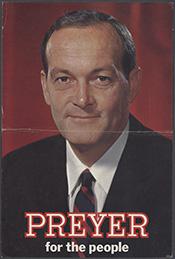
Historical · U.S. House · North Carolina · District 6
Lunsford Preyer
Former U.S. Representative · North Carolina District 6 · 1969–1981 · Democratic
Lunsford Preyer represented North Carolina's District 6 in the United States House of Representatives (1969–1981) for the Democratic party. The page below collects sourced biographical facts, term history, committee roles, and provenance for Preyer.
Bioguide ID: P000520
Key facts
- Full name
- Lunsford Preyer
- State
- North Carolina
- District
- District 6
- Party
- Democratic
- House service
- 1969–1981
- First House term
- 1969
- Status
- Left office
- Current term ends
- —
- Born
- 1919
- Bioguide ID
- P000520
- Committee assignments
- —
- Dataset version
- 1.20260605
Biographical narrative
958 words · sourced from the Wikipedia REST extract
Lunsford Richardson Preyer was a prominent American politician and jurist who served as a U.S. Representative for North Carolina's 6th congressional district from 1969 until 1981. A member of the Democratic Party, Preyer's career spanned various roles in law and public service, including a notable tenure as a district judge prior to his congressional service. His contributions to the legislative process and his involvement in significant committees during his time in office reflect his commitment to public service and governance.
Early life and career
Lunsford Richardson Preyer was born on January 11, 1919, in Greensboro, North Carolina. He grew up in a family with deep roots in the region, which influenced his later career in law and politics. Preyer attended Woodberry Forest School in Virginia, where he laid the groundwork for his future academic pursuits. He went on to Princeton University, graduating with an A.B. in English in 1941. His academic work included a senior thesis that explored the contrasting values of Charles Dickens and Alphonse Daudet. During his time at Princeton, he was actively involved in athletics, participating in both the 150 lb. football team and the golf team, and he served as vice-president of the Princeton Tower Club.
Following his undergraduate education, Preyer enlisted in the United States Navy during World War II, serving from 1941 to 1946. He held the positions of gunnery officer and executive officer on destroyers, participating in significant naval operations in both the Atlantic and Pacific theaters. For his service, he was awarded a Bronze Star for his actions during the Battle of Okinawa.
After the war, Preyer pursued a legal education, earning a Bachelor of Laws from Harvard Law School in 1949. His early career included a brief period in private legal practice in New York City before he returned to North Carolina. In 1950, he worked for Vick Chemical Company, a family business founded by his grandfather. Subsequently, he established a law practice in Greensboro from 1951 to 1956. During this time, he also served as a City Judge from 1953 to 1954 and was appointed as a Judge of the North Carolina Superior Court, a position he held from 1956 to 1961.
House tenure
Preyer's political career took a significant turn when he was appointed to the United States District Court for the Middle District of North Carolina in 1961. This appointment was made by President John F. Kennedy, and he was confirmed by the Senate in early 1962. However, his judicial service was relatively short-lived, as he resigned in 1963. Following his resignation, Preyer sought to further his political ambitions and ran for Governor of North Carolina in 1964, although he was not successful in that bid.
In 1968, Preyer was elected as a Democratic U.S. Representative for North Carolina's 6th congressional district. He began his first term in the 91st Congress on January 3, 1969. Over the course of his six terms in the House, which lasted until January 3, 1981, Preyer was involved in various legislative initiatives and served on several important committees. His tenure in Congress was marked by his leadership roles, including serving as Chairman of the House Ethics Committee and as a member of the House Select Committee on Assassinations, where he was part of the subcommittee focused on the assassination of President John F. Kennedy.
Preyer's congressional service was characterized by his commitment to ethical governance and transparency in political processes. His involvement in the Ethics Committee underscored his dedication to maintaining integrity within the legislative branch. He was also active in addressing issues related to civil rights and social justice during a transformative period in American history.
Despite his contributions, Preyer faced challenges in his later political career. He ran for re-election in 1980 but was unsuccessful in his bid to continue serving in the 97th Congress. His defeat marked the end of his direct involvement in federal legislative activities, but his impact on North Carolina politics and governance remained significant.
Legislative focus and committees
Throughout his time in Congress, Preyer was known for his focus on various legislative issues that were pertinent to his constituents and the broader national landscape. His role as Chairman of the House Ethics Committee was particularly notable, as it placed him at the forefront of discussions about ethical standards and accountability in government. This position allowed him to influence policies aimed at ensuring transparency and integrity among elected officials.
In addition to his work on the Ethics Committee, Preyer's participation in the House Select Committee on Assassinations highlighted his engagement with critical historical events and their implications for American society. His involvement in the JFK Subcommittee during the 95th Congress reflected his interest in understanding the circumstances surrounding the assassination and its impact on the nation.
Preyer's legislative focus also extended to issues related to civil rights, social justice, and public service. His background as a judge and legal practitioner informed his perspectives on legislation affecting the judicial system and civil liberties. He was known for advocating policies that aimed to improve the lives of his constituents and promote equitable treatment under the law.
After leaving Congress, Preyer continued to be active in civic affairs. He was elected to the Common Cause National Governing Board in 1988, further demonstrating his commitment to public service and civic engagement. Preyer spent the remainder of his life in Greensboro, North Carolina, where he passed away on April 3, 2001, after a battle with cancer. His legacy includes the L. Richardson Preyer Federal Building in Greensboro, named in his honor, and recognition for his contributions to public service alongside his wife, Emily, who also received accolades for her civic involvement. Preyer's life and career reflect a dedication to law, governance, and the principles of democracy.
Notable legislation
Sponsored and co-sponsored legislation for Lunsford Preyer is pending operator curation. The biographical narrative above carries the same provenance trail until per-bill rows are written.
Sources
- [1]https://en.wikipedia.org/wiki/L._Richardson_PreyerWikipedia · retrieved 2026-06-05
Notable quotes
Sourced quotes for Lunsford Preyer are pending operator curation. Narrative-scope provenance remains attached below.
Sources
- [1]https://en.wikipedia.org/wiki/L._Richardson_PreyerWikipedia · retrieved 2026-06-05
Key positions
Curated policy positions for Lunsford Preyer are pending operator review. The biographical narrative above carries the same provenance trail until per-topic positions are written.
Sources
- [1]https://en.wikipedia.org/wiki/L._Richardson_PreyerWikipedia · retrieved 2026-06-05
Terms served
- 1969–1971U.S. House · Term 1 · Democratic
- 1971–1973U.S. House · Term 2 · Democratic
- 1973–1975U.S. House · Term 3 · Democratic
- 1975–1977U.S. House · Term 4 · Democratic
- 1977–1979U.S. House · Term 5 · Democratic
- 1979–1981U.S. House · Term 6 · Democratic
Sources & provenance
Every attributable claim above carries a per-section [N] marker that resolves to the corresponding URL below. Each entry records the upstream provider, the canonical URL, and the timestamp at which the source was retrieved by the ingest pipeline.
Key facts
- https://bioguide.congress.gov/search/bio/P000520bioguide · retrieved 2026-06-05
- https://www.govtrack.us/congress/members/408905govtrack · retrieved 2026-06-05
Biographical narrative
- https://en.wikipedia.org/wiki/L._Richardson_Preyerwikipedia · retrieved 2026-06-05
Find your representative
Every U.S. state elects representatives by district. Browse North Carolina’s delegation, the full former-representative roster, or explore the role and term length.
Related on The Candidate
- Preceded by Horace KornegayEarlier holder of the North Carolina District 6 House seat · Democratic.Open
- Succeeded by Walter Johnston IIILater holder of the North Carolina District 6 House seat · Republican.Open
- Alfred GatlinFormer U.S. Representative · North Carolina District 1 · Crawford RepublicanOpen
- Clinton CobbFormer U.S. Representative · North Carolina District 1 · RepublicanOpen
- Eva ClaytonFormer U.S. Representative · North Carolina District 1 · DemocraticOpen
- Frank Ballance Jr.Former U.S. Representative · North Carolina District 1 · DemocraticOpen