
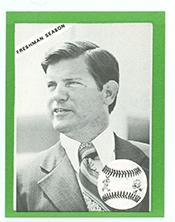
Historical · U.S. House · North Carolina · District 9
James Martin
Former U.S. Representative · North Carolina District 9 · 1973–1985 · Republican
James Martin represented North Carolina's District 9 in the United States House of Representatives (1973–1985) for the Republican party. The page below collects sourced biographical facts, term history, committee roles, and provenance for Martin.
Bioguide ID: M000183
Key facts
- Full name
- James Martin
- State
- North Carolina
- District
- District 9
- Party
- Republican
- House service
- 1973–1985
- First House term
- 1973
- Status
- Left office
- Current term ends
- —
- Born
- 1935
- Bioguide ID
- M000183
- Committee assignments
- —
- Dataset version
- 1.20260605
Biographical narrative
959 words · sourced from the Wikipedia REST extract
James G. Martin is a former American politician and chemist who served as a U.S. Representative for North Carolina's 9th congressional district from 1973 to 1985. A member of the Republican Party, Martin was later elected as the 70th governor of North Carolina, holding office from 1985 to 1993. His political career is marked by his significant contributions to both state and national politics, as well as his background in academia and science. Martin's tenure in the House of Representatives laid the groundwork for his later role as governor, where he became known for his focus on infrastructure and education.
Early life and career
James Grubbs Martin was born on December 11, 1935, in Savannah, Georgia, and spent his formative years in South Carolina. He pursued higher education at Davidson College, where he graduated in 1957 with a Bachelor of Science degree. During his time at Davidson, Martin was actively involved in musical pursuits as an avid tuba player and was a member of the Phi Mu Alpha Sinfonia music fraternity and the Beta Theta Pi social fraternity. Shortly after completing his undergraduate studies, he married Dorothy Ann McAulay, who hailed from Charlotte, North Carolina.
Following his graduation, Martin continued his academic journey by enrolling at Princeton University, where he earned a PhD in chemistry in 1960. His doctoral dissertation focused on the "Stereochemistry of the Diels-Alder reaction," showcasing his expertise in the field of chemistry. After obtaining his PhD, he returned to Davidson College as an associate professor of chemistry, a position he held until 1972. In this role, he not only taught but also advised the Young Republicans chapter at the college, indicating his early involvement in political matters.
Martin's political career began in earnest when he registered as a member of the Republican Party in the early 1960s, motivated by a belief in the necessity of two-party competition in the South. In 1966, he was elected to the Mecklenburg County Board of Commissioners, where he served for seven years. During his tenure, he held the position of chair from 1967 to 1968 and briefly in 1971. His leadership extended to the North Carolina Association of County Commissioners, where he served as president, further establishing his political credentials in the state.
House tenure
In 1972, Martin was elected to the United States House of Representatives, representing North Carolina's 9th congressional district, which is centered around Charlotte. His election marked the beginning of a six-term tenure in the House, during which he became known for his active involvement in various legislative matters. Martin served on the House Ways and Means Committee, which is responsible for taxation and revenue-related legislation. His role on this committee positioned him at the heart of fiscal policy discussions, allowing him to influence significant economic legislation.
In addition to his committee work, Martin held the position of chairman of the House Republican Research Committee, where he contributed to the development of party strategies and legislative initiatives. His dedication to public service was recognized in 1983 when he became the first elected official to receive the Charles Lathrop Parsons Award from the American Chemical Society, an honor bestowed for outstanding public service by an American chemist. This recognition highlighted the intersection of his scientific background and political career, underscoring his commitment to both fields.
During his time in the House, Martin was involved in various legislative initiatives and discussions that shaped national policy. His experience as a chemist informed his approach to issues related to science and technology, and he often advocated for policies that supported research and development. Martin's tenure in Congress was characterized by a focus on economic growth, education, and infrastructure, themes that would continue to resonate in his later political career.
Legislative focus and committees
Throughout his time in the House of Representatives, Martin's legislative focus encompassed a range of issues, reflecting his background in science and his commitment to public service. His work on the Ways and Means Committee allowed him to engage deeply with matters related to taxation, social security, and health care, positioning him as a key player in shaping fiscal policy during his tenure. Martin's scientific expertise also contributed to his advocacy for policies that promoted research and innovation, particularly in the fields of education and technology.
In addition to his committee responsibilities, Martin's leadership in the House Republican Research Committee enabled him to influence party strategy and legislative priorities. His ability to navigate complex political landscapes and build coalitions was instrumental in advancing the Republican agenda during a time of significant political change in the United States. Martin's tenure coincided with the presidency of Ronald Reagan, and he benefited from the political momentum generated by Reagan's administration, particularly during the 1984 election cycle.
In 1984, with incumbent governor Jim Hunt leaving office due to term limits, Martin sought the Republican nomination for governor and successfully won the election. His victory was aided by various factors, including the endorsement of Lieutenant Governor Jimmy Green, which helped him secure support among conservative Democrats in eastern North Carolina. Martin's transition from the House of Representatives to the governorship marked a significant shift in his political career, allowing him to focus on state-level issues, particularly infrastructure development and education.
In summary, James G. Martin's career as a U.S. Representative was marked by his commitment to public service, his scientific background, and his involvement in key legislative committees. His focus on economic growth, education, and infrastructure laid the groundwork for his subsequent role as governor of North Carolina, where he continued to advocate for policies that would shape the state's future. Martin's legacy as a politician is characterized by his dedication to both science and public service, reflecting the unique intersection of these two fields throughout his career.
Notable legislation
Sponsored and co-sponsored legislation for James Martin is pending operator curation. The biographical narrative above carries the same provenance trail until per-bill rows are written.
Sources
- [1]https://en.wikipedia.org/wiki/James_G._MartinWikipedia · retrieved 2026-06-05
Notable quotes
Sourced quotes for James Martin are pending operator curation. Narrative-scope provenance remains attached below.
Sources
- [1]https://en.wikipedia.org/wiki/James_G._MartinWikipedia · retrieved 2026-06-05
Key positions
Curated policy positions for James Martin are pending operator review. The biographical narrative above carries the same provenance trail until per-topic positions are written.
Sources
- [1]https://en.wikipedia.org/wiki/James_G._MartinWikipedia · retrieved 2026-06-05
Terms served
- 1973–1975U.S. House · Term 1 · Republican
- 1975–1977U.S. House · Term 2 · Republican
- 1977–1979U.S. House · Term 3 · Republican
- 1979–1981U.S. House · Term 4 · Republican
- 1981–1983U.S. House · Term 5 · Republican
- 1983–1985U.S. House · Term 6 · Republican
Sources & provenance
Every attributable claim above carries a per-section [N] marker that resolves to the corresponding URL below. Each entry records the upstream provider, the canonical URL, and the timestamp at which the source was retrieved by the ingest pipeline.
Key facts
- https://bioguide.congress.gov/search/bio/M000183bioguide · retrieved 2026-06-05
- https://www.govtrack.us/congress/members/407204govtrack · retrieved 2026-06-05
Biographical narrative
- https://en.wikipedia.org/wiki/James_G._Martinwikipedia · retrieved 2026-06-05
Find your representative
Every U.S. state elects representatives by district. Browse North Carolina’s delegation, the full former-representative roster, or explore the role and term length.
Related on The Candidate
- Preceded by Charles JonasEarlier holder of the North Carolina District 9 House seat · Republican.Open
- Succeeded by Alex McMillanLater holder of the North Carolina District 9 House seat · Republican.Open
- Alfred GatlinFormer U.S. Representative · North Carolina District 1 · Crawford RepublicanOpen
- Clinton CobbFormer U.S. Representative · North Carolina District 1 · RepublicanOpen
- Eva ClaytonFormer U.S. Representative · North Carolina District 1 · DemocraticOpen
- Frank Ballance Jr.Former U.S. Representative · North Carolina District 1 · DemocraticOpen