
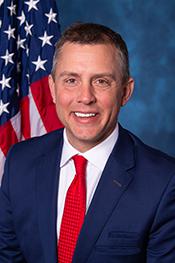
Historical · U.S. House · North Dakota · At-Large
Kelly Armstrong
Former U.S. Representative · North Dakota At-Large · 2019–2024 · Republican
Kelly Armstrong represented North Dakota's At-Large in the United States House of Representatives (2019–2024) for the Republican party. The page below collects sourced biographical facts, term history, committee roles, and provenance for Armstrong.
Bioguide ID: A000377
Key facts
- Full name
- Kelly Armstrong
- State
- North Dakota
- District
- At-Large
- Party
- Republican
- House service
- 2019–2024
- First House term
- 2019
- Status
- Left office
- Current term ends
- —
- Born
- 1976
- Bioguide ID
- A000377
- Committee assignments
- —
- Dataset version
- 1.20260603
Biographical narrative
961 words · sourced from the Wikipedia REST extract
Kelly Armstrong is an American politician and lawyer who served as the U.S. Representative for North Dakota's at-large congressional district from 2019 until 2024. A member of the Republican Party, he was first elected to Congress in 2018 and subsequently re-elected in 2020 and 2022. Following his tenure in the House, Armstrong transitioned to state leadership, becoming the 34th governor of North Dakota in 2024.
Early life and career
Kelly Michael Armstrong was born on October 8, 1976, in North Dakota. He completed his secondary education at Dickinson High School, graduating in 1995. Armstrong pursued higher education at the University of North Dakota, where he earned a Bachelor of Arts degree in psychology in 2001. He continued his studies at the University of North Dakota School of Law, obtaining his Juris Doctor in 2003 after spending his first year at the College of William & Mary.
Before entering politics, Armstrong built a career in law and business. He worked as a partner at the law firm Reichert Armstrong, which has offices in Grand Forks and Dickinson. Additionally, he served as the vice president of Armstrong Corp., a family-owned business. His political career began in earnest when he was elected to the North Dakota State Senate, representing the 36th district from 2013 to 2018. During this time, he also held the position of chair of the North Dakota Republican Party from 2015 to 2018, where he played a significant role in shaping the party's direction and strategy within the state.
House tenure
Armstrong announced his candidacy for the United States House of Representatives in February 2018. He received the endorsement of the North Dakota Republican Party at its state convention in April of that year. Armstrong successfully won the general election held on November 6, 2018, securing approximately 60.2% of the vote. Following his victory, he resigned from his position in the North Dakota Legislature on November 7, 2018, and officially took office in Congress in January 2019, succeeding Kevin Cramer, who had moved on to the U.S. Senate.
During his time in the House, Armstrong was re-elected twice, first in 2020, where he garnered nearly 69% of the vote, and again in 2022, with approximately 62% of the vote. His tenure in Congress was marked by a range of legislative activities and positions on various issues.
Armstrong was part of a group of seven Republican representatives who did not support efforts to challenge the results of the 2020 presidential election on January 6, 2021. This group acknowledged the allegations of election fraud but asserted that Congress did not have the authority to alter the election's outcome. His stance on this issue highlighted a willingness to break from party lines when he deemed it necessary.
In July 2022, Armstrong was among 47 Republican representatives who voted in favor of the Respect for Marriage Act, which aimed to codify same-sex marriage rights at the federal level. This vote drew criticism from some within his party, leading to a near-censure during a state party meeting. In September 2022, he also voted for the Merger Filing Fee Modernization Act, an initiative aimed at addressing antitrust concerns and promoting fair competition among corporations.
Armstrong's voting record included support for various measures related to national security and foreign policy. Following the 2023 Hamas attack on Israel, he voted to provide support to Israel. However, he later voted against a censure motion aimed at Representative Rashida Tlaib, citing concerns over the implications of the censure related to her criticisms of Israel. In December 2023, he participated in a significant vote to expel Representative George Santos from Congress after an ethics committee found that Santos had violated federal law.
On December 14, 2024, Armstrong submitted his resignation from Congress to assume the role of governor of North Dakota, effective at midnight that night. His departure from the House marked the end of a significant chapter in his political career.
Legislative focus and committees
During his time in the House of Representatives, Armstrong served on several key committees that shaped his legislative focus. He was the Vice Chair of the Committee on Energy and Commerce, where he participated in discussions and decisions related to energy policy, climate change, and technological innovation. Within this committee, he was involved in various subcommittees, including those focused on Energy, Climate, and Grid Security, Innovation, Data, and Commerce, as well as Oversight and Investigations.
Armstrong also served on the Committee on the Judiciary, where he was engaged in matters concerning civil rights, immigration, antitrust issues, and the broader legal framework governing federal governance. His involvement in the Judiciary Committee included participation in the Subcommittee on Constitution, Civil Rights, and Civil Liberties, as well as the Subcommittee on Immigration and Citizenship and the Subcommittee on Antitrust, Commercial, and Administrative Law. Additionally, he was part of the Judiciary Select Subcommittee on the Weaponization of the Federal Government, which focused on issues related to government accountability and oversight.
In addition to his committee assignments, Armstrong was a member of several caucuses that reflected his interests and priorities. These included the Republican Governance Group, the Friends of Norway Caucus, and the Fire Services Caucus, among others. His involvement in these groups indicated a commitment to various issues, including public safety, international relations, and mental health.
Armstrong's legislative career was characterized by a blend of traditional Republican values and a willingness to engage on issues that resonated with a broader constituency. His actions in Congress demonstrated a focus on both state and national concerns, reflecting his background as a North Dakota native and his commitment to serving the interests of his constituents. Following his departure from the House, Armstrong transitioned to the role of governor of North Dakota, where he continues to influence state policy and governance.
Notable legislation
Sponsored and co-sponsored legislation for Kelly Armstrong is pending operator curation. The biographical narrative above carries the same provenance trail until per-bill rows are written.
Sources
- [1]https://en.wikipedia.org/wiki/Kelly_ArmstrongWikipedia · retrieved 2026-06-03
Notable quotes
Sourced quotes for Kelly Armstrong are pending operator curation. Narrative-scope provenance remains attached below.
Sources
- [1]https://en.wikipedia.org/wiki/Kelly_ArmstrongWikipedia · retrieved 2026-06-03
Key positions
Curated policy positions for Kelly Armstrong are pending operator review. The biographical narrative above carries the same provenance trail until per-topic positions are written.
Sources
- [1]https://en.wikipedia.org/wiki/Kelly_ArmstrongWikipedia · retrieved 2026-06-03
Terms served
- 2019–2021U.S. House · Term 1 · Republican
- 2021–2023U.S. House · Term 2 · Republican
- 2023–2024U.S. House · Term 3 · Republican
Sources & provenance
Every attributable claim above carries a per-section [N] marker that resolves to the corresponding URL below. Each entry records the upstream provider, the canonical URL, and the timestamp at which the source was retrieved by the ingest pipeline.
Key facts
- https://bioguide.congress.gov/search/bio/A000377bioguide · retrieved 2026-06-03
- https://armstrong.house.govhouse.gov · retrieved 2026-06-03
Biographical narrative
- https://en.wikipedia.org/wiki/Kelly_Armstrongwikipedia · retrieved 2026-06-03
Find your representative
Every U.S. state elects representatives by district. Browse North Dakota’s delegation, the full former-representative roster, or explore the role and term length.
Related on The Candidate
- Preceded by Rick BergEarlier holder of the North Dakota At-Large House seat · Republican.Open
- Henry HelgesenFormer U.S. Representative · North Dakota District 1 · RepublicanOpen
- Hjalmar NygaardFormer U.S. Representative · North Dakota District 1 · RepublicanOpen
- John BaerFormer U.S. Representative · North Dakota District 1 · RepublicanOpen
- Olger BurtnessFormer U.S. Representative · North Dakota District 1 · RepublicanOpen
- Republican PartyFederal candidates and office holders on the Republican line.Open