
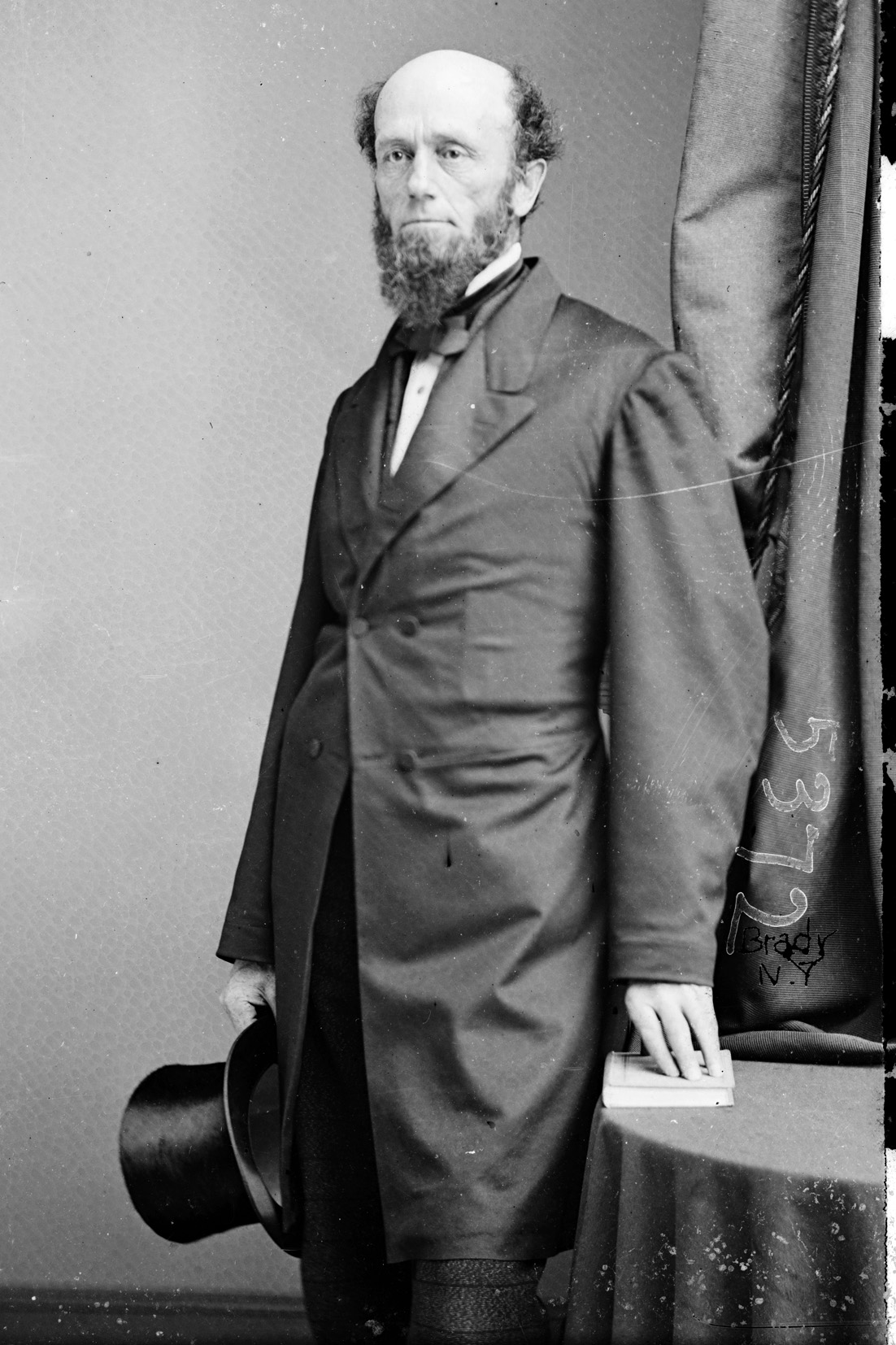
Historical · U.S. House · New Hampshire · District 1
James Pike
Former U.S. Representative · New Hampshire District 1 · 1855–1859 · Republican
James Pike represented New Hampshire's District 1 in the United States House of Representatives (1855–1859) for the Republican party. The page below collects sourced biographical facts, term history, committee roles, and provenance for Pike.
Bioguide ID: P000347
Key facts
- Full name
- James Pike
- State
- New Hampshire
- District
- District 1
- Party
- Republican
- House service
- 1855–1859
- First House term
- 1855
- Status
- Left office
- Current term ends
- —
- Born
- 1818
- Bioguide ID
- P000347
- Committee assignments
- —
- Dataset version
- 1.20260606
Biographical narrative
875 words · sourced from the Wikipedia REST extract
James Pike was a U.S. Representative from New Hampshire who served in the House of Representatives during the mid-19th century. A member of the Republican Party, Pike was initially elected as a candidate of the American Party and held office during a tumultuous period in American history, which included the lead-up to the Civil War. His political career spanned two terms in the House, and he later served in the Union Army during the Civil War. After his congressional tenure, Pike returned to his roots in ministry and continued to contribute to his community until his retirement.
Early life and career
James Pike was born on November 10, 1818, in Salisbury, Massachusetts. His early education included a focus on classical studies, which laid the groundwork for his later pursuits in theology. From 1837 to 1839, he attended Wesleyan University in Connecticut, where he furthered his theological education. This academic background was instrumental in shaping his future career as a minister.
Pike began his professional life in the ministry, serving as a preacher from 1841 until 1854. His work during this period likely involved engaging with local communities and addressing the spiritual needs of his congregation. In 1854, he relocated to Pembroke, New Hampshire, a move that would mark a significant transition in his career. This change not only placed him in a new geographical context but also set the stage for his entry into politics.
Pike's political career began in earnest when he was elected to the U.S. House of Representatives. Initially, he ran as a candidate of the American Party, a political group that emerged in the 1850s, primarily focused on issues related to immigration and opposition to the expansion of slavery. His election to the Thirty-fourth Congress marked the beginning of his formal political career, and he was subsequently re-elected as a Republican to the Thirty-fifth Congress.
House tenure
James Pike's congressional service spanned from March 4, 1855, to March 3, 1859. During this time, he represented New Hampshire's 1st congressional district, a role that required him to address the concerns and interests of his constituents amid a rapidly changing national landscape. His tenure in the House coincided with significant events in American history, including rising tensions over slavery and the impending Civil War.
As a member of the House, Pike was part of a legislative body that was grappling with critical issues of the day. Although specific details of his legislative activities are not provided, it can be inferred that he participated in discussions and decisions that shaped the direction of the nation during a pivotal era. His re-election as a Republican suggests that he maintained support among his constituents, reflecting his alignment with the party's platform and the prevailing sentiments in New Hampshire at the time.
Pike chose not to seek renomination in 1858, concluding his congressional career after two terms. This decision may have been influenced by various factors, including personal considerations or the shifting political landscape as the nation moved closer to the Civil War.
Legislative focus and committees
While specific legislative initiatives or committee assignments during Pike's time in Congress are not detailed in the available information, it is important to contextualize his service within the broader political environment of the 1850s. The period was marked by intense debates over issues such as states' rights, the expansion of slavery into new territories, and the growing divide between Northern and Southern states. As a Republican, Pike would have been aligned with the party's opposition to the spread of slavery, which was a central theme in the political discourse of the time.
Following his congressional service, Pike's life took a significant turn as he enlisted in the Union Army during the Civil War. He served as a colonel in the 16th New Hampshire Volunteer Infantry from November 1, 1862, to August 20, 1863. His military service included participation in the Siege of Port Hudson, a key engagement in the conflict that underscored the strategic importance of controlling the Mississippi River. This experience likely influenced his perspectives on governance and public service, as many veterans of the war returned to civilian life with a renewed commitment to their communities and the nation.
After the war, Pike returned to his roots in ministry, resuming his role as a preacher. He later became the presiding elder of the Dover district, a position that would have involved overseeing multiple congregations and providing spiritual leadership within the Methodist Church. His commitment to his faith and community continued until he stepped back from active duties in 1886.
James Pike lived in retirement until his death on July 26, 1895, in Newfields, New Hampshire. His contributions to public service, both as a legislator and a military officer, reflect a life dedicated to the principles of leadership and community engagement. He was interred in Locust Cemetery, where his legacy as a public servant and community leader is remembered.
Pike's life and career encapsulate a period of significant transformation in American society, marked by the challenges of governance, civil conflict, and the enduring influence of faith in public life. His experiences as a minister, legislator, and military officer provide insight into the complexities of 19th-century America and the roles individuals played in shaping the nation’s history.
Notable legislation
Sponsored and co-sponsored legislation for James Pike is pending operator curation. The biographical narrative above carries the same provenance trail until per-bill rows are written.
Sources
- [1]https://en.wikipedia.org/wiki/James_Pike_(politician)Wikipedia · retrieved 2026-06-06
Notable quotes
Sourced quotes for James Pike are pending operator curation. Narrative-scope provenance remains attached below.
Sources
- [1]https://en.wikipedia.org/wiki/James_Pike_(politician)Wikipedia · retrieved 2026-06-06
Key positions
Curated policy positions for James Pike are pending operator review. The biographical narrative above carries the same provenance trail until per-topic positions are written.
Sources
- [1]https://en.wikipedia.org/wiki/James_Pike_(politician)Wikipedia · retrieved 2026-06-06
Terms served
- 1855–1857U.S. House · Term 1 · American
- 1857–1859U.S. House · Term 2 · Republican
Sources & provenance
Every attributable claim above carries a per-section [N] marker that resolves to the corresponding URL below. Each entry records the upstream provider, the canonical URL, and the timestamp at which the source was retrieved by the ingest pipeline.
Key facts
- https://bioguide.congress.gov/search/bio/P000347bioguide · retrieved 2026-06-06
- https://www.govtrack.us/congress/members/408744govtrack · retrieved 2026-06-06
Biographical narrative
- https://en.wikipedia.org/wiki/James_Pike_(politician)wikipedia · retrieved 2026-06-06
Find your representative
Every U.S. state elects representatives by district. Browse New Hampshire’s delegation, the full former-representative roster, or explore the role and term length.
Related on The Candidate
- Preceded by George KittredgeEarlier holder of the New Hampshire District 1 House seat · Democratic.Open
- Succeeded by Daniel MarcyLater holder of the New Hampshire District 1 House seat · Democratic.Open
- Alonzo NuteFormer U.S. Representative · New Hampshire District 1 · RepublicanOpen
- Alphonse RoyFormer U.S. Representative · New Hampshire District 1 · DemocraticOpen
- Amos TuckFormer U.S. Representative · New Hampshire District 1 · WhigOpen
- Arthur JenksFormer U.S. Representative · New Hampshire District 1 · RepublicanOpen