
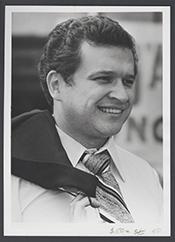
Historical · U.S. House · New Hampshire · District 1
Norman D’Amours
Former U.S. Representative · New Hampshire District 1 · 1975–1985 · Democratic
Norman D’Amours represented New Hampshire's District 1 in the United States House of Representatives (1975–1985) for the Democratic party. The page below collects sourced biographical facts, term history, committee roles, and provenance for D’Amours.
Bioguide ID: D000017
Key facts
- Full name
- Norman D’Amours
- State
- New Hampshire
- District
- District 1
- Party
- Democratic
- House service
- 1975–1985
- First House term
- 1975
- Status
- Left office
- Current term ends
- —
- Born
- 1937
- Bioguide ID
- D000017
- Committee assignments
- —
- Dataset version
- 1.20260605
Biographical narrative
1,059 words · sourced from the Wikipedia REST extract
Norman E. D'Amours is a former American politician and lawyer who served as a Democratic member of the United States House of Representatives for New Hampshire's 1st congressional district from 1975 until 1985. Over the course of his five terms in office, D'Amours was known for his involvement in banking and finance issues, reflecting his legal background and expertise in these areas. After leaving Congress, he continued to engage in public service, notably being appointed by President Bill Clinton as the chairman of the National Credit Union Administration, a position he held for seven years. D'Amours has remained active in various political and legal endeavors throughout his career.
Early life and career
Norman Edward D'Amours was born on October 14, 1937, in Holyoke, Massachusetts, located in Hampden County. He grew up in a family that valued education and community involvement, which likely influenced his future pursuits in law and politics. D'Amours attended parochial school in Holyoke before moving on to high school in Worcester, Massachusetts. His academic journey continued at Assumption College, where he earned a Bachelor of Arts degree in 1960. Following his undergraduate education, he pursued legal studies at Boston University School of Law, graduating with a Bachelor of Laws (LL.B.) in 1963.
After completing his education, D'Amours was admitted to the bar in Massachusetts in the same year and subsequently in New Hampshire in 1964. He also gained admission to the bar in the District of Columbia, which allowed him to practice law in multiple jurisdictions. D'Amours began his professional career as a practicing attorney in New Hampshire, where he developed a reputation for his legal acumen and commitment to public service. His early career included a significant role as an assistant attorney general for the state of New Hampshire from 1966 to 1969, where he handled various legal matters on behalf of the state.
In addition to his role as assistant attorney general, D'Amours served as the city prosecutor for Manchester, New Hampshire, from 1970 to 1972. This position allowed him to gain valuable experience in the legal system and further solidified his commitment to public service. His work in these roles laid the groundwork for his future political career, as he developed a deep understanding of legal and governmental processes.
House tenure
D'Amours was elected to the United States House of Representatives in 1974, beginning his first term on January 3, 1975. He represented New Hampshire's 1st congressional district, a position he would hold for a decade, spanning five consecutive terms until January 3, 1985. During his tenure in Congress, D'Amours was an active participant in various legislative matters, particularly those related to banking and finance. His legal background and experience in public service informed his approach to these issues, allowing him to contribute meaningfully to discussions and decisions that affected the financial landscape of the nation.
Throughout his time in the House, D'Amours was known for his commitment to his constituents and his ability to navigate complex legislative challenges. He served during several Congresses, including the 94th through the 98th, and was involved in a range of initiatives aimed at improving the economic well-being of his district and the country as a whole. His focus on banking and finance was particularly relevant during a period of significant economic change in the United States, as the country faced various challenges related to inflation, interest rates, and financial regulation.
In 1984, D'Amours sought to advance his political career by running for the United States Senate against the incumbent Republican Gordon J. Humphrey. Despite a competitive campaign, D'Amours was not successful, receiving a notable percentage of the vote but ultimately losing to Humphrey. Following his defeat, he concluded his service in the House, and his seat was eventually filled by Republican Bob Smith.
Legislative focus and committees
During his time in the House of Representatives, D'Amours was particularly focused on issues related to banking and finance, reflecting his legal expertise and understanding of economic matters. His work in these areas was crucial, as the nation grappled with various financial challenges during the late 1970s and early 1980s. D'Amours's contributions to legislative discussions on banking policy and financial regulation were informed by his background as an attorney and his experience in public service, allowing him to advocate effectively for policies that aimed to stabilize and improve the financial system.
In addition to his focus on banking and finance, D'Amours participated in various committees that addressed a range of issues affecting his constituents and the broader national landscape. His involvement in these committees allowed him to engage with colleagues from both parties and work collaboratively on legislation that aimed to address pressing concerns. D'Amours's ability to navigate the complexities of legislative processes and build bipartisan support for key initiatives was a hallmark of his tenure in Congress.
After leaving the House, D'Amours continued to serve the public in a different capacity. In 1993, he was appointed by President Bill Clinton to serve as the chairman of the National Credit Union Administration (NCUA). This federal agency oversees the regulation and supervision of credit unions in the United States, managing a significant amount of assets and ensuring the safety and soundness of these financial institutions. D'Amours was unanimously confirmed by the U.S. Senate for this position and served for seven years, during which he played a key role in shaping policies that affected the credit union sector.
In his later career, D'Amours remained engaged in national politics and continued to contribute to discussions on financial regulation and public policy. He became a partner in the law firm Dierman, Wortley, Zola & Associates in Washington, D.C., where he utilized his extensive experience and knowledge to advise clients on various legal and regulatory matters.
D'Amours's family life has also been an important aspect of his identity. He is the son of Albert and Edna Delvina (LaPlante) D'Amours and is married to Helen Elizabeth Manning. Together, they have three children: Susan, Danielle, and Norman. The family resides in Arlington, Virginia, where D'Amours continues to be involved in civic and political activities.
Overall, Norman E. D'Amours's career reflects a commitment to public service, legal expertise, and active engagement in the political process. His contributions to the U.S. House of Representatives and subsequent roles in federal agencies highlight his dedication to addressing the needs of his constituents and the broader American public.
Notable legislation
Sponsored and co-sponsored legislation for Norman D’Amours is pending operator curation. The biographical narrative above carries the same provenance trail until per-bill rows are written.
Sources
- [1]https://en.wikipedia.org/wiki/Norman_D'AmoursWikipedia · retrieved 2026-06-05
Notable quotes
Sourced quotes for Norman D’Amours are pending operator curation. Narrative-scope provenance remains attached below.
Sources
- [1]https://en.wikipedia.org/wiki/Norman_D'AmoursWikipedia · retrieved 2026-06-05
Key positions
Curated policy positions for Norman D’Amours are pending operator review. The biographical narrative above carries the same provenance trail until per-topic positions are written.
Sources
- [1]https://en.wikipedia.org/wiki/Norman_D'AmoursWikipedia · retrieved 2026-06-05
Terms served
- 1975–1977U.S. House · Term 1 · Democratic
- 1977–1979U.S. House · Term 2 · Democratic
- 1979–1981U.S. House · Term 3 · Democratic
- 1981–1983U.S. House · Term 4 · Democratic
- 1983–1985U.S. House · Term 5 · Democratic
Sources & provenance
Every attributable claim above carries a per-section [N] marker that resolves to the corresponding URL below. Each entry records the upstream provider, the canonical URL, and the timestamp at which the source was retrieved by the ingest pipeline.
Key facts
- https://bioguide.congress.gov/search/bio/D000017bioguide · retrieved 2026-06-05
- https://www.govtrack.us/congress/members/403143govtrack · retrieved 2026-06-05
Biographical narrative
- https://en.wikipedia.org/wiki/Norman_D'Amourswikipedia · retrieved 2026-06-05
Find your representative
Every U.S. state elects representatives by district. Browse New Hampshire’s delegation, the full former-representative roster, or explore the role and term length.
Related on The Candidate
- Preceded by Joseph HuotEarlier holder of the New Hampshire District 1 House seat · Democratic.Open
- Succeeded by William Zeliff Jr.Later holder of the New Hampshire District 1 House seat · Republican.Open
- Alonzo NuteFormer U.S. Representative · New Hampshire District 1 · RepublicanOpen
- Alphonse RoyFormer U.S. Representative · New Hampshire District 1 · DemocraticOpen
- Amos TuckFormer U.S. Representative · New Hampshire District 1 · WhigOpen
- Arthur JenksFormer U.S. Representative · New Hampshire District 1 · RepublicanOpen