
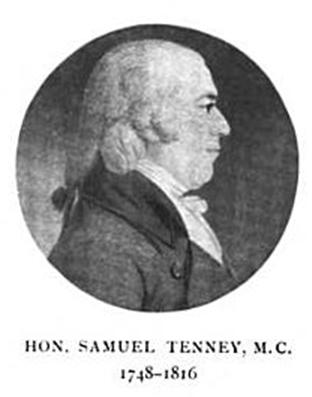
Historical · U.S. House · New Hampshire · At-Large
Samuel Tenney
Former U.S. Representative · New Hampshire At-Large · 1799–1807 · Federalist
Samuel Tenney represented New Hampshire's At-Large in the United States House of Representatives (1799–1807) for the Federalist party. The page below collects sourced biographical facts, term history, committee roles, and provenance for Tenney.
Bioguide ID: T000127
Key facts
- Full name
- Samuel Tenney
- State
- New Hampshire
- District
- At-Large
- Party
- Federalist
- House service
- 1799–1807
- First House term
- 1799
- Status
- Left office
- Current term ends
- —
- Born
- 1748
- Bioguide ID
- T000127
- Committee assignments
- —
- Dataset version
- 1.20260606
Biographical narrative
956 words · sourced from the Wikipedia REST extract
Samuel Tenney was a prominent figure in early American politics, serving as a U.S. Representative from New Hampshire. A member of the Federalist Party, he held office during a formative period in the United States' history, contributing to the legislative process and the establishment of the nation. His career spanned four terms in the House of Representatives, where he engaged in various political and civic activities, reflecting the complexities of governance in the early republic.
Early life and career
Samuel Tenney was born on November 27, 1748, in Byfield, which was part of the Province of Massachusetts Bay. He received his early education at Governor Dummer Academy, a prestigious institution at the time, and later graduated from Harvard College in 1772. Following his graduation, Tenney began his career as an educator, teaching school in Andover, Massachusetts. His academic pursuits were complemented by a study of medicine, which led him to practice as a physician in Exeter, New Hampshire.
During the American Revolutionary War, Tenney served as a surgeon, a role that would significantly shape his life and career. He was involved in the care of wounded soldiers after the Battle of Bunker Hill and served as a Surgeon's Mate with Massachusetts troops for approximately one year. Subsequently, he was appointed as a surgeon, primarily attached to the 1st Rhode Island Regiment. His military service included notable engagements, such as being present at the surrenders of British Generals John Burgoyne and Charles Cornwallis. He also endured the harsh winter at Valley Forge in 1777-1778. His contributions to the military were recognized when he was designated Acting Surgeon General of the Army by General George Washington.
After the war, Tenney returned to Exeter, where he transitioned into a political career alongside his medical practice. He played a role in the state constitutional convention of 1788, which was pivotal in shaping New Hampshire's governance. Additionally, he served as a judge of probate for Rockingham County from 1793 to 1800, further establishing his influence in local governance. His involvement in the medical community was marked by his position as secretary of the New Hampshire Medical Society, where he commissioned Paul Revere to create the first engraving of the society's seal. Tenney also contributed to public discourse on the U.S. Constitution under the pseudonym "Alfredus," engaging in the debates surrounding its design and ratification.
In his personal life, Tenney married Tabitha Gilman in 1788. Tabitha, who was born in Exeter and descended from a prominent New England family, became a notable author in her own right. The couple lived in a home that Tenney commissioned in Exeter, which would later be recognized for its historical significance.
House tenure
Samuel Tenney's congressional career began when he was elected as a Federalist to the 6th U.S. Congress, filling a vacancy created by the resignation of William Gordon. His initial term commenced on December 8, 1800. Over the course of his political career, Tenney was re-elected to serve in the 7th, 8th, and 9th Congresses, with his final term concluding on March 3, 1807. His tenure in the House of Representatives spanned a crucial period in the early years of the United States, characterized by the establishment of federal authority and the development of national policies.
During his time in Congress, Tenney was appointed as the chairman of the Committee on Revisal and Unfinished Business during the 8th and 9th Congresses. This role placed him at the center of legislative discussions and decision-making processes, where he contributed to the refinement and completion of various legislative matters. His work in this capacity underscored his commitment to effective governance and the legislative process.
Tenney's political career was marked by the challenges and complexities of early American governance. The Federalist Party, to which he belonged, was instrumental in shaping the nation's policies during its formative years, advocating for a strong central government and the promotion of commerce and industry. As a representative from New Hampshire, Tenney played a role in advancing the interests of his constituents while navigating the broader political landscape of the time.
Legislative focus and committees
Throughout his congressional tenure, Samuel Tenney's legislative focus reflected the priorities of the Federalist Party and the needs of his constituents in New Hampshire. His role as chairman of the Committee on Revisal and Unfinished Business was significant, as it involved overseeing the progress of legislation and ensuring that pending matters were addressed effectively. This position allowed him to influence the legislative agenda and contribute to the development of policies that aligned with Federalist principles.
While specific legislative initiatives or votes during Tenney's time in office are not detailed, his committee work suggests a commitment to the orderly functioning of Congress and the importance of revisiting and resolving outstanding legislative issues. The early 1800s were a time of significant change in the United States, with debates over federal authority, economic policy, and national identity shaping the political discourse. Tenney's contributions in this context were part of the broader efforts to establish a stable and effective government.
After concluding his service in Congress, Tenney continued to engage in scholarly and civic pursuits. His interests in literature, history, and science remained prominent, reflecting a lifelong commitment to education and public service. He passed away in Exeter on February 6, 1816, leaving behind a legacy intertwined with the early history of the United States and the development of its political institutions.
In summary, Samuel Tenney's life and career encapsulate the experiences of a dedicated public servant during a pivotal era in American history. His contributions as a physician, military surgeon, and U.S. Representative illustrate the multifaceted nature of leadership in the early republic, highlighting the interplay between personal commitment, civic duty, and the evolving landscape of American governance.
Notable legislation
Sponsored and co-sponsored legislation for Samuel Tenney is pending operator curation. The biographical narrative above carries the same provenance trail until per-bill rows are written.
Sources
- [1]https://en.wikipedia.org/wiki/Samuel_TenneyWikipedia · retrieved 2026-06-06
Notable quotes
Sourced quotes for Samuel Tenney are pending operator curation. Narrative-scope provenance remains attached below.
Sources
- [1]https://en.wikipedia.org/wiki/Samuel_TenneyWikipedia · retrieved 2026-06-06
Key positions
Curated policy positions for Samuel Tenney are pending operator review. The biographical narrative above carries the same provenance trail until per-topic positions are written.
Sources
- [1]https://en.wikipedia.org/wiki/Samuel_TenneyWikipedia · retrieved 2026-06-06
Terms served
- 1799–1801U.S. House · Term 1 · Federalist
- 1801–1803U.S. House · Term 2 · Federalist
- 1803–1805U.S. House · Term 3 · Federalist
- 1805–1807U.S. House · Term 4 · Federalist
Sources & provenance
Every attributable claim above carries a per-section [N] marker that resolves to the corresponding URL below. Each entry records the upstream provider, the canonical URL, and the timestamp at which the source was retrieved by the ingest pipeline.
Key facts
- https://bioguide.congress.gov/search/bio/T000127bioguide · retrieved 2026-06-06
- https://www.govtrack.us/congress/members/410709govtrack · retrieved 2026-06-06
Biographical narrative
- https://en.wikipedia.org/wiki/Samuel_Tenneywikipedia · retrieved 2026-06-06
Find your representative
Every U.S. state elects representatives by district. Browse New Hampshire’s delegation, the full former-representative roster, or explore the role and term length.
Related on The Candidate
- Preceded by Jeremiah SmithEarlier holder of the New Hampshire At-Large House seat · Federalist.Open
- Succeeded by Daniel DurellLater holder of the New Hampshire At-Large House seat · Republican.Open
- Alonzo NuteFormer U.S. Representative · New Hampshire District 1 · RepublicanOpen
- Alphonse RoyFormer U.S. Representative · New Hampshire District 1 · DemocraticOpen
- Amos TuckFormer U.S. Representative · New Hampshire District 1 · WhigOpen
- Arthur JenksFormer U.S. Representative · New Hampshire District 1 · RepublicanOpen