
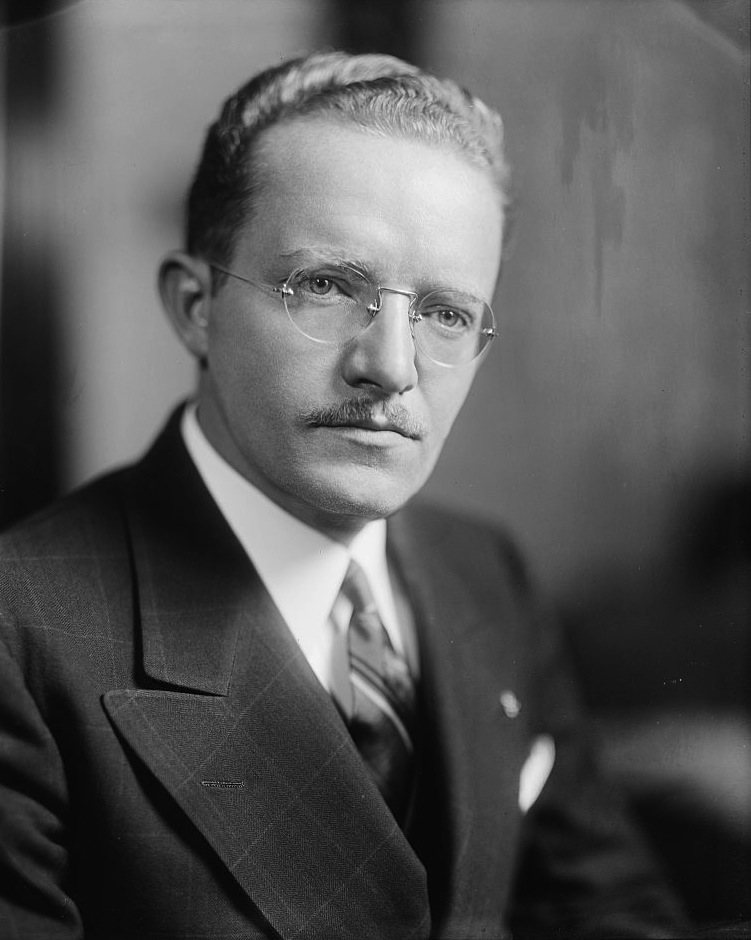
Historical · U.S. House · New Jersey · District 10
Fred Hartley Jr.
Former U.S. Representative · New Jersey District 10 · 1929–1949 · Republican
Fred Hartley Jr. represented New Jersey's District 10 in the United States House of Representatives (1929–1949) for the Republican party. The page below collects sourced biographical facts, term history, committee roles, and provenance for Jr..
Bioguide ID: H000298
Key facts
- Full name
- Fred Hartley Jr.
- State
- New Jersey
- District
- District 10
- Party
- Republican
- House service
- 1929–1949
- First House term
- 1929
- Status
- Left office
- Current term ends
- —
- Born
- 1902
- Bioguide ID
- H000298
- Committee assignments
- —
- Dataset version
- 1.20260605
Biographical narrative
924 words · sourced from the Wikipedia REST extract
Fred Hartley Jr. was an American politician who served as a Republican member of the United States House of Representatives from New Jersey. He represented both the 8th and 10th congressional districts during his ten terms in office, which spanned from 1929 to 1949. Hartley is most notably recognized for his sponsorship of the Taft–Hartley Act in 1947, a significant piece of labor legislation that revised earlier labor laws and aimed to address postwar labor unrest.
Early life and career
Fred Hartley Jr. was born on February 22, 1902, in Harrison, New Jersey. He received his early education in the public schools of Harrison and later attended Rutgers Preparatory School. Following his high school education, Hartley enrolled at Rutgers University, where he completed his studies in 1923. His initial foray into public service began shortly after his graduation when he successfully ran for the position of library commissioner in Kearny, New Jersey. He held this position for two years before being appointed as the police and fire commissioner for the same town, a role he maintained until 1928.
In 1928, Hartley transitioned into a political career by securing the Republican nomination for the United States House of Representatives seat in New Jersey's 8th congressional district. He won the election on November 6, 1928, defeating the incumbent Paul J. Moore in a closely contested race. The election results indicated a narrow victory for Hartley, who garnered 64,915 votes compared to Moore's 64,594, marking a margin of just 0.2%.
Upon taking office on March 4, 1929, Hartley became the youngest member of the 71st United States Congress at the age of 27. His early years in Congress were marked by a series of competitive elections, including a rematch against Moore in 1930, where he again emerged victorious with 50.4% of the vote. Hartley's political career continued to flourish during the challenging economic times of the Great Depression and World War II, as he managed to retain his seat through several elections, including victories against various Democratic challengers.
House tenure
Fred Hartley's tenure in the U.S. House of Representatives spanned two decades, during which he served ten consecutive terms. Initially representing New Jersey's 8th congressional district, he later transitioned to represent the 10th district after its establishment. Throughout his time in office, Hartley was known for his resilience in maintaining his seat amid the political shifts of the era. His electoral successes included defeating opponents such as William W. Harrison in 1932 and William Herda Smith in 1934, as well as a close victory against Lindsay H. Rudd in 1936, where he won with a narrow margin of 50.2% to 49.6%.
Hartley continued to secure re-election in subsequent years, defeating Rudd again in 1938 and successfully fending off challenges from candidates like William W. Holmwood in 1940, Frederic Bigelow in 1942, Luke A. Kiernan Jr. in 1944, and Peter W. Rodino Jr. in 1946. His ability to navigate the political landscape during these tumultuous times was indicative of his political acumen and the support he garnered from his constituents.
In 1946, following a shift in the political landscape, the Republican Party regained a majority in both houses of Congress for the first time since Hartley's initial election. This change allowed him to take on a leadership role as the chairman of the Committee on Education and Labor during the 80th United States Congress. His position enabled him to influence significant labor legislation, culminating in the introduction of the Taft–Hartley Act in 1947, which aimed to address labor unrest and revise aspects of the National Labor Relations Act.
Legislative focus and committees
Throughout his congressional career, Fred Hartley Jr. was particularly focused on labor issues, which became increasingly prominent in the post-World War II era. His concerns about labor unrest and its potential impact on economic and political stability led him to collaborate with Senator Robert A. Taft to draft the Taft–Hartley Act. This legislation represented a major revision of the Wagner Act of 1935 and sought to impose limitations on certain labor practices, including secondary boycotts. One of the most contentious aspects of the act was Section 14(b), which allowed states to enact right-to-work laws.
Despite facing opposition, including a veto from President Harry S. Truman, the Taft–Hartley Act was ultimately enacted after Congress successfully overrode the veto on June 23, 1947. The act's passage marked a significant moment in labor relations in the United States and has remained a point of contention in labor politics. Many labor unions have consistently advocated for its repeal, particularly the controversial provisions that allow states to restrict union membership requirements.
Hartley's legislative contributions extended beyond labor issues, as he participated in various committees and discussions that shaped national policies during his time in office. His leadership role in the Committee on Education and Labor positioned him at the forefront of key debates surrounding education, labor rights, and economic policies.
After the passage of the Taft–Hartley Act, Hartley chose not to seek re-election, concluding his congressional service on January 3, 1949. Following his departure from Congress, he made an unsuccessful bid for a New Jersey senatorial seat in 1954. Hartley then returned to New Jersey, where he worked as a business consultant until his death on May 11, 1969. He was buried in Fairmount Cemetery in Newark, New Jersey. Hartley's legacy in American politics is closely tied to the Taft–Hartley Act, which continues to influence labor relations in the United States. His son, Al Hartley, gained recognition as a cartoonist, particularly known for his work with Archie Comics.
Notable legislation
Sponsored and co-sponsored legislation for Fred Hartley Jr. is pending operator curation. The biographical narrative above carries the same provenance trail until per-bill rows are written.
Sources
- [1]https://en.wikipedia.org/wiki/Fred_A._Hartley_Jr.Wikipedia · retrieved 2026-06-05
Notable quotes
Sourced quotes for Fred Hartley Jr. are pending operator curation. Narrative-scope provenance remains attached below.
Sources
- [1]https://en.wikipedia.org/wiki/Fred_A._Hartley_Jr.Wikipedia · retrieved 2026-06-05
Key positions
Curated policy positions for Fred Hartley Jr. are pending operator review. The biographical narrative above carries the same provenance trail until per-topic positions are written.
Sources
- [1]https://en.wikipedia.org/wiki/Fred_A._Hartley_Jr.Wikipedia · retrieved 2026-06-05
Terms served
- 1929–1931U.S. House · Term 1 · Republican
- 1931–1933U.S. House · Term 2 · Republican
- 1933–1935U.S. House · Term 3 · Republican
- 1935–1937U.S. House · Term 4 · Republican
- 1937–1939U.S. House · Term 5 · Republican
- 1939–1941U.S. House · Term 6 · Republican
- 1941–1943U.S. House · Term 7 · Republican
- 1943–1945U.S. House · Term 8 · Republican
- 1945–1947U.S. House · Term 9 · Republican
- 1947–1949U.S. House · Term 10 · Republican
Sources & provenance
Every attributable claim above carries a per-section [N] marker that resolves to the corresponding URL below. Each entry records the upstream provider, the canonical URL, and the timestamp at which the source was retrieved by the ingest pipeline.
Key facts
- https://bioguide.congress.gov/search/bio/H000298bioguide · retrieved 2026-06-05
- https://www.govtrack.us/congress/members/405171govtrack · retrieved 2026-06-05
Biographical narrative
- https://en.wikipedia.org/wiki/Fred_A._Hartley_Jr.wikipedia · retrieved 2026-06-05
Find your representative
Every U.S. state elects representatives by district. Browse New Jersey’s delegation, the full former-representative roster, or explore the role and term length.
Related on The Candidate
- Preceded by Edward TownsendEarlier holder of the New Jersey District 10 House seat · Democratic.Open
- Succeeded by Peter Rodino Jr.Later holder of the New Jersey District 10 House seat · Democratic.Open
- Andrew HayFormer U.S. Representative · New Jersey District 1 · WhigOpen
- Charles WolvertonFormer U.S. Representative · New Jersey District 1 · RepublicanOpen
- Christopher BergenFormer U.S. Representative · New Jersey District 1 · RepublicanOpen
- Clement SinnicksonFormer U.S. Representative · New Jersey District 1 · RepublicanOpen