
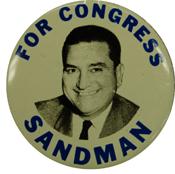
Historical · U.S. House · New Jersey · District 2
Charles Sandman Jr.
Former U.S. Representative · New Jersey District 2 · 1967–1975 · Republican
Charles Sandman Jr. represented New Jersey's District 2 in the United States House of Representatives (1967–1975) for the Republican party. The page below collects sourced biographical facts, term history, committee roles, and provenance for Jr..
Bioguide ID: S000045
Key facts
- Full name
- Charles Sandman Jr.
- State
- New Jersey
- District
- District 2
- Party
- Republican
- House service
- 1967–1975
- First House term
- 1967
- Status
- Left office
- Current term ends
- —
- Born
- 1921
- Bioguide ID
- S000045
- Committee assignments
- —
- Dataset version
- 1.20260605
Biographical narrative
895 words · sourced from the Wikipedia REST extract
Charles W. Sandman Jr. was an American politician who served as a U.S. Representative for New Jersey's 2nd congressional district from 1967 to 1975. A member of the Republican Party, Sandman had a diverse political career that included serving in the New Jersey Senate and running for governor multiple times. His tenure in the U.S. House of Representatives was marked by significant events, including his involvement in the impeachment proceedings against President Richard Nixon. Sandman’s political legacy continues to be recognized in New Jersey, where he is remembered for his contributions to state and national politics.
Early life and career
Charles William Sandman Jr. was born on October 23, 1921, in Philadelphia, Pennsylvania. He completed his early education at Cape May High School before pursuing higher education. Sandman earned a bachelor's degree from Temple University in Philadelphia and subsequently obtained a law degree from Rutgers School of Law–Newark. His academic background laid the foundation for his future career in law and politics.
During World War II, Sandman served in the United States Army Air Corps as a navigator. His military service took a dramatic turn when he was shot down and spent seven months as a prisoner of war in Germany. This experience likely shaped his views and commitment to public service.
After the war, Sandman returned to New Jersey, where he began his legal career. He established a law practice in Cape May Court House, New Jersey, and became involved in local politics. His political career began in earnest when he was elected to the New Jersey Senate in 1954, representing Cape May County. Sandman was re-elected to the Senate in 1958 and 1962, serving a total of three four-year terms. During his time in the New Jersey Senate, he held the position of Majority Leader in 1964 and 1965, demonstrating his leadership within the Republican Party.
In addition to his legislative work, Sandman was active in national politics as a delegate to the Republican National Conventions in 1956, 1960, 1964, and 1968. His involvement in these conventions highlighted his commitment to the Republican Party and its platform.
Sandman’s personal life included his marriage to Marion L. Cooney, with whom he had six children. His family continued his legacy in the legal profession, as several of his sons established a law practice in Cape May Court House.
House tenure
Sandman transitioned to federal politics when he successfully ran for the U.S. House of Representatives in 1966, while still serving in the New Jersey Senate. Upon winning the election, he resigned from his state position to assume his role in Congress. His first term in the House began in January 1967, and he would go on to serve a total of four terms until January 3, 1975.
During his time in the House, Sandman was a member of the House Judiciary Committee, which played a crucial role during the impeachment proceedings against President Richard Nixon. Initially, he was a staunch defender of Nixon, arguing against the allegations brought forth during the hearings. However, following the release of the "smoking gun" transcript, Sandman changed his stance and announced his intention to vote for impeachment, a decision that reflected the gravity of the evidence presented.
Sandman's tenure in Congress was not without challenges. The political climate during the early 1970s was tumultuous, particularly due to the Watergate scandal, which significantly impacted the Republican Party. In the 1974 elections, Sandman faced a difficult re-election campaign and was ultimately defeated by Democrat William J. Hughes. This defeat was indicative of the broader challenges faced by Republicans during this period, as the party struggled to maintain its influence in the wake of the scandal.
Legislative focus and committees
Throughout his congressional career, Sandman was involved in various legislative initiatives and committee activities. His role on the House Judiciary Committee was particularly notable, as it placed him at the center of one of the most significant political events of the era: the impeachment of President Nixon. Sandman's initial defense of Nixon and subsequent shift in position highlighted the complexities of political loyalty and accountability during a time of national crisis.
In addition to his work on the Judiciary Committee, Sandman was engaged in issues relevant to his constituents in southern New Jersey. His legislative focus included matters pertinent to his district, such as economic development, infrastructure, and local governance. Sandman's background in law likely informed his approach to legislative issues, as he sought to balance the interests of his constituents with the broader goals of the Republican Party.
After leaving Congress, Sandman was approached by Vice President Nelson Rockefeller to join the Ford administration in various capacities, including a potential ambassadorship. However, he declined these offers and instead accepted an appointment to the bench of the Superior Court of New Jersey from Governor Thomas Kean. This transition from legislator to judge marked a significant shift in Sandman's career, allowing him to continue serving the public in a different capacity.
Sandman's political legacy is reflected in various ways, including the renaming of a school in Lower Township to honor his contributions to the community. His involvement in state and national politics, along with his commitment to public service, left an enduring impact on New Jersey's political landscape. Charles W. Sandman Jr. passed away on August 26, 1985, but his contributions to American politics continue to be recognized and remembered.
Notable legislation
Sponsored and co-sponsored legislation for Charles Sandman Jr. is pending operator curation. The biographical narrative above carries the same provenance trail until per-bill rows are written.
Sources
- [1]https://en.wikipedia.org/wiki/Charles_W._Sandman_Jr.Wikipedia · retrieved 2026-06-05
Notable quotes
Sourced quotes for Charles Sandman Jr. are pending operator curation. Narrative-scope provenance remains attached below.
Sources
- [1]https://en.wikipedia.org/wiki/Charles_W._Sandman_Jr.Wikipedia · retrieved 2026-06-05
Key positions
Curated policy positions for Charles Sandman Jr. are pending operator review. The biographical narrative above carries the same provenance trail until per-topic positions are written.
Sources
- [1]https://en.wikipedia.org/wiki/Charles_W._Sandman_Jr.Wikipedia · retrieved 2026-06-05
Terms served
- 1967–1969U.S. House · Term 1 · Republican
- 1969–1971U.S. House · Term 2 · Republican
- 1971–1973U.S. House · Term 3 · Republican
- 1973–1975U.S. House · Term 4 · Republican
Sources & provenance
Every attributable claim above carries a per-section [N] marker that resolves to the corresponding URL below. Each entry records the upstream provider, the canonical URL, and the timestamp at which the source was retrieved by the ingest pipeline.
Key facts
- https://bioguide.congress.gov/search/bio/S000045bioguide · retrieved 2026-06-05
- https://www.govtrack.us/congress/members/409560govtrack · retrieved 2026-06-05
Biographical narrative
- https://en.wikipedia.org/wiki/Charles_W._Sandman_Jr.wikipedia · retrieved 2026-06-05
Find your representative
Every U.S. state elects representatives by district. Browse New Jersey’s delegation, the full former-representative roster, or explore the role and term length.
Related on The Candidate
- Preceded by Thomas McGrath Jr.Earlier holder of the New Jersey District 2 House seat · Democratic.Open
- Succeeded by William HughesLater holder of the New Jersey District 2 House seat · Democratic.Open
- Andrew HayFormer U.S. Representative · New Jersey District 1 · WhigOpen
- Charles WolvertonFormer U.S. Representative · New Jersey District 1 · RepublicanOpen
- Christopher BergenFormer U.S. Representative · New Jersey District 1 · RepublicanOpen
- Clement SinnicksonFormer U.S. Representative · New Jersey District 1 · RepublicanOpen