
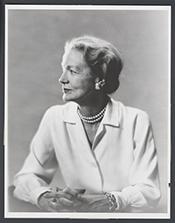
Historical · U.S. House · New Jersey · District 5
Millicent Fenwick
Former U.S. Representative · New Jersey District 5 · 1975–1983 · Republican
Millicent Fenwick represented New Jersey's District 5 in the United States House of Representatives (1975–1983) for the Republican party. The page below collects sourced biographical facts, term history, committee roles, and provenance for Fenwick.
Bioguide ID: F000078
Key facts
- Full name
- Millicent Fenwick
- State
- New Jersey
- District
- District 5
- Party
- Republican
- House service
- 1975–1983
- First House term
- 1975
- Status
- Left office
- Current term ends
- —
- Born
- 1910
- Bioguide ID
- F000078
- Committee assignments
- —
- Dataset version
- 1.20260605
Biographical narrative
961 words · sourced from the Wikipedia REST extract
Millicent H. Fenwick was an American politician and diplomat who served as a U.S. Representative for New Jersey's 5th congressional district from 1975 until 1983. A member of the Republican Party, Fenwick was known for her moderate and progressive stances within the party, particularly her advocacy for civil rights and women's issues. Before her tenure in Congress, she held various positions in local and state government, including a term in the New Jersey General Assembly. Following her time in the House of Representatives, she served as the first United States Ambassador to the United Nations Agencies for Food and Agriculture from 1983 to 1987.
Early life and career
Millicent Vernon Hammond was born on February 25, 1910, in New York City to Ogden H. Hammond and Mary Picton Stevens. Her father was a Yale graduate who worked as an insurance and real estate broker and was involved in local Republican politics in Bernardsville, New Jersey. Her mother hailed from a prominent family in Hoboken, New Jersey, and was a great-granddaughter of Edwin Augustus Stevens, the founder of Stevens Institute of Technology. Millicent was the second of three children, growing up in a large mansion in Bernardsville.
Tragedy struck the family when Millicent was just five years old; her mother died in the sinking of the RMS Lusitania during World War I. This event profoundly affected her father, who did not discuss his wife's death for the remainder of his life. In 1917, Ogden Hammond remarried, but Millicent reportedly had a strained relationship with her stepmother, which led her to form a close bond with her siblings instead.
Millicent's education began at the exclusive Nightingale-Bamford School in Manhattan, followed by Foxcroft School in Virginia. However, she left Foxcroft in 1925 when her father was appointed as the United States ambassador to Spain, and she did not complete her high school education. She later attended Barnard College and The New School for Social Research, where she studied philosophy under the renowned philosopher Bertrand Russell.
In 1929, Millicent met Hugh McLeod Fenwick, an aviation businessman. Their relationship began while he was still married, leading to a controversial extramarital affair that resulted in his divorce. Despite familial disapproval, they married in 1932 and had two children, Mary and Hugo. However, the marriage faced challenges, and they separated after the birth of their son, ultimately divorcing in 1945. Following her divorce, Millicent focused on raising her children and supporting her family.
To sustain herself financially, Fenwick briefly worked as a model for Harper's Bazaar and later as a caption editor for Vogue magazine, where she remained until 1948. She also compiled "Vogue's Book of Etiquette," which became a bestseller. By 1952, she retired from her career in fashion, as her children were older, and she could rely on her inheritance and trust accounts.
House tenure
Millicent Fenwick's political career began in earnest during the 1950s when she became actively involved in civil rights advocacy. She volunteered for various organizations, including the NAACP and local political candidates, and served on the New Jersey Committee of the United States Commission on Civil Rights from 1958 to 1974. Her political involvement led her to be elected to the Bernardsville borough council in 1957, making her the first woman to hold that position. She served on the council until 1964.
In 1969, Fenwick was elected to the New Jersey General Assembly, where she served from 1970 to 1972. During her time in the Assembly, she focused on improving working conditions for migrant laborers, advocating for better facilities in labor camps. Her commitment to social issues and her growing political influence set the stage for her future endeavors.
In 1974, Fenwick ran for the U.S. House of Representatives, successfully winning her seat in New Jersey's 5th congressional district. She took office in 1975 and served four consecutive terms until her departure from Congress in 1983. Throughout her tenure, she was recognized for her moderate and progressive positions, often championing civil rights and women's issues, which resonated with her constituents.
Legislative focus and committees
During her time in the House of Representatives, Millicent Fenwick served on various committees and was involved in a wide range of legislative issues. She was known for her advocacy on civil rights, women's rights, and social justice, aligning with her long-standing commitment to these causes. Her legislative work reflected her belief in the importance of equality and fairness for all individuals.
Fenwick's moderate stance within the Republican Party allowed her to work across party lines, fostering collaboration on key issues. She was regarded as a voice of reason and was often seen as a bridge between more conservative and liberal factions within Congress. Her approach to governance emphasized the need for dialogue and cooperation, which was particularly important during a time of significant political polarization.
In addition to her legislative work, Fenwick's role on various committees allowed her to influence policy in areas such as education, health, and social welfare. Her dedication to improving the lives of her constituents and advocating for underrepresented groups was a hallmark of her time in office.
After leaving Congress in 1983, Fenwick continued her public service as the first United States Ambassador to the United Nations Agencies for Food and Agriculture, a position she held until 1987. In this role, she focused on global food security and agricultural issues, further demonstrating her commitment to public service and humanitarian efforts.
Millicent H. Fenwick's career in politics and public service left a lasting impact on her community and the nation. Her advocacy for civil rights and her moderate approach to governance were significant contributions to the political landscape of her time. Fenwick passed away on September 16, 1992, leaving behind a legacy of dedication to public service and social justice.
Notable legislation
Sponsored and co-sponsored legislation for Millicent Fenwick is pending operator curation. The biographical narrative above carries the same provenance trail until per-bill rows are written.
Sources
- [1]https://en.wikipedia.org/wiki/Millicent_FenwickWikipedia · retrieved 2026-06-05
Notable quotes
Sourced quotes for Millicent Fenwick are pending operator curation. Narrative-scope provenance remains attached below.
Sources
- [1]https://en.wikipedia.org/wiki/Millicent_FenwickWikipedia · retrieved 2026-06-05
Key positions
Curated policy positions for Millicent Fenwick are pending operator review. The biographical narrative above carries the same provenance trail until per-topic positions are written.
Sources
- [1]https://en.wikipedia.org/wiki/Millicent_FenwickWikipedia · retrieved 2026-06-05
Terms served
- 1975–1977U.S. House · Term 1 · Republican
- 1977–1979U.S. House · Term 2 · Republican
- 1979–1981U.S. House · Term 3 · Republican
- 1981–1983U.S. House · Term 4 · Republican
Sources & provenance
Every attributable claim above carries a per-section [N] marker that resolves to the corresponding URL below. Each entry records the upstream provider, the canonical URL, and the timestamp at which the source was retrieved by the ingest pipeline.
Key facts
- https://bioguide.congress.gov/search/bio/F000078bioguide · retrieved 2026-06-05
- https://www.govtrack.us/congress/members/404036govtrack · retrieved 2026-06-05
Biographical narrative
- https://en.wikipedia.org/wiki/Millicent_Fenwickwikipedia · retrieved 2026-06-05
Find your representative
Every U.S. state elects representatives by district. Browse New Jersey’s delegation, the full former-representative roster, or explore the role and term length.
Related on The Candidate
- Preceded by Peter Frelinghuysen Jr.Earlier holder of the New Jersey District 5 House seat · Republican.Open
- Succeeded by Scott GarrettLater holder of the New Jersey District 5 House seat · Republican.Open
- Andrew HayFormer U.S. Representative · New Jersey District 1 · WhigOpen
- Charles WolvertonFormer U.S. Representative · New Jersey District 1 · RepublicanOpen
- Christopher BergenFormer U.S. Representative · New Jersey District 1 · RepublicanOpen
- Clement SinnicksonFormer U.S. Representative · New Jersey District 1 · RepublicanOpen