
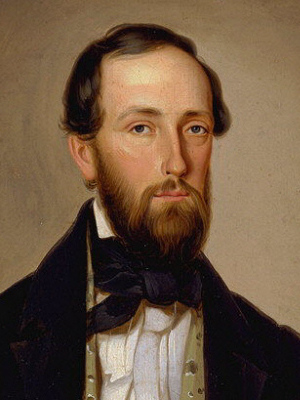
Historical · U.S. House · New Jersey · District 5
Rodman Price
Former U.S. Representative · New Jersey District 5 · 1851–1853 · Democratic
Rodman Price represented New Jersey's District 5 in the United States House of Representatives (1851–1853) for the Democratic party. The page below collects sourced biographical facts, term history, committee roles, and provenance for Price.
Bioguide ID: P000529
Key facts
- Full name
- Rodman Price
- State
- New Jersey
- District
- District 5
- Party
- Democratic
- House service
- 1851–1853
- First House term
- 1851
- Status
- Left office
- Current term ends
- —
- Born
- 1816
- Bioguide ID
- P000529
- Committee assignments
- —
- Dataset version
- 1.20260606
Biographical narrative
956 words · sourced from the Wikipedia REST extract
Rodman McCamley Price was an American politician and naval officer who served as a U.S. Representative for New Jersey's fifth congressional district from 1851 to 1853. A member of the Democratic Party, Price's political career was preceded by significant involvement in the U.S. Navy and the California gold rush. He later became the 17th Governor of New Jersey, holding office from 1854 to 1857. Price's life was marked by his transition from military service to business and politics, reflecting the dynamic changes in American society during the mid-19th century.
Early life and career
Rodman McCamley Price was born on May 5, 1816, in Newton, New Jersey. He came from a family with a history of military service, as both his grandfather and great-uncle served as quartermasters in the Continental Army and later became merchants. Price received his early education in the public schools of New York City and attended the Lawrenceville Academy. He pursued classical studies at The College of New Jersey, now known as Princeton University, but did not complete his degree due to health issues. Although he studied law, he never practiced as an attorney, opting instead to enter the commission business in New York.
In 1840, leveraging family connections to the administration of President Martin Van Buren, Price secured an appointment as a purser in the United States Navy. His early naval career involved assignments during peacetime, where he served aboard the USS Fulton and the USS Missouri. Notably, in July 1843, Price was part of the crew of the Missouri, which became one of the first steam warships to cross the Atlantic Ocean. Unfortunately, the Missouri was wrecked off the coast of Gibraltar, leading Price to spend time as a guest of the British Consul before he toured parts of Europe, including Spain and France.
Upon returning to duty, Price joined the USS Cyane, which was part of the Pacific Squadron under Commodore John D. Sloat. As purser, he was responsible for overseeing payrolls and occasionally made landfall in various ports to provision and negotiate with local merchants. His naval service coincided with the onset of the Mexican-American War, during which the Cyane played a role in the seizure of Monterey, California. Following this event, Price was appointed as prefect and alcalde in Monterey, where he oversaw the military administration and engaged in land title recording, which allowed him to capitalize on the land rush that followed the American annexation of California.
House tenure
After his time in California, Price returned to New York and secured a position as purser for the Pacific Squadron, relocating to San Francisco. The California gold rush significantly impacted his financial situation, as he became involved in real estate and local politics. Price was elected to the first Common Council of San Francisco and was an advocate for the city's Long Wharf project. However, his tenure in the Navy came to an end when he was detached from the Pacific Squadron due to financial irregularities.
In 1850, Price returned to New Jersey, where he purchased a mansion in Hoboken and entered into a partnership on Wall Street to manage his California investments. His political career gained momentum when he was nominated for the U.S. House of Representatives from New Jersey's fifth congressional district, a region that included Bergen, Essex, Hudson, and Passaic counties. His nomination was facilitated by his father and Robert Field Stockton, who had previously known Price during his time as military governor of California. The political landscape at the time was marked by divisions within the Whig Party, which allowed Price to secure a narrow victory in a district that was typically dominated by Whig candidates.
Price served one term in the House of Representatives from 1851 to 1853. His time in office was characterized by a lack of significant legislative activity; he was not an active member and focused primarily on his real estate interests and constituent services. Price participated in only one notable debate, where he spoke in favor of recodifying martial law aboard Navy vessels. He argued for the need to reform the punishment system at sea, advocating for summary courts-martial to have authority over captains' disciplinary actions. After losing his bid for re-election in 1852, Price returned to his property interests and business ventures.
Legislative focus and committees
During his brief tenure in the U.S. House of Representatives, Price's legislative focus was largely overshadowed by his interests in California real estate and his previous naval career. His participation in the House was limited, and he did not serve on any significant committees that would have allowed him to influence major legislation. The primary issue he addressed during his time in office was related to military law aboard naval vessels, reflecting his background and experience in the Navy.
Price's lack of engagement in broader legislative matters may have been influenced by the political climate of the time, as well as his personal focus on business opportunities. His one term in Congress was marked by a period of transition in American politics, particularly with the shifting allegiances and divisions within parties. After his defeat in the 1852 election, Price shifted his attention back to his business pursuits, which included managing his real estate holdings and engaging in various financial ventures.
Following his congressional career, Price's political ambitions did not wane. He was later recruited to run for governor of New Jersey on the Democratic ticket, a position he held from 1854 to 1857. His subsequent political career further demonstrated his ability to navigate the complexities of American politics during a time of significant change and upheaval. Price's life and career reflect the multifaceted nature of American society in the mid-19th century, encompassing military service, business acumen, and political engagement.
Notable legislation
Sponsored and co-sponsored legislation for Rodman Price is pending operator curation. The biographical narrative above carries the same provenance trail until per-bill rows are written.
Sources
- [1]https://en.wikipedia.org/wiki/Rodman_M._PriceWikipedia · retrieved 2026-06-06
Notable quotes
Sourced quotes for Rodman Price are pending operator curation. Narrative-scope provenance remains attached below.
Sources
- [1]https://en.wikipedia.org/wiki/Rodman_M._PriceWikipedia · retrieved 2026-06-06
Key positions
Curated policy positions for Rodman Price are pending operator review. The biographical narrative above carries the same provenance trail until per-topic positions are written.
Sources
- [1]https://en.wikipedia.org/wiki/Rodman_M._PriceWikipedia · retrieved 2026-06-06
Terms served
- 1851–1853U.S. House · Term 1 · Democratic
Sources & provenance
Every attributable claim above carries a per-section [N] marker that resolves to the corresponding URL below. Each entry records the upstream provider, the canonical URL, and the timestamp at which the source was retrieved by the ingest pipeline.
Key facts
- https://bioguide.congress.gov/search/bio/P000529bioguide · retrieved 2026-06-06
- https://www.govtrack.us/congress/members/408913govtrack · retrieved 2026-06-06
Biographical narrative
- https://en.wikipedia.org/wiki/Rodman_M._Pricewikipedia · retrieved 2026-06-06
Find your representative
Every U.S. state elects representatives by district. Browse New Jersey’s delegation, the full former-representative roster, or explore the role and term length.
Related on The Candidate
- Preceded by James KingEarlier holder of the New Jersey District 5 House seat · Whig.Open
- Succeeded by Alexander PenningtonLater holder of the New Jersey District 5 House seat · Ind. Republican-Democrat.Open
- Andrew HayFormer U.S. Representative · New Jersey District 1 · WhigOpen
- Charles WolvertonFormer U.S. Representative · New Jersey District 1 · RepublicanOpen
- Christopher BergenFormer U.S. Representative · New Jersey District 1 · RepublicanOpen
- Clement SinnicksonFormer U.S. Representative · New Jersey District 1 · RepublicanOpen