
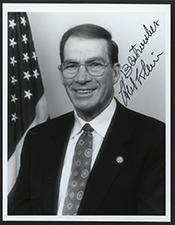
Historical · U.S. House · New Jersey · District 8
Herbert Klein
Former U.S. Representative · New Jersey District 8 · 1993–1995 · Democratic
Herbert Klein represented New Jersey's District 8 in the United States House of Representatives (1993–1995) for the Democratic party. The page below collects sourced biographical facts, term history, committee roles, and provenance for Klein.
Bioguide ID: K000262
Key facts
- Full name
- Herbert Klein
- State
- New Jersey
- District
- District 8
- Party
- Democratic
- House service
- 1993–1995
- First House term
- 1993
- Status
- Left office
- Current term ends
- —
- Born
- 1930
- Bioguide ID
- K000262
- Committee assignments
- —
- Dataset version
- 1.20260605
Biographical narrative
911 words · sourced from the Wikipedia REST extract
Herbert C. Klein was an American businessman, attorney, and politician who served as a U.S. Representative for New Jersey's 8th congressional district from 1993 to 1995. A member of the Democratic Party, Klein's political career was marked by his involvement in various legislative initiatives, particularly in the areas of banking and science. Before his tenure in Congress, he held positions in state politics and had a successful career in law and business.
Early life and career
Herbert C. Klein was born on June 24, 1930, in Newark, New Jersey. He was the son of Fae Sackin and Alfred Klein, an accountant. Klein's family had Jewish roots, with his parents being emigrants from Hungary and Russia. His educational journey began at Rutgers University, where he earned a Bachelor of Arts degree in 1950. He furthered his education by obtaining a Juris Doctor degree from Harvard Law School in 1952, followed by a Master of Laws from New York University in 1958.
Klein's service in the United States Air Force from 1954 to 1956 included an assignment at Wright-Patterson Air Force Base, located near Dayton, Ohio. After being admitted to the bar in 1953, he began practicing law in Passaic, New Jersey. In 1961, he founded the First Real Estate Investment Trust of New Jersey, marking the beginning of his significant involvement in the real estate sector.
Klein's political career commenced in the early 1970s when he successfully defeated incumbent Joseph Scancarella to become a member of the New Jersey General Assembly. He served in the Assembly from 1972 to 1976, during which he authored the legislation that established the New Jersey Economic Development Authority. Additionally, he played a role as co-counsel on a bond issue for the New Jersey Sports and Exposition Authority and was involved in the introduction of the state income tax. Following his time in the Assembly, Klein served as Executive Director of the Passaic County Democratic Committee from 1977 to 1981.
In 1992, Klein was elected as a Democrat to the 103rd United States Congress, succeeding the retiring eleven-term incumbent Robert Roe. His election came during a period when the Democratic Party held a strong presence in New Jersey's 8th district.
House tenure
Klein's tenure in the United States House of Representatives began in 1993 and lasted until January 3, 1995. During this time, he was an active member of the House Banking Committee, where he took on a leadership role and was instrumental in several legislative initiatives. Among his notable contributions was his involvement in the co-authorship of bills that authorized interstate branch banking. He also played a pivotal role in crafting provisions that addressed the challenges faced by the savings and loan industry, contributing to the passage of legislation aimed at resolving those issues.
In addition to his work on the Banking Committee, Klein served on the House Science Committee. His efforts in this capacity included co-authoring the National Competitiveness Act, legislation designed to enhance the strength and competitiveness of American industry. Klein's legislative focus reflected his commitment to addressing economic and industry-related challenges facing the nation.
Despite his contributions, Klein faced electoral challenges during the 1994 Congressional Elections. He was defeated for re-election by Bill Martini, a Clifton city councilman and Passaic County freeholder. This loss was part of a broader trend in which a significant number of Democrats lost their seats during that election cycle.
Legislative focus and committees
Throughout his time in Congress, Klein's legislative focus was primarily centered on banking and economic development. His leadership on the House Banking Committee allowed him to influence key policies related to the financial sector. The bills he co-authored that authorized interstate branch banking were significant in modernizing the banking industry and facilitating greater competition among financial institutions.
Klein's work on the House Science Committee further underscored his commitment to fostering innovation and competitiveness in American industries. The National Competitiveness Act, which he co-authored, aimed to bolster the nation's industrial capabilities, reflecting his understanding of the importance of a strong economic foundation for the country.
In addition to his legislative responsibilities, Klein maintained a robust professional background in business and law. He achieved notable success in the legal field, obtaining one of the largest civil verdicts for a plaintiff in New Jersey in the case of Laganella v. Braen. His extensive experience in both business and law provided him with a unique perspective that informed his legislative priorities.
Klein's affiliations extended beyond his congressional duties. He served continuously as a Trustee of the First Real Estate Investment Trust of New Jersey from its founding in 1961, taking on the role of President from 1991 to 1993. His involvement in various philanthropic and educational organizations included serving on the Board of Trustees of Rutgers University and as President of the Board of Trustees of Beth Israel Hospital. Additionally, he participated in several committees and boards related to economic development and the arts, reflecting his commitment to community engagement and public service.
Herbert C. Klein passed away on November 24, 2023, at the age of 93. His contributions to public service, law, and business left a lasting impact on his community and the state of New Jersey. Following his death, the United States House of Representatives held a moment of silence in his honor, recognizing his service and dedication to the public. Klein's legacy is marked by his commitment to legislative initiatives that aimed to strengthen the economy and improve the lives of his constituents.
Notable legislation
Sponsored and co-sponsored legislation for Herbert Klein is pending operator curation. The biographical narrative above carries the same provenance trail until per-bill rows are written.
Sources
- [1]https://en.wikipedia.org/wiki/Herb_Klein_(politician)Wikipedia · retrieved 2026-06-05
Notable quotes
Sourced quotes for Herbert Klein are pending operator curation. Narrative-scope provenance remains attached below.
Sources
- [1]https://en.wikipedia.org/wiki/Herb_Klein_(politician)Wikipedia · retrieved 2026-06-05
Key positions
Curated policy positions for Herbert Klein are pending operator review. The biographical narrative above carries the same provenance trail until per-topic positions are written.
Sources
- [1]https://en.wikipedia.org/wiki/Herb_Klein_(politician)Wikipedia · retrieved 2026-06-05
Terms served
- 1993–1995U.S. House · Term 1 · Democratic
Sources & provenance
Every attributable claim above carries a per-section [N] marker that resolves to the corresponding URL below. Each entry records the upstream provider, the canonical URL, and the timestamp at which the source was retrieved by the ingest pipeline.
Key facts
- https://bioguide.congress.gov/search/bio/K000262bioguide · retrieved 2026-06-05
- https://www.govtrack.us/congress/members/406420govtrack · retrieved 2026-06-05
Biographical narrative
- https://en.wikipedia.org/wiki/Herb_Klein_(politician)wikipedia · retrieved 2026-06-05
Find your representative
Every U.S. state elects representatives by district. Browse New Jersey’s delegation, the full former-representative roster, or explore the role and term length.
Related on The Candidate
- Preceded by Robert RoeEarlier holder of the New Jersey District 8 House seat · Democratic.Open
- Succeeded by William MartiniLater holder of the New Jersey District 8 House seat · Republican.Open
- Andrew HayFormer U.S. Representative · New Jersey District 1 · WhigOpen
- Charles WolvertonFormer U.S. Representative · New Jersey District 1 · RepublicanOpen
- Christopher BergenFormer U.S. Representative · New Jersey District 1 · RepublicanOpen
- Clement SinnicksonFormer U.S. Representative · New Jersey District 1 · RepublicanOpen