
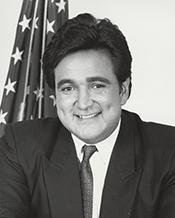
Historical · U.S. House · New Mexico · District 3
William Richardson
Former U.S. Representative · New Mexico District 3 · 1983–1997 · Democratic
William Richardson represented New Mexico's District 3 in the United States House of Representatives (1983–1997) for the Democratic party. The page below collects sourced biographical facts, term history, committee roles, and provenance for Richardson.
Bioguide ID: R000229
Key facts
- Full name
- William Richardson
- State
- New Mexico
- District
- District 3
- Party
- Democratic
- House service
- 1983–1997
- First House term
- 1983
- Status
- Left office
- Current term ends
- —
- Born
- 1947
- Bioguide ID
- R000229
- Committee assignments
- —
- Dataset version
- 1.20260605
Biographical narrative
890 words · sourced from the Wikipedia REST extract
William Blaine Richardson III was an American politician who served as a U.S. Representative for New Mexico's 3rd congressional district from 1983 until 1997. A member of the Democratic Party, Richardson's political career spanned several decades and included notable roles such as U.S. ambassador to the United Nations and Secretary of Energy during the Clinton administration. He also held the position of governor of New Mexico from 2003 to 2011. Richardson's legislative work in Congress focused on issues pertinent to Native American affairs and international relations, reflecting his diverse background and extensive experience in diplomacy.
Early life and career
William Blaine Richardson III was born on November 15, 1947, in Pasadena, California. He spent his early childhood in Coyoacán, a borough in Mexico City, where he was raised in a bilingual environment. His father, William Blaine Richardson Jr., was an American bank executive of Anglo-American and Mexican descent, while his mother, María Luisa López-Collada Márquez, was a Mexican national with Spanish ancestry. The family background provided Richardson with a unique perspective on cultural and political issues, which would later inform his career in public service.
At the age of 13, Richardson was sent to the United States to attend the Middlesex School, a preparatory institution in Concord, Massachusetts. During his time there, he developed an interest in baseball, playing as a pitcher. He subsequently enrolled at Tufts University in 1966, where he continued to pursue his passion for the sport while majoring in French and political science. Richardson's collegiate experience included participation in summer baseball leagues, where he played for teams in the Cape Cod Baseball League. He graduated from Tufts in 1970 and went on to earn a master's degree in international affairs from the Fletcher School of Law and Diplomacy at Tufts in 1971.
Richardson's early career in politics began with his work for Republican Congressman F. Bradford Morse from Massachusetts from 1971 to 1973. He then transitioned to the Kissinger State Department during the Nixon administration, where he focused on congressional relations. His experience in Washington, D.C., continued as he served on the Senate Foreign Relations Committee from 1976 to 1978, further solidifying his interest in international affairs and governance.
House tenure
In 1978, Richardson relocated to Santa Fe, New Mexico, where he began to establish his political presence. He first ran for the House of Representatives in 1980 but was narrowly defeated by the Republican incumbent, Manuel Lujan. Undeterred, Richardson successfully campaigned for New Mexico's newly established 3rd congressional district in 1982. He was elected to the House of Representatives, where he would serve for 14 years, representing a district characterized by its cultural and ethnic diversity.
During his tenure in Congress, Richardson was active in various legislative initiatives and held several leadership positions. He served as the Chair of the Congressional Hispanic Caucus during the 98th Congress and later chaired the House Natural Resources Subcommittee on Native American Affairs in the 103rd Congress. His legislative efforts included sponsoring significant bills such as the American Indian Religious Freedom Act Amendments of 1994, the Indian Dams Safety Act, and the Tribal Self-Governance Act. These initiatives reflected his commitment to addressing the rights and needs of Native American communities.
Richardson's role in Congress also extended to the Democratic leadership, where he served as a deputy majority whip. His close relationship with President Bill Clinton developed during this period, as they collaborated on various issues, including the North American Free Trade Agreement (NAFTA). Richardson's involvement in the negotiations for NAFTA earned him recognition, including the Aztec Eagle Award, Mexico's highest honor for a foreigner. His diplomatic skills were further demonstrated through his participation in foreign policy missions, including a notable trip to Baghdad in 1995, where he negotiated for the release of American citizens held by Iraqi authorities.
Legislative focus and committees
Throughout his congressional career, Richardson maintained a focus on issues that affected both his constituents and broader international relations. His legislative priorities included advocating for Native American rights, environmental protection, and economic development. He held approximately 2,000 town meetings during his time in office, demonstrating a commitment to engaging with his constituents and addressing their concerns.
Richardson's work on Native American affairs was particularly significant, as he sought to improve the quality of life for indigenous populations in New Mexico and beyond. His sponsorship of the Tribal Self-Governance Act aimed to enhance the autonomy of tribal governments, allowing them greater control over federal funds and resources. Additionally, the American Indian Religious Freedom Act Amendments of 1994 sought to protect the religious practices and cultural heritage of Native American tribes.
In addition to his domestic legislative efforts, Richardson's experience in international diplomacy shaped his approach to foreign policy issues. His background and fluency in Spanish allowed him to engage effectively with Latin American leaders and advocate for U.S. interests in the region. His diplomatic missions often focused on humanitarian efforts and conflict resolution, reflecting his belief in the importance of dialogue and cooperation in international relations.
Richardson's tenure in the U.S. House of Representatives concluded in 1997, after which he continued to serve in various capacities, including as governor of New Mexico and in several high-profile roles within the Clinton administration. His extensive experience in both legislative and executive branches of government contributed to his reputation as a knowledgeable and influential figure in American politics.
Notable legislation
Sponsored and co-sponsored legislation for William Richardson is pending operator curation. The biographical narrative above carries the same provenance trail until per-bill rows are written.
Sources
- [1]https://en.wikipedia.org/wiki/Bill_RichardsonWikipedia · retrieved 2026-06-05
Notable quotes
Sourced quotes for William Richardson are pending operator curation. Narrative-scope provenance remains attached below.
Sources
- [1]https://en.wikipedia.org/wiki/Bill_RichardsonWikipedia · retrieved 2026-06-05
Key positions
Curated policy positions for William Richardson are pending operator review. The biographical narrative above carries the same provenance trail until per-topic positions are written.
Sources
- [1]https://en.wikipedia.org/wiki/Bill_RichardsonWikipedia · retrieved 2026-06-05
Terms served
- 1983–1985U.S. House · Term 1 · Democratic
- 1985–1987U.S. House · Term 2 · Democratic
- 1987–1989U.S. House · Term 3 · Democratic
- 1989–1991U.S. House · Term 4 · Democratic
- 1991–1993U.S. House · Term 5 · Democratic
- 1993–1995U.S. House · Term 6 · Democratic
- 1995–1997U.S. House · Term 7 · Democratic
- 1997–1997U.S. House · Term 8 · Democratic
Sources & provenance
Every attributable claim above carries a per-section [N] marker that resolves to the corresponding URL below. Each entry records the upstream provider, the canonical URL, and the timestamp at which the source was retrieved by the ingest pipeline.
Key facts
- https://bioguide.congress.gov/search/bio/R000229bioguide · retrieved 2026-06-05
- https://www.govtrack.us/congress/members/409205govtrack · retrieved 2026-06-05
Biographical narrative
- https://en.wikipedia.org/wiki/Bill_Richardsonwikipedia · retrieved 2026-06-05
Find your representative
Every U.S. state elects representatives by district. Browse New Mexico’s delegation, the full former-representative roster, or explore the role and term length.
Related on The Candidate
- Succeeded by William RedmondLater holder of the New Mexico District 3 House seat · Republican.Open
- Albert SimmsFormer U.S. Representative · New Mexico District 1 · RepublicanOpen
- Benigno HernándezFormer U.S. Representative · New Mexico District 1 · RepublicanOpen
- Debra HaalandFormer U.S. Representative · New Mexico District 1 · DemocraticOpen
- Harvey FergussonFormer U.S. Representative · New Mexico District 1 · DemocraticOpen
- Democratic PartyFederal candidates and office holders on the Democratic line.Open