
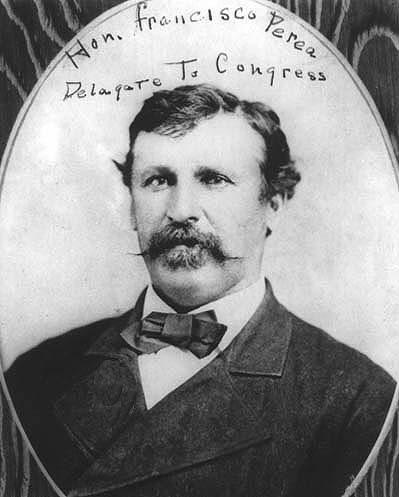
Historical · U.S. House · New Mexico · At-Large
Francisco Perea
Former U.S. Representative · New Mexico At-Large · 1863–1865 · Republican
Francisco Perea represented New Mexico's At-Large in the United States House of Representatives (1863–1865) for the Republican party. The page below collects sourced biographical facts, term history, committee roles, and provenance for Perea.
Bioguide ID: P000224
Key facts
- Full name
- Francisco Perea
- State
- New Mexico
- District
- At-Large
- Party
- Republican
- House service
- 1863–1865
- First House term
- 1863
- Status
- Left office
- Current term ends
- —
- Born
- 1830
- Bioguide ID
- P000224
- Committee assignments
- —
- Dataset version
- 1.20260606
Biographical narrative
834 words · sourced from the Wikipedia REST extract
Francisco Perea was a prominent American businessman and politician who served as a U.S. Representative for New Mexico's at-large congressional district during the mid-19th century. Born on January 9, 1830, in Los Padillas, New Mexico, Perea's life and career were deeply intertwined with the historical transitions of the region, particularly following the Mexican-American War. His political career included serving as a delegate to the U.S. Congress and as a lieutenant colonel in the Union Army during the American Civil War. Perea's legacy includes his contributions to the political landscape of New Mexico and his involvement in various business ventures throughout his life.
Early life and career
Francisco Perea was born into a family with deep roots in New Mexico's colonial history. His parents, Juan Perea and Josefa Chaves de Perea, were part of the Hispano community, which had established itself in the region long before it became part of the United States. Perea was the third child in his family and was notably the maternal grandson of Francisco Xavier Chávez, the first Governor of the Departamento de Nuevo México during the early 19th century.
Perea's early education took place in select schools in Bernalillo County and Santa Fe, where he attended from 1836 to 1839. He later pursued higher education at the Jesuit College in St. Louis, Missouri, from 1843 to 1845, and continued his studies at the Bank Street Academy in New York City from 1847 to 1849. This period coincided with the Mexican-American War, which resulted in significant territorial changes for New Mexico. Upon his return to New Mexico, he found that the territory had been annexed by the United States and subsequently organized as a territory in 1850.
Perea married Dolores Otero on March 15, 1851, and the couple had a total of eighteen children, though many did not survive infancy. After the death of his first wife, he married Gabriela Montoya on November 14, 1870. Throughout the 1850s, Perea was actively engaged in business, particularly in stock raising and commercial activities. He established a trade network along the Santa Fe Trail, transporting goods between St. Louis and Mexico, and also traveled to California and New York City for business purposes.
House tenure
Perea's political career began in earnest when he was elected to represent Bernalillo County in the Territorial House in 1858. However, he declined to take his seat, citing family health issues and a lack of consent to be a candidate. His political involvement became more pronounced during the American Civil War when he took on a leadership role in the Union Army. Perea was commissioned as a lieutenant colonel and organized a battalion known as Perea's Battalion, which was stationed in Albuquerque and tasked with defending the territory against Confederate forces and local threats.
Following his military service, Perea was elected as a delegate to the Thirty-Eighth Congress, serving from March 4, 1863, to March 3, 1865. During his tenure, he represented the interests of the New Mexico Territory at a time of significant national upheaval. Perea was active in the political landscape, attending the 1864 Republican National Convention as New Mexico's delegate, where he supported the renomination of President Abraham Lincoln. His congressional service coincided with critical events in American history, including the Civil War and Lincoln's assassination, which he witnessed firsthand at Ford's Theatre in April 1865.
Despite being renominated for a subsequent term in the summer of 1865, Perea did not win re-election. His congressional career marked a significant moment for New Mexico, as he was one of the early representatives of the territory in the U.S. Congress.
Legislative focus and committees
During his time in Congress, Perea's legislative focus reflected the interests and needs of the New Mexico Territory, which was undergoing significant changes due to its recent incorporation into the United States. His work as a delegate involved advocating for the territory's development and integration into the broader political framework of the nation. Perea's background in business and his experiences during the Civil War likely informed his perspectives on issues related to commerce, defense, and territorial governance.
After his congressional tenure, Perea continued to engage in public service. He was elected to the Territorial Council of New Mexico multiple times, reflecting his ongoing commitment to the political landscape of the region. In 1881, he relocated to Jemez Springs, where he became involved in the local economy as a proprietor of health springs and a hotel. His later appointment as the U.S. postmaster of Jemez Springs from 1894 to 1905 further exemplified his dedication to public service and community engagement.
Perea's life spanned a transformative period in American history, and his contributions to the political and economic development of New Mexico are notable. He passed away on May 21, 1913, in Albuquerque, New Mexico, and was interred in Fairview Cemetery. His legacy is remembered as part of the early political fabric of New Mexico, reflecting the complexities of governance and representation during a time of significant change in the United States.
Notable legislation
Sponsored and co-sponsored legislation for Francisco Perea is pending operator curation. The biographical narrative above carries the same provenance trail until per-bill rows are written.
Sources
- [1]https://en.wikipedia.org/wiki/Francisco_PereaWikipedia · retrieved 2026-06-06
Notable quotes
Sourced quotes for Francisco Perea are pending operator curation. Narrative-scope provenance remains attached below.
Sources
- [1]https://en.wikipedia.org/wiki/Francisco_PereaWikipedia · retrieved 2026-06-06
Key positions
Curated policy positions for Francisco Perea are pending operator review. The biographical narrative above carries the same provenance trail until per-topic positions are written.
Sources
- [1]https://en.wikipedia.org/wiki/Francisco_PereaWikipedia · retrieved 2026-06-06
Terms served
- 1863–1865U.S. House · Term 1 · Republican
Sources & provenance
Every attributable claim above carries a per-section [N] marker that resolves to the corresponding URL below. Each entry records the upstream provider, the canonical URL, and the timestamp at which the source was retrieved by the ingest pipeline.
Key facts
- https://bioguide.congress.gov/search/bio/P000224bioguide · retrieved 2026-06-06
- https://www.govtrack.us/congress/members/408627govtrack · retrieved 2026-06-06
Biographical narrative
- https://en.wikipedia.org/wiki/Francisco_Pereawikipedia · retrieved 2026-06-06
Find your representative
Every U.S. state elects representatives by district. Browse New Mexico’s delegation, the full former-representative roster, or explore the role and term length.
Related on The Candidate
- Preceded by John WattsEarlier holder of the New Mexico At-Large House seat · Republican.Open
- Succeeded by José ChavesLater holder of the New Mexico At-Large House seat · Republican.Open
- Albert SimmsFormer U.S. Representative · New Mexico District 1 · RepublicanOpen
- Benigno HernándezFormer U.S. Representative · New Mexico District 1 · RepublicanOpen
- Debra HaalandFormer U.S. Representative · New Mexico District 1 · DemocraticOpen
- Harvey FergussonFormer U.S. Representative · New Mexico District 1 · DemocraticOpen