
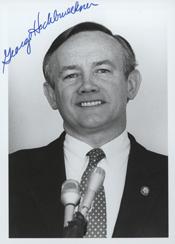
Historical · U.S. House · New York · District 1
George Hochbrueckner
Former U.S. Representative · New York District 1 · 1987–1995 · Democratic
George Hochbrueckner represented New York's District 1 in the United States House of Representatives (1987–1995) for the Democratic party. The page below collects sourced biographical facts, term history, committee roles, and provenance for Hochbrueckner.
Bioguide ID: H000670
Key facts
- Full name
- George Hochbrueckner
- State
- New York
- District
- District 1
- Party
- Democratic
- House service
- 1987–1995
- First House term
- 1987
- Status
- Left office
- Current term ends
- —
- Born
- 1938
- Bioguide ID
- H000670
- Committee assignments
- —
- Dataset version
- 1.20260605
Biographical narrative
951 words · sourced from the Wikipedia REST extract
George J. Hochbrueckner is a former Democratic member of the United States House of Representatives, who served New York's 1st congressional district for four terms from 1987 until 1995. His political career was preceded by a background in engineering and state politics, where he gained experience that would inform his legislative work in Congress. Hochbrueckner's tenure in the House coincided with significant political shifts in the United States, particularly the Republican Revolution of the mid-1990s, which ultimately led to his defeat in the 1994 elections.
Early life and career
George Joseph Hochbrueckner was born on September 20, 1938. He completed his high school education in 1956 and subsequently enlisted in the United States Navy. During his service, he specialized as an Aviation Electronics Technician, a role that provided him with technical skills and discipline. He was honorably discharged from the Navy in 1959, marking the end of his military service and the beginning of his academic pursuits.
Following his time in the Navy, Hochbrueckner attended several institutions of higher education, including the State University of New York at Stony Brook, Hofstra University, and California State University, Northridge. His studies spanned approximately two and a half years, during which he focused on engineering. This educational background laid the groundwork for his subsequent career in the engineering field.
Hochbrueckner's professional journey included on-the-job training as an engineer, where he gained valuable experience working for notable companies such as Litton and Teledyne in California, as well as Grumman in New York. His engineering background would later influence his approach to policy and legislation, particularly in areas related to technology and infrastructure.
In addition to his engineering career, Hochbrueckner entered politics, serving in the New York State Assembly from 1975 to 1984. During his time in the Assembly, he participated in five consecutive New York State Legislatures, specifically the 181st through the 185th. His experience in state politics provided him with a solid foundation in legislative processes and governance, which he would carry into his congressional career.
House tenure
Hochbrueckner's congressional career began when he was elected to the U.S. House of Representatives in 1986, representing New York's 1st congressional district. He officially took office on January 3, 1987. His election came during a period of significant political change in the United States, as the Democratic Party was navigating the complexities of governance in a landscape that was increasingly competitive.
During his time in the House, Hochbrueckner served four consecutive terms, during which he was involved in various legislative initiatives and discussions. His tenure was marked by a commitment to addressing the needs of his constituents in Long Island, New York. Hochbrueckner's focus included issues pertinent to his district, such as economic development, environmental protection, and veterans' affairs, reflecting the diverse interests of the constituents he represented.
Hochbrueckner's time in Congress coincided with the broader political dynamics of the late 1980s and early 1990s, including the rise of the Republican Party and the shifting priorities of the federal government. His legislative efforts were shaped by these dynamics, as he worked to balance the interests of his party with the needs of his district.
In 1994, Hochbrueckner faced a challenging electoral environment during the midterm elections, which were characterized by a significant Republican wave known as the Republican Revolution. This political shift resulted in the loss of several Democratic seats across the country, including Hochbrueckner's. He was defeated by Republican candidate Michael P. Forbes, marking the end of his congressional career when he left office on January 3, 1995.
Legislative focus and committees
Throughout his congressional tenure, George J. Hochbrueckner was involved in various legislative initiatives that reflected his background and the interests of his constituents. His engineering experience informed his approach to issues related to technology and infrastructure, as he sought to promote advancements that would benefit his district and the nation as a whole.
Hochbrueckner's legislative focus included economic development initiatives aimed at enhancing job opportunities and supporting local businesses. He recognized the importance of a robust economy for the residents of Long Island and worked to advocate for policies that would stimulate growth and investment in the region.
Environmental issues were also a significant aspect of Hochbrueckner's legislative agenda. He was attentive to the environmental challenges facing Long Island, including concerns related to pollution, land use, and conservation efforts. His commitment to environmental protection was evident in his support for legislation aimed at safeguarding natural resources and promoting sustainable practices.
In addition to economic and environmental issues, Hochbrueckner was a strong advocate for veterans' affairs. Given his own military background, he understood the importance of supporting those who had served in the armed forces. He worked to ensure that veterans received the benefits and services they deserved, addressing issues such as healthcare, education, and employment opportunities for veterans returning to civilian life.
During his time in the House, Hochbrueckner served on various committees, which allowed him to engage in the legislative process and influence policy decisions. His committee assignments provided him with the opportunity to collaborate with colleagues from both parties and to contribute to discussions on a wide range of issues affecting the nation.
After leaving Congress, Hochbrueckner continued his career in public service as a Senior Policy Advisor at Nossaman LLP, where he worked out of their Washington, D.C., office. This role allowed him to leverage his legislative experience and expertise in policy matters, contributing to discussions on issues relevant to his background and interests.
Hochbrueckner's life and career reflect a commitment to public service, engineering, and the well-being of his constituents. His experiences in the military, education, and state politics shaped his approach to governance and legislative priorities during his time in the U.S. House of Representatives.
Notable legislation
Sponsored and co-sponsored legislation for George Hochbrueckner is pending operator curation. The biographical narrative above carries the same provenance trail until per-bill rows are written.
Sources
- [1]https://en.wikipedia.org/wiki/George_J._HochbruecknerWikipedia · retrieved 2026-06-05
Notable quotes
Sourced quotes for George Hochbrueckner are pending operator curation. Narrative-scope provenance remains attached below.
Sources
- [1]https://en.wikipedia.org/wiki/George_J._HochbruecknerWikipedia · retrieved 2026-06-05
Key positions
Curated policy positions for George Hochbrueckner are pending operator review. The biographical narrative above carries the same provenance trail until per-topic positions are written.
Sources
- [1]https://en.wikipedia.org/wiki/George_J._HochbruecknerWikipedia · retrieved 2026-06-05
Terms served
- 1987–1989U.S. House · Term 1 · Democratic
- 1989–1991U.S. House · Term 2 · Democratic
- 1991–1993U.S. House · Term 3 · Democratic
- 1993–1995U.S. House · Term 4 · Democratic
Sources & provenance
Every attributable claim above carries a per-section [N] marker that resolves to the corresponding URL below. Each entry records the upstream provider, the canonical URL, and the timestamp at which the source was retrieved by the ingest pipeline.
Key facts
- https://bioguide.congress.gov/search/bio/H000670bioguide · retrieved 2026-06-05
- https://www.govtrack.us/congress/members/405524govtrack · retrieved 2026-06-05
Biographical narrative
- https://en.wikipedia.org/wiki/George_J._Hochbruecknerwikipedia · retrieved 2026-06-05
Find your representative
Every U.S. state elects representatives by district. Browse New York’s delegation, the full former-representative roster, or explore the role and term length.
Related on The Candidate
- Preceded by William CarneyEarlier holder of the New York District 1 House seat · Republican.Open
- Succeeded by Michael ForbesLater holder of the New York District 1 House seat · Democratic.Open
- Abel HuntingtonFormer U.S. Representative · New York District 1 · JacksonOpen
- Alfred ChapinFormer U.S. Representative · New York District 1 · DemocraticOpen
- Cadwallader ColdenFormer U.S. Representative · New York District 1 · FederalistOpen
- Charles FloydFormer U.S. Representative · New York District 1 · DemocraticOpen