
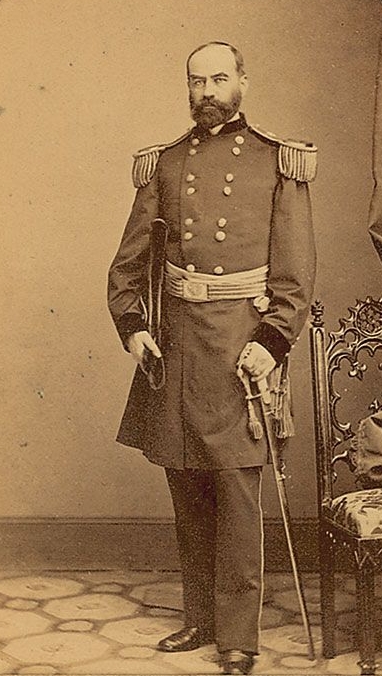
Historical · U.S. House · New York · District 14
Henry Van Rensselaer
Former U.S. Representative · New York District 14 · 1841–1843 · Whig
Henry Van Rensselaer represented New York's District 14 in the United States House of Representatives (1841–1843) for the Whig party. The page below collects sourced biographical facts, term history, committee roles, and provenance for Rensselaer.
Bioguide ID: V000052
Key facts
- Full name
- Henry Van Rensselaer
- State
- New York
- District
- District 14
- Party
- Whig
- House service
- 1841–1843
- First House term
- 1841
- Status
- Left office
- Current term ends
- —
- Born
- 1810
- Bioguide ID
- V000052
- Committee assignments
- —
- Dataset version
- 1.20260606
Biographical narrative
829 words · sourced from the Wikipedia REST extract
Henry Van Rensselaer was a notable American politician and military officer, who served as a U.S. Representative from New York's 14th congressional district during the early 1840s. A member of the Whig Party, he held office in the United States Congress from 1841 until 1843. In addition to his political career, Van Rensselaer had a distinguished military background, serving as a colonel in the Union Army during the American Civil War. His life was marked by connections to prominent families and institutions, reflecting a legacy intertwined with American history.
Early life and career
Henry Van Rensselaer was born on May 14, 1810, at the manor house in Albany, New York. He was the son of Stephen Van Rensselaer III, a significant figure in New York's history who served as the patroon of the Manor of Rensselaerswyck and was also a U.S. Representative. His mother, Cornelia Paterson, was the daughter of William Paterson, who held the positions of Governor of New Jersey and Associate Justice of the United States Supreme Court. This familial background placed Van Rensselaer in a lineage of influential figures in American politics and governance.
Van Rensselaer pursued higher education at the United States Military Academy at West Point, graduating in 1831. Following his graduation, he was appointed as a brevet Second Lieutenant in the Fifth Regiment of the United States Infantry on July 1, 1831. However, his military career was short-lived as he resigned from the army on January 27, 1832. After leaving military service, he engaged in agricultural activities near Ogdensburg, New York. His career took a political turn when he served as a military aide to Governor William H. Seward from 1839 to 1840.
The death of his father in 1839 marked a significant turning point in Van Rensselaer's life. As the fifth son, he inherited wild lands in St. Lawrence County along the St. Lawrence River, while his elder brother, Stephen Van Rensselaer IV, inherited the family manor on the Albany side of the Hudson River. This inheritance not only connected him to the land but also to the economic opportunities that came with it.
House tenure
Henry Van Rensselaer was elected as a member of the Whig Party to the Twenty-seventh United States Congress, serving from March 4, 1841, to March 3, 1843. His tenure in the House of Representatives was characterized by the political dynamics of the early 1840s, a period marked by significant national issues and the evolving role of the Whig Party in American politics. Although he served only one term, his election reflected the Whig Party's influence in New York and its broader national aspirations during this era.
During his time in Congress, Van Rensselaer was involved in the legislative processes and discussions that shaped the nation. However, specific details regarding the bills he supported or the committees he served on during his congressional term are not documented in the available records. After completing his term in the House, he transitioned to a career in the private sector, where he took on leadership roles in various mining companies, including the American Mineral Company and the Consolidated Franklinite Company. He also served as a director of the Northern Railroad, which later became known as the Rutland Railroad, before resigning to help establish the Ogdensburg, Clayton and Rome Railroad.
Legislative focus and committees
While specific legislative initiatives and committee assignments during Henry Van Rensselaer's time in Congress are not detailed in the available records, his affiliation with the Whig Party suggests that his legislative focus may have aligned with the party's principles, which included support for economic modernization, infrastructure development, and a cautious approach to expansionism. The Whig Party was known for advocating for internal improvements, such as transportation infrastructure, which were crucial for the economic development of the nation during that period.
After his congressional service, Van Rensselaer's career took a notable turn when the American Civil War broke out. He reentered military service, achieving the rank of colonel in the Union Army. He was appointed chief of staff to General Winfield Scott, a prominent military leader during the early years of the war. Following Scott's retirement, Van Rensselaer continued to serve in various capacities, including as an inspector general for several army corps and departments.
Henry Van Rensselaer's life reflects a blend of military and political service, underscoring the interconnectedness of these spheres in the 19th century. His contributions to both the military and the political landscape of his time illustrate the roles that individuals of his background played in shaping American history.
Van Rensselaer passed away on March 23, 1864, in Cincinnati, Ohio, due to typhoid fever, shortly before the conclusion of the Civil War. He was interred in the Grace Episcopal Churchyard in Jamaica, Queens, New York City. His legacy continued through his descendants, who maintained connections to notable figures in American society. Through his family, he is linked to various historical narratives, including those of prominent individuals in the arts and politics.
Notable legislation
Sponsored and co-sponsored legislation for Henry Van Rensselaer is pending operator curation. The biographical narrative above carries the same provenance trail until per-bill rows are written.
Sources
- [1]https://en.wikipedia.org/wiki/Henry_Bell_Van_RensselaerWikipedia · retrieved 2026-06-06
Notable quotes
Sourced quotes for Henry Van Rensselaer are pending operator curation. Narrative-scope provenance remains attached below.
Sources
- [1]https://en.wikipedia.org/wiki/Henry_Bell_Van_RensselaerWikipedia · retrieved 2026-06-06
Key positions
Curated policy positions for Henry Van Rensselaer are pending operator review. The biographical narrative above carries the same provenance trail until per-topic positions are written.
Sources
- [1]https://en.wikipedia.org/wiki/Henry_Bell_Van_RensselaerWikipedia · retrieved 2026-06-06
Terms served
- 1841–1843U.S. House · Term 1 · Whig
Sources & provenance
Every attributable claim above carries a per-section [N] marker that resolves to the corresponding URL below. Each entry records the upstream provider, the canonical URL, and the timestamp at which the source was retrieved by the ingest pipeline.
Key facts
- https://bioguide.congress.gov/search/bio/V000052bioguide · retrieved 2026-06-06
- https://www.govtrack.us/congress/members/411094govtrack · retrieved 2026-06-06
Biographical narrative
- https://en.wikipedia.org/wiki/Henry_Bell_Van_Rensselaerwikipedia · retrieved 2026-06-06
Find your representative
Every U.S. state elects representatives by district. Browse New York’s delegation, the full former-representative roster, or explore the role and term length.
Related on The Candidate
- Preceded by John FineEarlier holder of the New York District 14 House seat · Democratic.Open
- Succeeded by Charles RogersLater holder of the New York District 14 House seat · Whig.Open
- Abel HuntingtonFormer U.S. Representative · New York District 1 · JacksonOpen
- Alfred ChapinFormer U.S. Representative · New York District 1 · DemocraticOpen
- Cadwallader ColdenFormer U.S. Representative · New York District 1 · FederalistOpen
- Charles FloydFormer U.S. Representative · New York District 1 · DemocraticOpen