
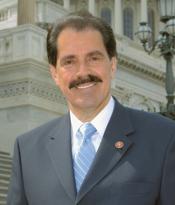
Historical · U.S. House · New York · District 15
José Serrano
Former U.S. Representative · New York District 15 · 1989–2021 · Democratic
José Serrano represented New York's District 15 in the United States House of Representatives (1989–2021) for the Democratic party. The page below collects sourced biographical facts, term history, committee roles, and provenance for Serrano.
Bioguide ID: S000248
Key facts
- Full name
- José Serrano
- State
- New York
- District
- District 15
- Party
- Democratic
- House service
- 1989–2021
- First House term
- 1989
- Status
- Left office
- Current term ends
- —
- Born
- 1943
- Bioguide ID
- S000248
- Committee assignments
- —
- Dataset version
- 1.20260604
Biographical narrative
949 words · sourced from the Wikipedia REST extract
José E. Serrano is a former American politician who served as a U.S. Representative for New York's 15th congressional district from 1989 until his retirement in 2021. A member of the Democratic Party, Serrano was notable for representing a district that is among the smallest in geographical size but one of the most densely populated areas in the United States, encompassing parts of the South Bronx. Throughout his lengthy tenure in Congress, he became known for his progressive stance on various issues and was recognized as the longest-serving Hispanic-American in the House of Representatives.
Early life and career
José E. Serrano was born on October 24, 1943, in Mayagüez, Puerto Rico. At the age of seven, he moved with his family to The Bronx, New York City, where he was raised in the Millbrook Houses, a public housing development. Serrano attended Grace Dodge Vocational High School in the Bronx and later enrolled at Lehman College in 1961, although his time there was brief.
In 1964, Serrano enlisted in the United States Army, serving as a private in the 172nd Support Battalion of the Army Medical Corps until 1966. Following his military service, he worked at Manufacturers Hanover Bank from 1961 to 1969, except for the period he was in the Army. His early involvement in public service began in 1969 when he was elected to the New York City District 7 School Board, a position he held until 1974. He also served as chairman of the South Bronx Community Corporation and was a delegate to the 1976 Democratic National Convention, further solidifying his commitment to community engagement and political activism.
Serrano's political career advanced when he was elected to the New York State Assembly, where he served from 1975 until 1990. During his time in the Assembly, he represented various legislative districts, initially the 75th and later the 73rd. He held significant leadership roles, including Chairman of the Committee on Consumer Affairs from 1979 to 1983 and Chairman of the Committee on Education from 1983 to 1990. His experience in state politics laid the groundwork for his subsequent election to the U.S. House of Representatives.
House tenure
José E. Serrano was elected to the U.S. House of Representatives in 1990, winning a special election to fill the vacancy left by the resignation of Congressman Robert García. Serrano secured an overwhelming 92% of the vote in that election and maintained a strong electoral presence throughout his career, consistently winning re-election with similarly high margins. His congressional district, which underwent several number changes—initially the 18th from 1990 to 1993, then the 16th from 1993 to 2013, and finally the 15th from 2013 until his retirement—was recognized as one of the safest Democratic seats in Congress.
During his tenure, Serrano was a member of the Progressive Caucus and was regarded as one of the most progressive voices in the House. He was known for his advocacy on various issues, including social justice, environmental protection, and economic equity. Serrano's commitment to his constituents was evident in his focus on local needs, which included significant earmarks for community projects, although he faced criticism from some fiscal conservatives regarding his spending priorities.
One notable moment in Serrano's career occurred in 2005 when he was one of only three members of the House to vote in favor of an immediate withdrawal of American troops from Iraq. His progressive stance was further illustrated through his repeated attempts to introduce a joint resolution aimed at repealing the 22nd Amendment, which imposes term limits on the presidency, although these efforts did not advance beyond committee consideration.
Serrano's dedication to environmental issues was particularly pronounced. He championed initiatives to construct greenways, acquire parklands, and clean up the Bronx River, a waterway that runs through his district. His efforts were recognized when, in 2007, a beaver was spotted in the Bronx River for the first time in two centuries, a discovery that biologists named "José" in his honor. Additionally, he played a key role in the acquisition of South Brother Island, the last privately owned island in New York Harbor, for preservation as a wildlife refuge.
Legislative focus and committees
Throughout his congressional career, Serrano served on several important committees, most notably the House Appropriations Committee. He was one of three New York-area congressmen on this committee, alongside Nita Lowey and Grace Meng. By the end of his tenure, Serrano held the position of ranking member of the Appropriations Subcommittee on Financial Services, having previously served as its chair. His leadership in this role enabled him to influence significant funding decisions, including the successful inclusion of provisions in the 2007 omnibus spending bill that extended the 50 State Quarters program to honor the District of Columbia and U.S. territories, including Puerto Rico.
Serrano was also an advocate for the rights of Puerto Ricans, particularly those under investigation by the FBI. In 2000, he facilitated an agreement that led to the release of a substantial number of previously classified FBI files concerning Puerto Rican political activists. His commitment to social justice extended to international affairs as well; he was critical of the Bush administration's policies toward Venezuela and invited Venezuelan President Hugo Chávez to speak in his district during a visit to New York City.
José E. Serrano's congressional career came to an end when he chose not to seek re-election in 2020, following a diagnosis of Parkinson's disease. His departure marked the end of a significant chapter in the representation of New York's 15th district, which was succeeded by Ritchie Torres. Serrano's legacy in Congress is characterized by his long-standing commitment to progressive values, community advocacy, and a focus on the needs of his constituents in the Bronx.
Notable legislation
Sponsored and co-sponsored legislation for José Serrano is pending operator curation. The biographical narrative above carries the same provenance trail until per-bill rows are written.
Sources
- [1]https://en.wikipedia.org/wiki/Jos%C3%A9_E._SerranoWikipedia · retrieved 2026-06-04
Notable quotes
Sourced quotes for José Serrano are pending operator curation. Narrative-scope provenance remains attached below.
Sources
- [1]https://en.wikipedia.org/wiki/Jos%C3%A9_E._SerranoWikipedia · retrieved 2026-06-04
Key positions
Curated policy positions for José Serrano are pending operator review. The biographical narrative above carries the same provenance trail until per-topic positions are written.
Sources
- [1]https://en.wikipedia.org/wiki/Jos%C3%A9_E._SerranoWikipedia · retrieved 2026-06-04
Terms served
- 1989–1991U.S. House · Term 1 · Democratic
- 1991–1993U.S. House · Term 2 · Democratic
- 1993–1995U.S. House · Term 3 · Democratic
- 1995–1997U.S. House · Term 4 · Democratic
- 1997–1999U.S. House · Term 5 · Democratic
- 1999–2001U.S. House · Term 6 · Democratic
- 2001–2003U.S. House · Term 7 · Democratic
- 2003–2005U.S. House · Term 8 · Democratic
- 2005–2007U.S. House · Term 9 · Democratic
- 2007–2009U.S. House · Term 10 · Democratic
- 2009–2011U.S. House · Term 11 · Democratic
- 2011–2013U.S. House · Term 12 · Democratic
- 2013–2015U.S. House · Term 13 · Democratic
- 2015–2017U.S. House · Term 14 · Democratic
- 2017–2019U.S. House · Term 15 · Democratic
- 2019–2021U.S. House · Term 16 · Democratic
Sources & provenance
Every attributable claim above carries a per-section [N] marker that resolves to the corresponding URL below. Each entry records the upstream provider, the canonical URL, and the timestamp at which the source was retrieved by the ingest pipeline.
Key facts
- https://bioguide.congress.gov/search/bio/S000248bioguide · retrieved 2026-06-04
- https://serrano.house.govhouse.gov · retrieved 2026-06-04
Biographical narrative
- https://en.wikipedia.org/wiki/Jos%C3%A9_E._Serranowikipedia · retrieved 2026-06-04
Find your representative
Every U.S. state elects representatives by district. Browse New York’s delegation, the full former-representative roster, or explore the role and term length.
Related on The Candidate
- Preceded by Leo ZeferettiEarlier holder of the New York District 15 House seat · Democratic.Open
- Abel HuntingtonFormer U.S. Representative · New York District 1 · JacksonOpen
- Alfred ChapinFormer U.S. Representative · New York District 1 · DemocraticOpen
- Cadwallader ColdenFormer U.S. Representative · New York District 1 · FederalistOpen
- Charles FloydFormer U.S. Representative · New York District 1 · DemocraticOpen
- Democratic PartyFederal candidates and office holders on the Democratic line.Open