
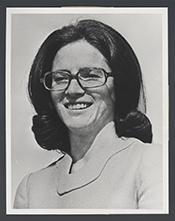
Historical · U.S. House · New York · District 16
Elizabeth Holtzman
Former U.S. Representative · New York District 16 · 1973–1981 · Democratic
Elizabeth Holtzman represented New York's District 16 in the United States House of Representatives (1973–1981) for the Democratic party. The page below collects sourced biographical facts, term history, committee roles, and provenance for Holtzman.
Bioguide ID: H000752
Key facts
- Full name
- Elizabeth Holtzman
- State
- New York
- District
- District 16
- Party
- Democratic
- House service
- 1973–1981
- First House term
- 1973
- Status
- Left office
- Current term ends
- —
- Born
- 1941
- Bioguide ID
- H000752
- Committee assignments
- —
- Dataset version
- 1.20260605
Biographical narrative
930 words · sourced from the Wikipedia REST extract
Elizabeth Holtzman is a former American politician and attorney who served as a U.S. Representative for New York's 16th congressional district from 1973 to 1981. A member of the Democratic Party, Holtzman gained national attention for her electoral victory over a long-standing incumbent and became one of the youngest women ever elected to Congress at that time. Following her tenure in the House, she continued her public service as the district attorney of Kings County and later as the comptroller of New York City. Holtzman remains active in political discourse and has sought public office in subsequent years.
Early life and career
Elizabeth Holtzman was born on August 11, 1941, in Brooklyn, New York, to Russian immigrant parents. Her father, Sidney Holtzman, was a lawyer, and her mother, Filia Ravitz, held a doctorate from Columbia University and later became the head of the Russia department at Hunter College. Holtzman's upbringing in a Jewish family included attending Hebrew school, which contributed to her cultural and educational foundation.
Holtzman received her early education at the Ethical Culture Fieldston School and Abraham Lincoln High School, where she became actively involved in student government, serving as vice president in 1958. She graduated magna cum laude from Radcliffe College in 1961, majoring in American history and literature. Holtzman then attended Harvard Law School, where she graduated in 1965. During her time at Harvard, she was one of only 15 women in a class of 500 students and was recognized as a member of Phi Beta Kappa.
While at Harvard, Holtzman became involved with the Student Nonviolent Coordinating Committee, working on civil rights cases in Alabama and Georgia. She also contributed to the NAACP Legal Defense and Educational Fund. After being admitted to the New York State Bar Association, she began her legal career at the law firm Paul, Weiss, Rifkind, Wharton & Garrison in 1970. Holtzman later transitioned into politics, running for office in 1972 after a brief period of legal practice. In 1976, she was elected to the Harvard Board of Overseers and served as a visiting scholar at New York University School of Law in 1981.
Holtzman has been involved in various public service roles beyond her congressional career. In 1984, she participated in a delegation to Paraguay to search for Nazi war criminal Josef Mengele. She was appointed by President Bill Clinton to the Nazi War Crimes and Japanese Imperial Government Records Interagency Working Group and later served on the Homeland Security Advisory Council, resigning in protest over a controversial family separation policy at the U.S.-Mexico border.
House tenure
Holtzman's political career in the U.S. House of Representatives began when she announced her candidacy for the Democratic nomination for New York's 16th congressional district on March 28, 1972. Her campaign was notable for its challenge against long-serving incumbent Emanuel Celler, who had been in office since 1922. Holtzman believed that Celler was vulnerable due to his lack of a district office and diminishing visibility in local political circles. Despite facing a well-established opponent with significant backing from the Democratic political machine and the Liberal Party of New York, Holtzman campaigned vigorously, raising approximately $32,000 and borrowing an additional $4,000.
In the primary election, Holtzman successfully defeated both Celler and another candidate, Robert O'Donnell. Celler's attempts to contest the primary results were ultimately unsuccessful, with the courts ruling in Holtzman's favor. Following Celler's withdrawal from the race, Holtzman went on to win the general election against Republican nominee Nicholas R. Macchio Jr. and Conservative nominee William Sampol. This victory marked a significant moment in U.S. political history, as Holtzman became the youngest woman ever elected to Congress at the age of 31, a record that would later be surpassed.
Holtzman's tenure in the House of Representatives spanned four terms, during which she was involved in various legislative initiatives and political activities. Her election was seen as a watershed moment for women in politics, and she was often recognized for her role in breaking barriers in a male-dominated political landscape.
Legislative focus and committees
During her time in Congress, Holtzman focused on a range of issues, reflecting her commitment to civil rights, social justice, and government accountability. She was known for her advocacy on behalf of marginalized communities and her efforts to promote legislation that aligned with her progressive values. Holtzman served on several committees, where she contributed to discussions and decisions on key legislative matters.
In addition to her legislative work, Holtzman was actively involved in various political movements and causes. She was a vocal opponent of the impeachment of President Bill Clinton, arguing that the charges against him did not warrant such a drastic measure and were not comparable to the impeachment of Richard Nixon. Her stance on impeachment highlighted her belief in the importance of proportionality in political accountability.
After leaving Congress in 1981, Holtzman continued her public service career as the district attorney of Kings County from 1982 to 1989, and later served as the comptroller of New York City from 1990 to 1993. Throughout her career, she has remained engaged in political discourse, including running for the Democratic nomination in New York's 10th congressional district in the 2022 election, although she was not successful in that bid.
Holtzman's career reflects her enduring commitment to public service and her influence on American politics, particularly in relation to women's representation and civil rights advocacy. Her work continues to resonate within the political landscape, as she remains a figure of interest for those studying the evolution of women's roles in government and the broader implications of her legislative contributions.
Notable legislation
Sponsored and co-sponsored legislation for Elizabeth Holtzman is pending operator curation. The biographical narrative above carries the same provenance trail until per-bill rows are written.
Sources
- [1]https://en.wikipedia.org/wiki/Elizabeth_HoltzmanWikipedia · retrieved 2026-06-05
Notable quotes
Sourced quotes for Elizabeth Holtzman are pending operator curation. Narrative-scope provenance remains attached below.
Sources
- [1]https://en.wikipedia.org/wiki/Elizabeth_HoltzmanWikipedia · retrieved 2026-06-05
Key positions
Curated policy positions for Elizabeth Holtzman are pending operator review. The biographical narrative above carries the same provenance trail until per-topic positions are written.
Sources
- [1]https://en.wikipedia.org/wiki/Elizabeth_HoltzmanWikipedia · retrieved 2026-06-05
Terms served
- 1973–1975U.S. House · Term 1 · Democratic
- 1975–1977U.S. House · Term 2 · Democratic
- 1977–1979U.S. House · Term 3 · Democratic
- 1979–1981U.S. House · Term 4 · Democratic
Sources & provenance
Every attributable claim above carries a per-section [N] marker that resolves to the corresponding URL below. Each entry records the upstream provider, the canonical URL, and the timestamp at which the source was retrieved by the ingest pipeline.
Key facts
- https://bioguide.congress.gov/search/bio/H000752bioguide · retrieved 2026-06-05
- https://www.govtrack.us/congress/members/405603govtrack · retrieved 2026-06-05
Biographical narrative
- https://en.wikipedia.org/wiki/Elizabeth_Holtzmanwikipedia · retrieved 2026-06-05
Find your representative
Every U.S. state elects representatives by district. Browse New York’s delegation, the full former-representative roster, or explore the role and term length.
Related on The Candidate
- Preceded by James MurphyEarlier holder of the New York District 16 House seat · Democratic.Open
- Succeeded by Eliot EngelLater holder of the New York District 16 House seat · Democratic.Open
- Abel HuntingtonFormer U.S. Representative · New York District 1 · JacksonOpen
- Alfred ChapinFormer U.S. Representative · New York District 1 · DemocraticOpen
- Cadwallader ColdenFormer U.S. Representative · New York District 1 · FederalistOpen
- Charles FloydFormer U.S. Representative · New York District 1 · DemocraticOpen