
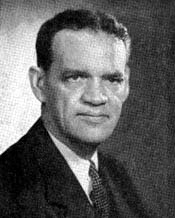
Historical · U.S. House · New York · District 16
Ellsworth Buck
Former U.S. Representative · New York District 16 · 1943–1949 · Republican
Ellsworth Buck represented New York's District 16 in the United States House of Representatives (1943–1949) for the Republican party. The page below collects sourced biographical facts, term history, committee roles, and provenance for Buck.
Bioguide ID: B001016
Key facts
- Full name
- Ellsworth Buck
- State
- New York
- District
- District 16
- Party
- Republican
- House service
- 1943–1949
- First House term
- 1943
- Status
- Left office
- Current term ends
- —
- Born
- 1892
- Bioguide ID
- B001016
- Committee assignments
- —
- Dataset version
- 1.20260605
Biographical narrative
944 words · sourced from the Wikipedia REST extract
Ellsworth Buck was an American businessman and educator who served as a Republican member of the United States House of Representatives for New York's 16th congressional district during the 1940s. His political career spanned three terms in Congress, during which he engaged in various legislative activities and took positions on significant issues of the time. Buck's background in education and business informed his approach to governance, and he was involved in various local and national initiatives throughout his life.
Early life and career
Ellsworth Brewer Buck was born on July 3, 1892, in Chicago, Illinois. He was educated at Morgan Park Academy before attending Dartmouth College, where he graduated in 1914. Following his graduation, Buck enlisted in the United States Naval Reserve in 1917, a decision that reflected his commitment to public service during a time of global conflict. He underwent training at the Massachusetts Institute of Technology, where he became a meteorology instructor, contributing to the war effort through his expertise.
In 1919, Buck relocated to Staten Island, New York, where he began a career in business. He took on the role of chairman of the board for L.A. Dreyfus Co., a company that was initially involved in the chewing gum industry before relocating to Edison, New Jersey, and eventually being acquired by Wrigley. His leadership in this position demonstrated his capabilities in managing corporate affairs and navigating the complexities of the business world.
Buck's involvement in public service extended beyond his business endeavors. He served as the chairman of the Chewing Gum Code Authority from 1934 to 1935, a role that likely involved overseeing industry standards and practices during a period of economic recovery. In 1935, he was appointed to the New York City Board of Education, where he began a long tenure in educational governance. Buck was vice president of the Board from 1938 until 1942 and subsequently served as president from 1942 to 1944. His leadership in education reflected his commitment to improving the educational landscape in New York City.
House tenure
Buck's political career in the U.S. House of Representatives began when he was elected in 1944 to fill the vacancy left by the death of Congressman James A. O'Leary. He officially took office on June 6, 1944, and served until January 3, 1949. During his time in Congress, Buck was a member of the Seventy-eighth, Seventy-ninth, and Eightieth United States Congresses. His election came during a critical period in American history, marked by World War II and its aftermath, as well as significant social and economic changes.
Throughout his congressional tenure, Buck was known for his support of the Taft-Hartley Act, which aimed to regulate labor unions and their activities. This legislation was controversial and faced opposition from organized labor groups, reflecting the complexities of labor relations during the post-war era. Additionally, Buck voted in favor of a proposal to ban the poll tax, a measure that sought to eliminate a financial barrier that disenfranchised many voters, particularly African Americans in the southern states. His legislative actions indicated a willingness to engage with contentious issues and advocate for reforms that aligned with his political beliefs.
Buck's representation of Staten Island also included opposition to the establishment of the Fresh Kills Landfill, a significant local issue that had implications for environmental and community health. His stance on this matter showcased his engagement with local constituents and their concerns, as well as his broader commitment to public welfare.
Despite his active participation in Congress, Buck chose not to seek reelection in 1948. His decision marked the end of his formal political career, although he remained involved in public service in various capacities after leaving office.
Legislative focus and committees
During his time in the House of Representatives, Buck's legislative focus encompassed a range of issues, particularly those related to labor, education, and local governance. His support for the Taft-Hartley Act positioned him within a broader Republican agenda aimed at curbing the power of labor unions, reflecting the political climate of the era. This legislation was part of a larger national conversation about labor rights and the balance of power between workers and employers.
Buck's advocacy for the abolition of the poll tax highlighted his engagement with civil rights issues, particularly in the context of voting access. By supporting measures to eliminate this barrier, he contributed to the ongoing struggle for equality and representation in the electoral process. His actions in this area were indicative of a growing awareness of civil rights issues that would gain prominence in the following decades.
In addition to his legislative work, Buck's experience as an educator and businessman informed his approach to governance. His leadership roles in the New York City Board of Education provided him with insights into educational policy and the challenges faced by schools and communities. This background likely influenced his perspectives on education-related legislation during his congressional tenure.
After his retirement from Congress, Buck continued to engage in public service. He served as a delegate to the 1952 Republican National Convention and held positions such as director of the Office of Trade Investment and Monetary Affairs in 1954. Additionally, he acted as a public advisor for the United States delegation to the United Nations Economic and Social Council in Geneva, Switzerland, in 1955. These roles reflected his ongoing commitment to public affairs and international engagement.
Ellsworth Buck passed away on August 14, 1970, at his home in Stephenson, Wisconsin. Following his death, he was cremated, and his ashes were placed in Thunder Mountain Ranch Cemetery. His life and career encompassed significant contributions to both local and national governance, reflecting a dedication to public service that spanned several decades.
Notable legislation
Sponsored and co-sponsored legislation for Ellsworth Buck is pending operator curation. The biographical narrative above carries the same provenance trail until per-bill rows are written.
Sources
- [1]https://en.wikipedia.org/wiki/Ellsworth_B._BuckWikipedia · retrieved 2026-06-05
Notable quotes
Sourced quotes for Ellsworth Buck are pending operator curation. Narrative-scope provenance remains attached below.
Sources
- [1]https://en.wikipedia.org/wiki/Ellsworth_B._BuckWikipedia · retrieved 2026-06-05
Key positions
Curated policy positions for Ellsworth Buck are pending operator review. The biographical narrative above carries the same provenance trail until per-topic positions are written.
Sources
- [1]https://en.wikipedia.org/wiki/Ellsworth_B._BuckWikipedia · retrieved 2026-06-05
Terms served
- 1943–1945U.S. House · Term 1 · Republican
- 1945–1947U.S. House · Term 2 · Republican
- 1947–1949U.S. House · Term 3 · Republican
Sources & provenance
Every attributable claim above carries a per-section [N] marker that resolves to the corresponding URL below. Each entry records the upstream provider, the canonical URL, and the timestamp at which the source was retrieved by the ingest pipeline.
Key facts
- https://bioguide.congress.gov/search/bio/B001016bioguide · retrieved 2026-06-05
- https://www.govtrack.us/congress/members/401966govtrack · retrieved 2026-06-05
Biographical narrative
- https://en.wikipedia.org/wiki/Ellsworth_B._Buckwikipedia · retrieved 2026-06-05
Find your representative
Every U.S. state elects representatives by district. Browse New York’s delegation, the full former-representative roster, or explore the role and term length.
Related on The Candidate
- Preceded by William PheifferEarlier holder of the New York District 16 House seat · Republican.Open
- Succeeded by James MurphyLater holder of the New York District 16 House seat · Democratic.Open
- Abel HuntingtonFormer U.S. Representative · New York District 1 · JacksonOpen
- Alfred ChapinFormer U.S. Representative · New York District 1 · DemocraticOpen
- Cadwallader ColdenFormer U.S. Representative · New York District 1 · FederalistOpen
- Charles FloydFormer U.S. Representative · New York District 1 · DemocraticOpen