
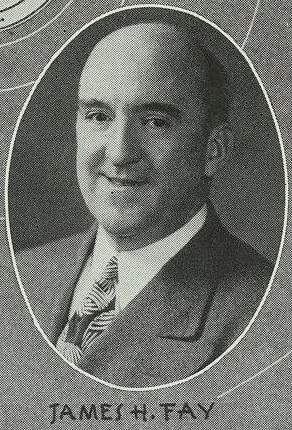
Historical · U.S. House · New York · District 16
James Fay
Former U.S. Representative · New York District 16 · 1939–1945 · Democratic
James Fay represented New York's District 16 in the United States House of Representatives (1939–1945) for the Democratic party. The page below collects sourced biographical facts, term history, committee roles, and provenance for Fay.
Bioguide ID: F000051
Key facts
- Full name
- James Fay
- State
- New York
- District
- District 16
- Party
- Democratic
- House service
- 1939–1945
- First House term
- 1939
- Status
- Left office
- Current term ends
- —
- Born
- 1899
- Bioguide ID
- F000051
- Committee assignments
- —
- Dataset version
- 1.20260605
Biographical narrative
874 words · sourced from the Wikipedia REST extract
James Fay was an American politician and veteran who served as a U.S. Representative for New York's 16th congressional district. A member of the Democratic Party, he held office during two nonconsecutive terms from 1939 to 1941 and again from 1943 to 1945. His political career was marked by his support for the New Deal and his involvement in various government roles prior to his congressional service. Fay's life was shaped by his experiences in World War I, where he sustained injuries that impacted his later life and career.
Early life and career
James Fay was born on April 29, 1899, in Manhattan, New York City. He received his early education in Manhattan and graduated from De La Salle Institute, a private Catholic school known for its academic rigor. Following his education, Fay enlisted in the New York National Guard's 69th Infantry Regiment in 1917, shortly before the United States entered World War I. His regiment was federalized and became part of the 165th Infantry, which served in France during the war. Fay's military service was significant; he attained the rank of private first class and was wounded in combat, resulting in the loss of his left leg below the knee. For his bravery and service, he was awarded the Purple Heart. After the war, he was discharged from the military in 1919.
Following his military service, Fay transitioned into a career in public service. In 1923, he was appointed as secretary to the president of Bellevue and Allied Hospitals, where he began to establish himself in the field of government administration. He pursued further education and earned his LL.B. degree from Brooklyn Law School in 1929. His career continued to advance as he took on roles within the New York City government; he served as the deputy commissioner and later the acting commissioner of hospitals from 1929 to 1934. Subsequently, he became the chief field deputy for the Internal Revenue Service in New York's 3rd district, a position he held from 1935 until 1938. These roles provided him with substantial experience in government operations and public administration, laying the groundwork for his future political career.
House tenure
Fay's entry into politics was marked by his successful campaign for the United States House of Representatives in 1938. He was the Democratic nominee for New York's 16th congressional district, where he positioned himself as a supporter of President Franklin D. Roosevelt and the New Deal policies aimed at economic recovery during the Great Depression. Fay's primary election campaign was notable for his victory over incumbent John J. O'Connor, who was critical of the New Deal. Following his primary success, Fay won the general election and began his first term in Congress in 1939.
During his initial term, which lasted until 1941, Fay participated in various legislative activities and contributed to discussions surrounding New Deal initiatives. However, he faced challenges in the political landscape, particularly in the 1940 election, where he lost his bid for reelection to Republican candidate William T. Pheiffer. Despite this setback, Fay remained active in politics and returned to the electoral arena in 1942, successfully defeating Pheiffer in a rematch. This victory allowed him to serve a second term in Congress from 1943 to 1945.
Fay's second term was characterized by continued support for the New Deal and engagement with issues relevant to his constituents. However, he chose not to seek reelection in 1944, concluding his congressional service after his second term. Following his departure from Congress, he returned to Manhattan, where he shifted his focus to the fields of advertising and public relations.
Legislative focus and committees
Throughout his time in the House of Representatives, James Fay was known for his alignment with the Democratic Party's platform, particularly in relation to the New Deal. His legislative focus included issues pertinent to economic recovery, social welfare, and public health, reflecting the priorities of his constituents in New York's 16th district. While specific details regarding the committees he served on during his tenure are not documented, it is typical for members of Congress to engage with committees that align with their interests and the needs of their districts. Fay's background in public health and administration likely influenced his legislative priorities and committee assignments.
Fay's political career was shaped by his experiences both as a veteran and as a public servant. His commitment to his constituents and his support for federal initiatives aimed at improving economic conditions were central to his legislative work. After leaving Congress, he continued to contribute to public discourse through his work in advertising and public relations, utilizing his skills and experiences gained in government to influence public opinion and policy.
James Fay passed away on September 10, 1948, at his home in Gramercy Park, Manhattan. He was buried at Pinelawn National Cemetery in East Farmingdale, New York, which is now known as Long Island National Cemetery. He is remembered as a figure who navigated the complexities of public service and politics during a transformative period in American history. Fay was married to Hazel DeWitt Kelly in 1931, and they had two children, James Herbert and Hazel. His legacy as a veteran and public servant continues to be recognized in the context of New York's political history.
Notable legislation
Sponsored and co-sponsored legislation for James Fay is pending operator curation. The biographical narrative above carries the same provenance trail until per-bill rows are written.
Sources
- [1]https://en.wikipedia.org/wiki/James_H._FayWikipedia · retrieved 2026-06-05
Notable quotes
Sourced quotes for James Fay are pending operator curation. Narrative-scope provenance remains attached below.
Sources
- [1]https://en.wikipedia.org/wiki/James_H._FayWikipedia · retrieved 2026-06-05
Key positions
Curated policy positions for James Fay are pending operator review. The biographical narrative above carries the same provenance trail until per-topic positions are written.
Sources
- [1]https://en.wikipedia.org/wiki/James_H._FayWikipedia · retrieved 2026-06-05
Terms served
- 1939–1941U.S. House · Term 1 · Democratic
- 1943–1945U.S. House · Term 2 · Democratic
Sources & provenance
Every attributable claim above carries a per-section [N] marker that resolves to the corresponding URL below. Each entry records the upstream provider, the canonical URL, and the timestamp at which the source was retrieved by the ingest pipeline.
Key facts
- https://bioguide.congress.gov/search/bio/F000051bioguide · retrieved 2026-06-05
- https://www.govtrack.us/congress/members/404011govtrack · retrieved 2026-06-05
Biographical narrative
- https://en.wikipedia.org/wiki/James_H._Faywikipedia · retrieved 2026-06-05
Find your representative
Every U.S. state elects representatives by district. Browse New York’s delegation, the full former-representative roster, or explore the role and term length.
Related on The Candidate
- Preceded by John O’ConnorEarlier holder of the New York District 16 House seat · Democratic.Open
- Succeeded by James MurphyLater holder of the New York District 16 House seat · Democratic.Open
- Abel HuntingtonFormer U.S. Representative · New York District 1 · JacksonOpen
- Alfred ChapinFormer U.S. Representative · New York District 1 · DemocraticOpen
- Cadwallader ColdenFormer U.S. Representative · New York District 1 · FederalistOpen
- Charles FloydFormer U.S. Representative · New York District 1 · DemocraticOpen