
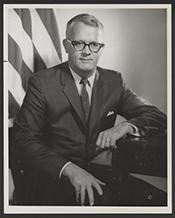
Historical · U.S. House · New York · District 2
James Grover Jr.
Former U.S. Representative · New York District 2 · 1963–1975 · Republican
James Grover Jr. represented New York's District 2 in the United States House of Representatives (1963–1975) for the Republican party. The page below collects sourced biographical facts, term history, committee roles, and provenance for Jr..
Bioguide ID: G000504
Key facts
- Full name
- James Grover Jr.
- State
- New York
- District
- District 2
- Party
- Republican
- House service
- 1963–1975
- First House term
- 1963
- Status
- Left office
- Current term ends
- —
- Born
- 1919
- Bioguide ID
- G000504
- Committee assignments
- —
- Dataset version
- 1.20260605
Biographical narrative
853 words · sourced from the Wikipedia REST extract
James R. Grover Jr. was an American lawyer and politician who served as a U.S. Representative for New York's 2nd congressional district from 1963 until 1975. A member of the Republican Party, Grover's political career spanned over a decade during a transformative period in American history. He was known for his commitment to his constituents and his active participation in legislative matters during his time in Congress. His career in public service was preceded by a background in law and local government, which provided him with a foundation for his legislative work.
Early life and career
James R. Grover Jr. was born on March 5, 1919, in Babylon, New York. He was the son of James and Christine Grover, with his father serving as the village police chief, which likely influenced Grover's early understanding of community service and governance. He pursued higher education at Hofstra University, where he graduated in 1941. Following his graduation, Grover entered military service during World War II, enlisting in the United States Army Air Forces. His service from 1943 to 1945 included deployment in the China-Burma-India Theater, a critical front in the war that involved complex operations in challenging conditions.
After returning from military service, Grover continued his education and earned a law degree from Columbia Law School in 1949. He subsequently established a legal practice in Babylon, New York, where he began to build a reputation in his community. His legal career provided him with insights into the workings of the law and governance, which would later inform his political endeavors.
Grover's entry into politics began at the state level. He served as a member of the New York State Assembly representing Suffolk County's 3rd District from 1957 to 1962. During his tenure in the Assembly, he participated in the 171st, 172nd, and 173rd New York State Legislatures. This experience allowed him to gain valuable legislative skills and understand the intricacies of state governance, setting the stage for his future role in the U.S. Congress.
In 1943, Grover married Mary Fullerton, and together they raised four children. His family life was an integral part of his identity, and his experiences as a husband and father likely influenced his perspectives on policy and community needs.
House tenure
James R. Grover Jr. was elected to the United States House of Representatives as a Republican in 1962, beginning his first term on January 3, 1963. Over the course of his political career, he was re-elected five times, serving a total of six terms in Congress until January 3, 1975. His tenure in the House coincided with a period of significant social and political change in the United States, including the Civil Rights Movement, the Vietnam War, and various domestic policy reforms.
During his time in Congress, Grover represented New York's 2nd congressional district, which encompasses parts of Long Island. His role as a representative involved addressing the needs and concerns of his constituents, advocating for local interests, and participating in national legislative discussions. Grover's legislative efforts were shaped by the political landscape of the 1960s and early 1970s, a time marked by both progress and contention on various issues.
Despite his active engagement in legislative matters, Grover faced challenges in his later years in office. In November 1974, he was defeated in his bid for re-election by Thomas J. Downey, marking the end of his congressional career. This defeat reflected the shifting political dynamics of the time, as well as the growing influence of the Democratic Party in certain regions, including New York.
Legislative focus and committees
Throughout his congressional career, James R. Grover Jr. was involved in a range of legislative issues, reflecting the diverse interests of his constituents and the broader national agenda. While specific details about the bills he sponsored or supported are not provided, it is common for representatives to focus on areas such as economic development, education, healthcare, and infrastructure, among others. Grover's background as a lawyer likely informed his approach to legislative matters, emphasizing the importance of legal frameworks and regulatory considerations in policymaking.
In addition to his legislative work, Grover's committee assignments would have played a significant role in shaping his contributions to Congress. Members of the House typically serve on various committees that oversee specific areas of policy, such as finance, education, or foreign affairs. These committees are essential for reviewing proposed legislation, conducting hearings, and making recommendations to the full House. Grover's participation in these committees would have allowed him to advocate for the interests of his district while also engaging with broader national issues.
After leaving Congress, Grover continued to be recognized for his contributions to public service. He passed away on October 14, 2012, leaving behind a legacy of civic engagement and commitment to his community. His life and career reflect the experiences of many public servants who navigate the complexities of governance while striving to make a positive impact on the lives of their constituents. Grover's journey from local law practice to the halls of Congress exemplifies the pathways through which individuals can influence policy and contribute to the democratic process in the United States.
Notable legislation
Sponsored and co-sponsored legislation for James Grover Jr. is pending operator curation. The biographical narrative above carries the same provenance trail until per-bill rows are written.
Sources
- [1]https://en.wikipedia.org/wiki/James_R._Grover_Jr.Wikipedia · retrieved 2026-06-05
Notable quotes
Sourced quotes for James Grover Jr. are pending operator curation. Narrative-scope provenance remains attached below.
Sources
- [1]https://en.wikipedia.org/wiki/James_R._Grover_Jr.Wikipedia · retrieved 2026-06-05
Key positions
Curated policy positions for James Grover Jr. are pending operator review. The biographical narrative above carries the same provenance trail until per-topic positions are written.
Sources
- [1]https://en.wikipedia.org/wiki/James_R._Grover_Jr.Wikipedia · retrieved 2026-06-05
Terms served
- 1963–1965U.S. House · Term 1 · Republican
- 1965–1967U.S. House · Term 2 · Republican
- 1967–1969U.S. House · Term 3 · Republican
- 1969–1971U.S. House · Term 4 · Republican
- 1971–1973U.S. House · Term 5 · Republican
- 1973–1975U.S. House · Term 6 · Republican
Sources & provenance
Every attributable claim above carries a per-section [N] marker that resolves to the corresponding URL below. Each entry records the upstream provider, the canonical URL, and the timestamp at which the source was retrieved by the ingest pipeline.
Key facts
- https://bioguide.congress.gov/search/bio/G000504bioguide · retrieved 2026-06-05
- https://www.govtrack.us/congress/members/404849govtrack · retrieved 2026-06-05
Biographical narrative
- https://en.wikipedia.org/wiki/James_R._Grover_Jr.wikipedia · retrieved 2026-06-05
Find your representative
Every U.S. state elects representatives by district. Browse New York’s delegation, the full former-representative roster, or explore the role and term length.
Related on The Candidate
- Preceded by Leonard HallEarlier holder of the New York District 2 House seat · Republican.Open
- Succeeded by Thomas DowneyLater holder of the New York District 2 House seat · Democratic.Open
- Abel HuntingtonFormer U.S. Representative · New York District 1 · JacksonOpen
- Alfred ChapinFormer U.S. Representative · New York District 1 · DemocraticOpen
- Cadwallader ColdenFormer U.S. Representative · New York District 1 · FederalistOpen
- Charles FloydFormer U.S. Representative · New York District 1 · DemocraticOpen