
Historical · U.S. House · New York · District 22
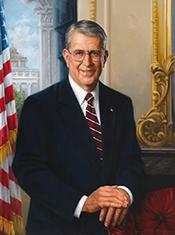
Gerald Solomon
Former U.S. Representative · New York District 22 · 1979–1999 · Republican
Gerald Solomon represented New York's District 22 in the United States House of Representatives (1979–1999) for the Republican party. The page below collects sourced biographical facts, term history, committee roles, and provenance for Solomon.
Bioguide ID: S000675
Key facts
- Full name
- Gerald Solomon
- State
- New York
- District
- District 22
- Party
- Republican
- House service
- 1979–1999
- First House term
- 1979
- Status
- Left office
- Current term ends
- —
- Born
- 1930
- Bioguide ID
- S000675
- Committee assignments
- —
- Dataset version
- 1.20260605
Biographical narrative
1,058 words · sourced from the Wikipedia REST extract
Gerald B. H. Solomon was an American businessman and politician who served as a U.S. Representative for New York's 22nd congressional district from 1979 until 1999. A member of the Republican Party, Solomon was known for his advocacy on defense and veterans' issues, as well as for his role in shaping legislation that impacted military recruitment on college campuses. His political career spanned two decades, during which he held significant positions, including chair of the House Rules Committee. After leaving Congress, he continued to engage in public affairs through lobbying and consulting until his death in 2001.
Early life and career
Gerald Brooks Hunt Solomon was born on August 14, 1930, in Okeechobee, Florida. He was raised by his mother, Eugenia, and his stepfather, Seymour Solomon. At the age of 15, his family relocated to New York, where he completed his education. Solomon attended schools in Florida and Delmar, New York, ultimately graduating from Bethlehem Central High School in 1948. He pursued higher education at Siena College and later at St. Lawrence University, although his academic journey was interrupted by military service.
In the early 1950s, Solomon sought to join the United States Marine Corps Reserve during the Korean War. Initially deemed ineligible due to a childhood illness, he successfully enlisted in 1951. Solomon served as a radio operator with the 2nd Marine Division and was stationed aboard the USS Siboney, a helicopter carrier. He attained the rank of private first class and remained in the Marine Corps Reserve until 1959, achieving the rank of lance corporal.
Following his military service, Solomon entered the business world, becoming involved in various ventures. In the 1950s and 1960s, he worked with M. Solomon, a women's clothing business owned by his stepfather. He later became a partner in the Associates of Glens Falls insurance company and the Anchor Realty real estate brokerage. Additionally, he served as president of Solomon, Veysey, Dixon, Gohn Associates, an investment brokerage. His business acumen and community involvement, including leadership roles in local organizations such as the merchants association and the chamber of commerce, provided him with a platform for political engagement.
Solomon's political career began in 1968 when he was elected as the Town Supervisor of Queensbury, New York, defeating the incumbent. This position also made him a member of the Warren County Board of Supervisors. He was reelected in 1971 and served until December 1972. Initially a Democrat, Solomon switched his party affiliation to Republican in 1968, citing a shift in his political beliefs following the presidency of Lyndon B. Johnson. He subsequently served in the New York State Assembly from 1973 to 1978, where he was known for his fiscal conservatism and advocacy for limited government.
House tenure
In November 1978, Solomon was elected to the U.S. House of Representatives, marking the beginning of a ten-term career in Congress. He quickly became recognized for his strong support of military and defense issues, aligning himself with the Republican Party's conservative agenda. In 1980, he was an early supporter of Ronald Reagan's presidential campaign, advocating for policies aimed at reducing taxes, revitalizing the economy, and strengthening national defense. Solomon's commitment to these principles earned him a prominent position within the party.
Throughout his tenure, Solomon was involved in various legislative initiatives. He was a proponent of the line-item veto and supported a constitutional amendment to ban flag burning. His strong stance on gun rights was evident in his opposition to gun control measures, which included a notable confrontation with fellow Representative Patrick J. Kennedy over the issue. Solomon's advocacy extended to veterans' affairs, where he played a crucial role in efforts to elevate the Veterans Administration to cabinet status, ultimately leading to the establishment of the United States Department of Veterans Affairs.
In 1994, following the Republican Party's takeover of the House, Solomon sought the position of Speaker but withdrew his candidacy in favor of Newt Gingrich, who had garnered majority support among Republican members. Solomon was subsequently appointed as the chairman of the House Rules Committee, a role he held from 1995 until his retirement in 1999. His leadership in this capacity allowed him to influence the legislative process significantly.
Solomon's contributions to veterans' issues were particularly noteworthy. He was instrumental in the creation of the Saratoga National Cemetery, which was later named the Gerald B. H. Solomon Saratoga National Cemetery in his honor. He also led efforts to address the concerns of former Marines regarding the construction of the United States Air Force Memorial, advocating for its relocation to a site deemed more appropriate.
Legislative focus and committees
During his time in the House of Representatives, Solomon's legislative focus encompassed a range of issues, with a strong emphasis on defense, veterans' affairs, and military recruitment. One of his most significant legislative achievements was the introduction and passage of the Solomon Amendment, which prohibited federal funding to colleges and universities that barred military recruiters from their campuses. This legislation underscored his commitment to ensuring that military service was accessible and respected within academic institutions.
In addition to his work on the Solomon Amendment, Solomon was a vocal advocate for various defense-related initiatives. He supported measures aimed at enhancing the capabilities of the U.S. military and ensuring that veterans received the benefits and recognition they deserved. His efforts to elevate the Veterans Administration to cabinet status reflected his dedication to improving the lives of those who served in the armed forces.
Throughout his congressional career, Solomon served on several committees, including the House Rules Committee, where he played a pivotal role in shaping the legislative agenda. His leadership in this committee allowed him to influence the flow of legislation and the rules governing debate and voting in the House. Solomon's tenure was marked by a commitment to conservative principles, fiscal responsibility, and a strong national defense.
After leaving Congress in 1999, Solomon transitioned to the private sector, where he operated a lobbying and strategic consulting firm. His post-congressional career allowed him to continue engaging in public policy and advocacy. Solomon passed away on October 26, 2001, in Queensbury, New York. He was interred at the national veterans' cemetery in Schuylerville, New York, a facility he had championed during his time in office. His legacy in Congress remains tied to his advocacy for veterans and his influence on military recruitment policies in higher education.
Notable legislation
Sponsored and co-sponsored legislation for Gerald Solomon is pending operator curation. The biographical narrative above carries the same provenance trail until per-bill rows are written.
Sources
- [1]https://en.wikipedia.org/wiki/Gerald_SolomonWikipedia · retrieved 2026-06-05
Notable quotes
Sourced quotes for Gerald Solomon are pending operator curation. Narrative-scope provenance remains attached below.
Sources
- [1]https://en.wikipedia.org/wiki/Gerald_SolomonWikipedia · retrieved 2026-06-05
Key positions
Curated policy positions for Gerald Solomon are pending operator review. The biographical narrative above carries the same provenance trail until per-topic positions are written.
Sources
- [1]https://en.wikipedia.org/wiki/Gerald_SolomonWikipedia · retrieved 2026-06-05
Terms served
- 1979–1981U.S. House · Term 1 · Republican
- 1981–1983U.S. House · Term 2 · Republican
- 1983–1985U.S. House · Term 3 · Republican
- 1985–1987U.S. House · Term 4 · Republican
- 1987–1989U.S. House · Term 5 · Republican
- 1989–1991U.S. House · Term 6 · Republican
- 1991–1993U.S. House · Term 7 · Republican
- 1993–1995U.S. House · Term 8 · Republican
- 1995–1997U.S. House · Term 9 · Republican
- 1997–1999U.S. House · Term 10 · Republican
Sources & provenance
Every attributable claim above carries a per-section [N] marker that resolves to the corresponding URL below. Each entry records the upstream provider, the canonical URL, and the timestamp at which the source was retrieved by the ingest pipeline.
Key facts
- https://bioguide.congress.gov/search/bio/S000675bioguide · retrieved 2026-06-05
- https://www.govtrack.us/congress/members/410147govtrack · retrieved 2026-06-05
Biographical narrative
- https://en.wikipedia.org/wiki/Gerald_Solomonwikipedia · retrieved 2026-06-05
Find your representative
Every U.S. state elects representatives by district. Browse New York’s delegation, the full former-representative roster, or explore the role and term length.
Related on The Candidate
- Preceded by Jacob GilbertEarlier holder of the New York District 22 House seat · Democratic.Open
- Succeeded by Richard HannaLater holder of the New York District 22 House seat · Republican.Open
- Abel HuntingtonFormer U.S. Representative · New York District 1 · JacksonOpen
- Alfred ChapinFormer U.S. Representative · New York District 1 · DemocraticOpen
- Cadwallader ColdenFormer U.S. Representative · New York District 1 · FederalistOpen
- Charles FloydFormer U.S. Representative · New York District 1 · DemocraticOpen