
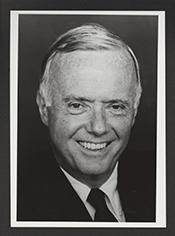
Historical · U.S. House · New York · District 29
Amo Houghton Jr.
Former U.S. Representative · New York District 29 · 1987–2005 · Republican
Amo Houghton Jr. represented New York's District 29 in the United States House of Representatives (1987–2005) for the Republican party. The page below collects sourced biographical facts, term history, committee roles, and provenance for Jr..
Bioguide ID: H000814
Key facts
- Full name
- Amo Houghton Jr.
- State
- New York
- District
- District 29
- Party
- Republican
- House service
- 1987–2005
- First House term
- 1987
- Status
- Left office
- Current term ends
- —
- Born
- 1926
- Bioguide ID
- H000814
- Committee assignments
- —
- Dataset version
- 1.20260605
Biographical narrative
874 words · sourced from the Wikipedia REST extract
Amory Houghton Jr. was an American politician and businessman who served as a U.S. Representative for New York's 29th congressional district from 1987 until 2005. A member of the Republican Party, Houghton was known for his moderate political stance and his efforts to foster bipartisanship in Congress. He came from a prominent family in upstate New York, with deep roots in both business and politics, and was one of the wealthiest members of Congress during his tenure.
Early life and career
Amory Houghton Jr. was born on August 7, 1926, in Corning, New York, into a family with a notable legacy in business and public service. He was the son of Amory Houghton and Laura DeKay Richardson, and the grandson of Alanson B. Houghton, who was also a prominent figure in the region. Houghton received his early education at St. Paul's School in Concord, New Hampshire, where he graduated in 1945. His connection to the school continued later in life when he served as a member of its board of trustees.
In 1944, during World War II, Houghton enlisted in the United States Marine Corps. He served aboard the USS Macon and at Guantanamo Bay Naval Base, participating in operations related to the Battle of the Caribbean. Houghton attained the rank of private first class and was discharged from military service in 1946.
Following his military service, Houghton pursued higher education at Harvard University, where he earned a Bachelor of Arts degree in 1950 and a Master of Business Administration in 1952. He then joined Corning Glass Works, the family business founded in 1851 by his great-great-grandfather. Houghton held various positions within the company, including accountant, process engineer, manufacturing foreman, and sales manager. He became a member of the board of directors in 1955, was appointed vice president in 1957, and served as president starting in 1961. Houghton held the role of chairman and chief executive officer from 1964 until 1983. In addition to his leadership at Corning, he served on the boards of several other major corporations, including IBM, First National City Bank (later Citigroup), Procter & Gamble, Genentech, and B. F. Goodrich.
House tenure
Houghton entered politics in 1986 when he was elected to the United States House of Representatives as a Republican, representing New York's 29th congressional district. His election marked the beginning of a nine-term career in Congress, during which he became known for his moderate voting record. Houghton was often recognized as one of the wealthiest members of Congress, with an estimated net worth of $475 million.
Throughout his time in office, Houghton was regarded as a bridge-builder between the two major political parties. He was a founding member of the Republican Main Street Partnership, an organization aimed at promoting moderate Republican values. His approach to governance emphasized civility and collaboration, and he was frequently called upon to mediate between Democratic and Republican members on contentious issues.
Houghton was re-elected multiple times, often securing more than 65 percent of the vote in his elections. His moderate stance sometimes put him at odds with the more conservative elements of his party, particularly as the Republican Party shifted towards a more Southern and socially conservative orientation. Notably, he was one of the most vocal pro-choice Republicans in Congress.
In 2004, Houghton announced that he would not seek a tenth term in office, and his congressional career concluded on January 3, 2005, when he was succeeded by John R. "Randy" Kuhl.
Legislative focus and committees
During his tenure in the House, Houghton served on several important committees, including the International Relations Committee and the Ways and Means Committee. His legislative focus reflected a blend of traditional Republican priorities and progressive issues. While he generally aligned with Republican positions on budgetary matters, he also supported Democratic initiatives concerning environmental protection, civil rights, and funding for the arts and education.
Houghton was known for his independent voting record on several high-profile issues. He was one of four Republicans who voted against the impeachment articles against President Bill Clinton in 1998, demonstrating his willingness to break with party lines on significant matters. In 2001, he was among a small group of Republicans who opposed the permanent repeal of the estate tax, reflecting his moderate fiscal views.
On October 10, 2002, Houghton was one of six House Republicans who voted against the resolution authorizing the invasion of Iraq, a decision that underscored his cautious approach to foreign military engagements. Additionally, he was one of only three Republicans to oppose an initial version of the Jobs and Growth Tax Relief Reconciliation Act of 2003, although he ultimately supported the final version of the legislation.
Throughout his congressional career, Houghton maintained a reputation as a respected figure in Upstate New York politics. His commitment to bipartisanship and moderate governance earned him recognition among his peers and constituents alike. After leaving office, he continued to engage in public discourse, notably expressing his concerns regarding the presidency of Donald Trump in the years following his retirement.
Houghton passed away on March 4, 2020, leaving behind a legacy as a prominent businessman and a moderate voice in American politics. His contributions to both the business world and public service reflect a life dedicated to leadership and civic engagement.
Notable legislation
Sponsored and co-sponsored legislation for Amo Houghton Jr. is pending operator curation. The biographical narrative above carries the same provenance trail until per-bill rows are written.
Sources
- [1]https://en.wikipedia.org/wiki/Amo_HoughtonWikipedia · retrieved 2026-06-05
Notable quotes
Sourced quotes for Amo Houghton Jr. are pending operator curation. Narrative-scope provenance remains attached below.
Sources
- [1]https://en.wikipedia.org/wiki/Amo_HoughtonWikipedia · retrieved 2026-06-05
Key positions
Curated policy positions for Amo Houghton Jr. are pending operator review. The biographical narrative above carries the same provenance trail until per-topic positions are written.
Sources
- [1]https://en.wikipedia.org/wiki/Amo_HoughtonWikipedia · retrieved 2026-06-05
Terms served
- 1987–1989U.S. House · Term 1 · Republican
- 1989–1991U.S. House · Term 2 · Republican
- 1991–1993U.S. House · Term 3 · Republican
- 1993–1995U.S. House · Term 4 · Republican
- 1995–1997U.S. House · Term 5 · Republican
- 1997–1999U.S. House · Term 6 · Republican
- 1999–2001U.S. House · Term 7 · Republican
- 2001–2003U.S. House · Term 8 · Republican
- 2003–2005U.S. House · Term 9 · Republican
Sources & provenance
Every attributable claim above carries a per-section [N] marker that resolves to the corresponding URL below. Each entry records the upstream provider, the canonical URL, and the timestamp at which the source was retrieved by the ingest pipeline.
Key facts
- https://bioguide.congress.gov/search/bio/H000814bioguide · retrieved 2026-06-05
- http://www.house.gov/houghtonhouse.gov · retrieved 2026-06-05
Biographical narrative
- https://en.wikipedia.org/wiki/Amo_Houghtonwikipedia · retrieved 2026-06-05
Find your representative
Every U.S. state elects representatives by district. Browse New York’s delegation, the full former-representative roster, or explore the role and term length.
Related on The Candidate
- Preceded by Edward PattisonEarlier holder of the New York District 29 House seat · Democratic.Open
- Succeeded by Randy Kuhl Jr.Later holder of the New York District 29 House seat · Republican.Open
- Abel HuntingtonFormer U.S. Representative · New York District 1 · JacksonOpen
- Alfred ChapinFormer U.S. Representative · New York District 1 · DemocraticOpen
- Cadwallader ColdenFormer U.S. Representative · New York District 1 · FederalistOpen
- Charles FloydFormer U.S. Representative · New York District 1 · DemocraticOpen