
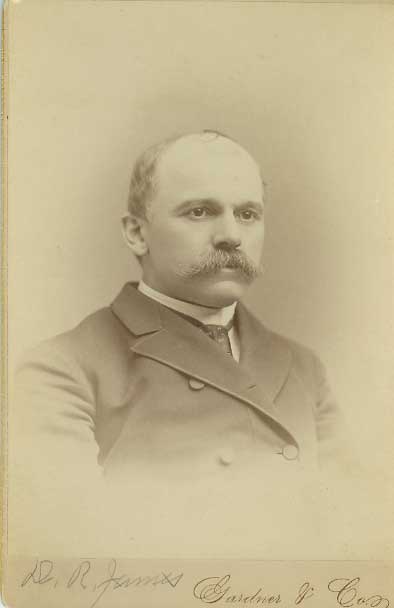
Historical · U.S. House · New York · District 3
Darwin James
Former U.S. Representative · New York District 3 · 1883–1887 · Republican
Darwin James represented New York's District 3 in the United States House of Representatives (1883–1887) for the Republican party. The page below collects sourced biographical facts, term history, committee roles, and provenance for James.
Bioguide ID: J000048
Key facts
- Full name
- Darwin James
- State
- New York
- District
- District 3
- Party
- Republican
- House service
- 1883–1887
- First House term
- 1883
- Status
- Left office
- Current term ends
- —
- Born
- 1834
- Bioguide ID
- J000048
- Committee assignments
- —
- Dataset version
- 1.20260606
Biographical narrative
929 words · sourced from the Wikipedia REST extract
Darwin James was a U.S. Representative from New York who served in the late 19th century. A member of the Republican Party, he held office during the Forty-eighth and Forty-ninth Congresses from 1883 to 1887. His political career was marked by a strong advocacy for free silver, a significant economic issue of his time. After serving two terms in the House of Representatives, he declined renomination and continued his career in various public service roles and mercantile pursuits until his death in 1908.
Early life and career
Darwin Rush James was born on May 14, 1834, in Williamsburg, Massachusetts. His early education took place at the Mount Pleasant Boarding School located in Amherst, Massachusetts, where he likely received a foundational education that would serve him well in his future endeavors. In 1847, when James was thirteen years old, his family relocated to Williamsburg, New York. This move marked a significant transition in his life, as he began to immerse himself in the local community and its economic activities.
In 1850, at the age of sixteen, James entered the mercantile business in New York City. This early foray into commerce provided him with practical experience in trade and business operations, which would later inform his political and economic perspectives. His involvement in the mercantile sector allowed him to develop a network of contacts and gain insights into the economic challenges faced by businesses during that period.
James's career in commerce advanced as he took on several prominent roles. He became the Secretary of the New York Board of Trade and Transportation, a position that placed him at the intersection of commerce and public policy. This role likely enhanced his understanding of the transportation and trade issues that were critical to New York's economic landscape in the late 19th century. Furthermore, his appointment as Park Commissioner of Brooklyn from 1876 to 1882 demonstrated his commitment to public service and urban development, as he was involved in overseeing the management and improvement of public parks during a time of significant urban growth.
House tenure
Darwin James's political career took a significant turn when he was elected to the U.S. House of Representatives as a Republican. His first term began on March 4, 1883, when he was elected to the Forty-eighth Congress. He was subsequently re-elected to the Forty-ninth Congress, serving until March 3, 1887. During his time in Congress, James became known for his strong advocacy of free silver, a monetary policy that aimed to increase the money supply by allowing the free coinage of silver. This issue was a crucial topic of debate during his tenure, reflecting the economic struggles of the time, particularly for farmers and working-class citizens who sought relief from deflationary pressures.
James's support for free silver aligned him with a broader movement within the Republican Party that sought to address the economic challenges faced by many Americans in the post-Civil War era. His position on this issue likely resonated with his constituents, who were concerned about the impact of monetary policy on their livelihoods. However, after serving two terms, James declined renomination for a third term, a decision that may have reflected his desire to pursue other interests or a shift in the political landscape.
Legislative focus and committees
Throughout his congressional career, Darwin James was actively engaged in various legislative matters, with a particular emphasis on economic issues such as free silver. His advocacy for this policy was part of a larger national debate regarding the monetary system and its implications for economic growth and stability. The free silver movement sought to counteract the deflationary pressures that many Americans were experiencing, particularly in rural areas where farmers were struggling with debt and low crop prices.
In addition to his focus on monetary policy, James's legislative work included participation in committees that addressed a range of issues pertinent to his constituents and the nation. While specific committee assignments during his tenure are not detailed in the available records, it is common for members of Congress to serve on committees that align with their interests and the needs of their districts. These committees play a crucial role in shaping legislation, conducting hearings, and overseeing government operations.
After concluding his service in the House of Representatives, James continued to engage in public service. In 1890, he was appointed as the chairman of the United States Board of Indian Commissioners, a position that involved oversight of federal policies and programs related to Native American tribes. This role underscored his ongoing commitment to public service and his interest in addressing complex social issues.
In 1898, James also served as a member of the New York Canal Commission, where he contributed to the management and development of the state's canal system. This involvement reflected his continued engagement with infrastructure and economic development, areas that were vital to New York's growth during that period.
Following his public service roles, James returned to mercantile pursuits, indicating a return to the business world that had initially shaped his career. He remained active in various capacities until his death on November 19, 1908, in Brooklyn, New York. His contributions to both commerce and public service left a lasting impact on his community and the state of New York.
Darwin James was interred in the City Cemetery in Williamsburg, Massachusetts, marking the end of a life dedicated to public service and commerce. His career reflects the complexities of American political and economic life in the late 19th century, highlighting the interplay between business interests and legislative action during a transformative period in U.S. history.
Notable legislation
Sponsored and co-sponsored legislation for Darwin James is pending operator curation. The biographical narrative above carries the same provenance trail until per-bill rows are written.
Sources
- [1]https://en.wikipedia.org/wiki/Darwin_R._JamesWikipedia · retrieved 2026-06-06
Notable quotes
Sourced quotes for Darwin James are pending operator curation. Narrative-scope provenance remains attached below.
Sources
- [1]https://en.wikipedia.org/wiki/Darwin_R._JamesWikipedia · retrieved 2026-06-06
Key positions
Curated policy positions for Darwin James are pending operator review. The biographical narrative above carries the same provenance trail until per-topic positions are written.
Sources
- [1]https://en.wikipedia.org/wiki/Darwin_R._JamesWikipedia · retrieved 2026-06-06
Terms served
- 1883–1885U.S. House · Term 1 · Republican
- 1885–1887U.S. House · Term 2 · Republican
Sources & provenance
Every attributable claim above carries a per-section [N] marker that resolves to the corresponding URL below. Each entry records the upstream provider, the canonical URL, and the timestamp at which the source was retrieved by the ingest pipeline.
Key facts
- https://bioguide.congress.gov/search/bio/J000048bioguide · retrieved 2026-06-06
- https://www.govtrack.us/congress/members/405953govtrack · retrieved 2026-06-06
Biographical narrative
- https://en.wikipedia.org/wiki/Darwin_R._Jameswikipedia · retrieved 2026-06-06
Find your representative
Every U.S. state elects representatives by district. Browse New York’s delegation, the full former-representative roster, or explore the role and term length.
Related on The Candidate
- Preceded by John SmithEarlier holder of the New York District 3 House seat · Independent.Open
- Succeeded by Stephen WhiteLater holder of the New York District 3 House seat · Republican.Open
- Abel HuntingtonFormer U.S. Representative · New York District 1 · JacksonOpen
- Alfred ChapinFormer U.S. Representative · New York District 1 · DemocraticOpen
- Cadwallader ColdenFormer U.S. Representative · New York District 1 · FederalistOpen
- Charles FloydFormer U.S. Representative · New York District 1 · DemocraticOpen