
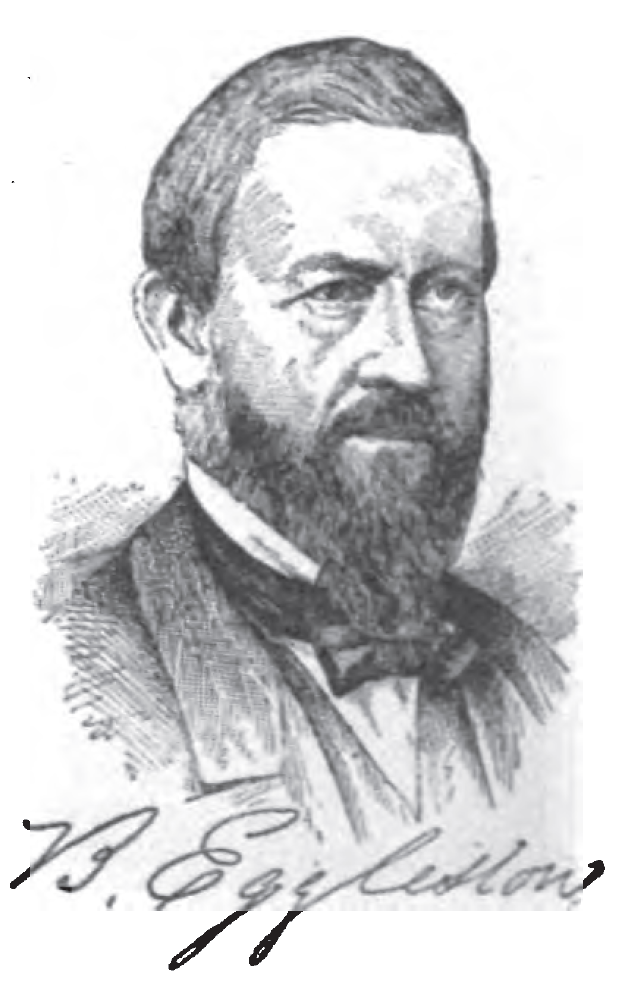
Historical · U.S. House · Ohio · District 1
Benjamin Eggleston
Former U.S. Representative · Ohio District 1 · 1865–1869 · Republican
Benjamin Eggleston represented Ohio's District 1 in the United States House of Representatives (1865–1869) for the Republican party. The page below collects sourced biographical facts, term history, committee roles, and provenance for Eggleston.
Bioguide ID: E000090
Key facts
- Full name
- Benjamin Eggleston
- State
- Ohio
- District
- District 1
- Party
- Republican
- House service
- 1865–1869
- First House term
- 1865
- Status
- Left office
- Current term ends
- —
- Born
- 1816
- Bioguide ID
- E000090
- Committee assignments
- —
- Dataset version
- 1.20260606
Biographical narrative
910 words · sourced from the Wikipedia REST extract
Benjamin Eggleston was a prominent figure in Ohio's political landscape during the mid-19th century. He served as a U.S. Representative for Ohio's 1st congressional district and was affiliated with the Republican Party. His congressional career spanned two terms from 1865 to 1869, during which he participated in significant legislative activities during a transformative period in American history. Prior to his tenure in Congress, Eggleston engaged in various business ventures and held local political positions, contributing to his community and the state of Ohio. After leaving Congress, he continued to be involved in state politics and business until his death in 1888.
Early life and career
Benjamin Eggleston was born on January 3, 1816, in Corinth, New York. His early education included preparatory studies, which laid the groundwork for his future endeavors. In 1831, when he was just fifteen years old, Eggleston moved with his family to Hocking County, Ohio. This move marked a significant transition in his life, as he would spend much of his formative years in Ohio, a state that would later play a crucial role in his political career.
Upon relocating to Ohio, Eggleston initially worked on a canal boat, which was a common means of transportation and trade during that era. This experience not only provided him with insight into the transportation industry but also sparked his entrepreneurial spirit. Over time, he became the owner of several boats and developed interests in various companies, showcasing his ability to engage in mercantile pursuits and navigate the complexities of business.
In 1845, Eggleston settled in Cincinnati, a city that would become central to his professional and political life. In Cincinnati, he continued his engagement in mercantile activities, which likely contributed to his understanding of the economic landscape and the needs of his constituents. His involvement in local governance began when he was elected as the presiding officer of the city council of Cincinnati, a position that allowed him to influence local policy and governance directly.
Eggleston's political aspirations grew, and he became a delegate to the Republican National Convention in 1860, where he played a role in shaping the party's platform during a critical time in American history. Additionally, he served as a presidential elector for the Lincoln/Hamlin ticket in the same year, further solidifying his commitment to the Republican Party and its ideals.
His political career continued to evolve when he was elected to the Ohio Senate, serving from 1862 to 1865. This position provided him with valuable legislative experience and a deeper understanding of state governance, preparing him for his future role in the U.S. Congress.
House tenure
Eggleston's congressional career began when he was elected as a Republican to the Thirty-ninth Congress, which commenced on March 4, 1865. He served in this capacity until March 3, 1869, completing two full terms in the House of Representatives. During his time in Congress, Eggleston was involved in legislative discussions and decisions that were significant to the nation, particularly in the context of post-Civil War America.
His tenure coincided with a period of reconstruction and significant political change, as the country was grappling with the aftermath of the Civil War. The Republican Party, which Eggleston represented, was at the forefront of efforts to address the challenges of rebuilding the nation and integrating formerly enslaved individuals into society. While specific details of his legislative contributions are not provided, it can be inferred that as a member of Congress during this transformative period, Eggleston would have engaged in discussions and votes on key issues related to civil rights, economic recovery, and national unity.
Despite his efforts and contributions during his time in office, Eggleston faced challenges in securing re-election. He was an unsuccessful candidate for re-election to the Forty-first Congress in 1868, marking the end of his formal legislative career at the federal level. However, his political journey did not conclude with his departure from Congress.
Legislative focus and committees
While specific details regarding the committees Eggleston served on during his congressional tenure are not documented, it is reasonable to assume that his background in business and local governance influenced his legislative focus. Given the economic challenges of the time, he may have been involved in discussions surrounding commerce, infrastructure, and economic recovery efforts, particularly as the nation sought to rebuild after the Civil War.
Eggleston's experience in the Ohio Senate prior to his congressional service likely provided him with insights into state-level issues that could have informed his legislative priorities at the national level. His involvement in local politics and business would have equipped him with a unique perspective on the needs of his constituents, allowing him to advocate for policies that aligned with their interests.
After his congressional career, Eggleston returned to Ohio politics, serving again in the Ohio Senate in 1880 and 1881. This return to state politics indicates his continued commitment to public service and his desire to influence policy at the state level. Following his time in the Senate, he resumed his mercantile pursuits, reflecting his ongoing engagement in business and the economy.
Benjamin Eggleston passed away on February 9, 1888, in Cincinnati, Ohio. His contributions to both local and national politics, as well as his entrepreneurial endeavors, left a lasting impact on the communities he served. He was interred in Spring Grove Cemetery, a testament to his life and legacy in Ohio. Through his various roles, Eggleston exemplified the interconnectedness of business and politics during a pivotal era in American history.
Notable legislation
Sponsored and co-sponsored legislation for Benjamin Eggleston is pending operator curation. The biographical narrative above carries the same provenance trail until per-bill rows are written.
Sources
- [1]https://en.wikipedia.org/wiki/Benjamin_EgglestonWikipedia · retrieved 2026-06-06
Notable quotes
Sourced quotes for Benjamin Eggleston are pending operator curation. Narrative-scope provenance remains attached below.
Sources
- [1]https://en.wikipedia.org/wiki/Benjamin_EgglestonWikipedia · retrieved 2026-06-06
Key positions
Curated policy positions for Benjamin Eggleston are pending operator review. The biographical narrative above carries the same provenance trail until per-topic positions are written.
Sources
- [1]https://en.wikipedia.org/wiki/Benjamin_EgglestonWikipedia · retrieved 2026-06-06
Terms served
- 1865–1867U.S. House · Term 1 · Republican
- 1867–1869U.S. House · Term 2 · Republican
Sources & provenance
Every attributable claim above carries a per-section [N] marker that resolves to the corresponding URL below. Each entry records the upstream provider, the canonical URL, and the timestamp at which the source was retrieved by the ingest pipeline.
Key facts
- https://bioguide.congress.gov/search/bio/E000090bioguide · retrieved 2026-06-06
- https://www.govtrack.us/congress/members/403783govtrack · retrieved 2026-06-06
Biographical narrative
- https://en.wikipedia.org/wiki/Benjamin_Egglestonwikipedia · retrieved 2026-06-06
Find your representative
Every U.S. state elects representatives by district. Browse Ohio’s delegation, the full former-representative roster, or explore the role and term length.
Related on The Candidate
- Preceded by Timothy DayEarlier holder of the Ohio District 1 House seat · Ind. Republican-Democrat.Open
- Succeeded by Peter StraderLater holder of the Ohio District 1 House seat · Democratic.Open
- Aaron PerryFormer U.S. Representative · Ohio District 1 · RepublicanOpen
- Alexander DuncanFormer U.S. Representative · Ohio District 1 · DemocraticOpen
- Bellamy StorerFormer U.S. Representative · Ohio District 1 · WhigOpen
- Bellamy StorerFormer U.S. Representative · Ohio District 1 · RepublicanOpen