
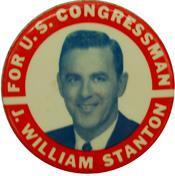
Historical · U.S. House · Ohio · District 11
John Stanton
Former U.S. Representative · Ohio District 11 · 1965–1983 · Republican
John Stanton represented Ohio's District 11 in the United States House of Representatives (1965–1983) for the Republican party. The page below collects sourced biographical facts, term history, committee roles, and provenance for Stanton.
Bioguide ID: S000804
Key facts
- Full name
- John Stanton
- State
- Ohio
- District
- District 11
- Party
- Republican
- House service
- 1965–1983
- First House term
- 1965
- Status
- Left office
- Current term ends
- —
- Born
- 1924
- Bioguide ID
- S000804
- Committee assignments
- —
- Dataset version
- 1.20260605
Biographical narrative
1,058 words · sourced from the Wikipedia REST extract
J. William Stanton was an American politician who served as a Republican U.S. Representative from Ohio's 11th congressional district from 1965 until 1983. His tenure in Congress spanned nine terms, during which he was known for his moderate stances on various issues and his ability to bridge gaps between business interests and labor organizations. Following his congressional career, Stanton continued to engage in public service as an executive at the World Bank. He is remembered as the last Republican to represent Ohio's 11th district in Congress.
Early life and career
J. William Stanton was born on February 20, 1924, in Painesville, Ohio. He was the son of Francis Michael Stanton, a World War I veteran, and Mary Callinan Stanton. His family background was marked by both military service and immigrant roots; his maternal grandfather, Matthew Callinan, was a streetcar conductor who tragically died in one of the largest transportation accidents in American history. Stanton grew up in a household with six children, four of whom passed away before reaching adulthood, which shaped his perspective on life and resilience.
Stanton's early achievements included earning the rank of Eagle Scout, a distinction that would later be recognized with the Distinguished Eagle Scout Award in March 2002. He graduated from Culver Military Academy in June 1942, shortly before receiving his draft notice. His military service during World War II was significant; he served in the 33rd Infantry Division Reconnaissance Troop, participating in campaigns in Hawaii, New Guinea, and the Philippines. His service earned him both the Bronze Star and the Purple Heart.
After returning from military service, Stanton pursued higher education at Georgetown University. Initially considering a career in foreign service, he switched to business administration due to logistical challenges. He graduated in 1949, having served as president of his senior class. Following his graduation, Stanton entered the business world, opening a Lincoln-Mercury dealership in Painesville, which eventually grew into one of the largest Ford Motor Company franchises in the area. Notably, one of his salespeople during this time was Don Shula, who would later become famous as the head coach of the Miami Dolphins.
Stanton's entry into politics was motivated by local issues, particularly a county-wide regulation that affected business development in Painesville. He was elected as a Lake County commissioner in both 1956 and 1960, where he began to establish his reputation as a public servant. His political affiliation with the Republican Party was influenced by his admiration for Abraham Lincoln, although he identified as socially liberal and fiscally conservative, a stance that would characterize his later congressional career.
House tenure
Stanton's congressional career began when he was elected to the 89th Congress, taking office on January 3, 1965. He served in the U.S. House of Representatives until January 3, 1983, completing a total of nine terms. Throughout his time in office, Stanton was known for his pragmatic approach to legislation and his willingness to collaborate with colleagues across party lines. His moderate political stance allowed him to maintain relationships with both business leaders and labor organizations, reflecting his commitment to finding balanced solutions to complex issues.
During his tenure, Stanton participated in significant legislative actions, including voting in favor of landmark legislation such as the Voting Rights Act of 1965 and the Civil Rights Act of 1968. His support for the Medicare program for the elderly was notable, as he was one of only six Republican representatives from Ohio to endorse this initiative. These votes highlighted his willingness to support measures aimed at expanding civil rights and improving healthcare access for Americans.
Stanton's ability to navigate the political landscape of the time was indicative of his understanding of the needs and concerns of his constituents. He was known for his focus on issues that affected everyday Americans, which resonated with voters in his district. His long tenure in Congress allowed him to build a reputation as a reliable representative who was attentive to the evolving needs of his constituents.
Despite his success in Congress, Stanton chose not to seek re-election for the 98th United States Congress. His decision marked the end of an era for the 11th district, as he was the last Republican to hold that seat. Following his congressional career, he transitioned to a role at the World Bank, where he continued to engage in public service and contribute to international development efforts.
Legislative focus and committees
Throughout his time in the House of Representatives, Stanton was involved in various legislative committees and initiatives that reflected his interests and the needs of his constituents. His moderate political philosophy allowed him to engage with a wide range of issues, from civil rights to healthcare and economic development. He was particularly focused on legislation that aimed to improve the quality of life for his constituents in Ohio.
Stanton's support for civil rights legislation was a significant aspect of his legislative focus. By voting in favor of the Voting Rights Act and the Civil Rights Act, he demonstrated a commitment to advancing equality and justice in American society. His actions in this area were indicative of a broader trend among some moderate Republicans during the 1960s and 1970s, who sought to align with civil rights movements while maintaining their party affiliation.
In addition to civil rights, Stanton's support for the Medicare program illustrated his concern for the elderly and the importance of accessible healthcare. His backing of such initiatives positioned him as a representative who prioritized the welfare of vulnerable populations, aligning with the needs of many constituents in his district.
Stanton's involvement in various committees allowed him to influence a range of policies and initiatives. His ability to work across party lines and engage with different stakeholders was a hallmark of his legislative approach. This collaborative spirit enabled him to advocate effectively for his constituents while navigating the complexities of congressional politics.
In summary, J. William Stanton's career as a U.S. Representative was marked by significant contributions to civil rights and healthcare legislation, reflecting his commitment to serving the needs of his constituents. His moderate stance and ability to collaborate with diverse groups distinguished him as a notable figure in Ohio politics during his time in office. After leaving Congress, he continued to engage in public service, leaving a legacy of dedication to both his community and the broader goals of social and economic progress.
Notable legislation
Sponsored and co-sponsored legislation for John Stanton is pending operator curation. The biographical narrative above carries the same provenance trail until per-bill rows are written.
Sources
- [1]https://en.wikipedia.org/wiki/J._William_StantonWikipedia · retrieved 2026-06-05
Notable quotes
Sourced quotes for John Stanton are pending operator curation. Narrative-scope provenance remains attached below.
Sources
- [1]https://en.wikipedia.org/wiki/J._William_StantonWikipedia · retrieved 2026-06-05
Key positions
Curated policy positions for John Stanton are pending operator review. The biographical narrative above carries the same provenance trail until per-topic positions are written.
Sources
- [1]https://en.wikipedia.org/wiki/J._William_StantonWikipedia · retrieved 2026-06-05
Terms served
- 1965–1967U.S. House · Term 1 · Republican
- 1967–1969U.S. House · Term 2 · Republican
- 1969–1971U.S. House · Term 3 · Republican
- 1971–1973U.S. House · Term 4 · Republican
- 1973–1975U.S. House · Term 5 · Republican
- 1975–1977U.S. House · Term 6 · Republican
- 1977–1979U.S. House · Term 7 · Republican
- 1979–1981U.S. House · Term 8 · Republican
- 1981–1983U.S. House · Term 9 · Republican
Sources & provenance
Every attributable claim above carries a per-section [N] marker that resolves to the corresponding URL below. Each entry records the upstream provider, the canonical URL, and the timestamp at which the source was retrieved by the ingest pipeline.
Key facts
- https://bioguide.congress.gov/search/bio/S000804bioguide · retrieved 2026-06-05
- https://www.govtrack.us/congress/members/410270govtrack · retrieved 2026-06-05
Biographical narrative
- https://en.wikipedia.org/wiki/J._William_Stantonwikipedia · retrieved 2026-06-05
Find your representative
Every U.S. state elects representatives by district. Browse Ohio’s delegation, the full former-representative roster, or explore the role and term length.
Related on The Candidate
- Preceded by Oliver BoltonEarlier holder of the Ohio District 11 House seat · Republican.Open
- Succeeded by Stephanie JonesLater holder of the Ohio District 11 House seat · Democratic.Open
- Aaron PerryFormer U.S. Representative · Ohio District 1 · RepublicanOpen
- Alexander DuncanFormer U.S. Representative · Ohio District 1 · DemocraticOpen
- Bellamy StorerFormer U.S. Representative · Ohio District 1 · WhigOpen
- Bellamy StorerFormer U.S. Representative · Ohio District 1 · RepublicanOpen