
Historical · U.S. House · Ohio · District 11
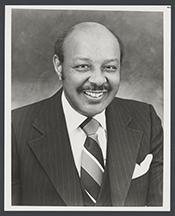
Louis Stokes
Former U.S. Representative · Ohio District 11 · 1969–1999 · Democratic
Louis Stokes represented Ohio's District 11 in the United States House of Representatives (1969–1999) for the Democratic party. The page below collects sourced biographical facts, term history, committee roles, and provenance for Stokes.
Bioguide ID: S000948
Key facts
- Full name
- Louis Stokes
- State
- Ohio
- District
- District 11
- Party
- Democratic
- House service
- 1969–1999
- First House term
- 1969
- Status
- Left office
- Current term ends
- —
- Born
- 1925
- Bioguide ID
- S000948
- Committee assignments
- —
- Dataset version
- 1.20260605
Biographical narrative
1,020 words · sourced from the Wikipedia REST extract
Louis Stokes was an American attorney and politician who served as a U.S. Representative for Ohio's 11th congressional district. A member of the Democratic Party, he was notable for being the first African American congressman elected from Ohio. Stokes had a distinguished career in the U.S. House of Representatives, spanning 30 years, during which he held significant leadership roles, including chairmanship of the United States House Permanent Select Committee on Intelligence and the Congressional Black Caucus. His legislative work focused on civil rights, veterans' issues, and ethics, leaving a lasting impact on both his constituents and the broader political landscape.
Early life and career
Louis Stokes was born on February 23, 1925, in Cleveland, Ohio, to Louise and Charles Stokes. He grew up in a challenging environment, living with his brother, Carl B. Stokes, in one of the first federally funded housing projects known as the Outhwaite Homes. This early experience in a public housing project would later inform his commitment to civil rights and social justice.
Stokes attended Central High School in Cleveland and, following his graduation, served in the United States Army from 1943 to 1946 during World War II. After his military service, he took advantage of the G.I. Bill to pursue higher education. He attended Western Reserve University and later enrolled in the Cleveland State University College of Law, where he earned his law degree in 1953. Following his graduation, Stokes began his legal career in Cleveland, where he became known for his advocacy in civil rights cases. Notably, he argued the landmark case of Terry v. Ohio before the United States Supreme Court in 1968, which addressed issues related to police practices and the Fourth Amendment.
Stokes entered politics in 1968 when he was elected to the U.S. House of Representatives, initially representing Ohio's 21st District. His election marked a significant milestone as he became the first African American congressman from Ohio. Following a redistricting in 1992, he transitioned to represent the newly created 11th District, which encompassed much of the same area he had previously served. Over the course of his career, Stokes was re-elected multiple times, ultimately serving a total of 15 terms in Congress before retiring in 1999.
House tenure
During his extensive tenure in the House of Representatives, Stokes was known for his commitment to securing funding and resources for his constituents, particularly in Cleveland. He served on the House Appropriations Committee, where he played a crucial role in advocating for financial support for various projects and initiatives in his district. Stokes had a particular focus on veterans' issues, working to secure funding for healthcare facilities and services for veterans in the Cleveland area.
In addition to his work on appropriations, Stokes held several prominent leadership positions during his time in Congress. In the 1970s, he was appointed chairman of the United States House Select Committee on Assassinations, which was tasked with investigating the murders of President John F. Kennedy and civil rights leader Martin Luther King Jr. This role placed him at the center of significant historical inquiries and underscored his commitment to addressing issues of justice and accountability.
Stokes also served on the House committee that investigated the Iran–Contra Affair, a political scandal that involved the secret sale of arms to Iran to fund Contra rebels in Nicaragua. His leadership extended to the United States House Committee on Ethics, where he oversaw investigations into corruption scandals, including the Abscam case, which ultimately led to the convictions of several members of Congress. His reputation for integrity and commitment to ethical governance was recognized by colleagues and legal professionals alike.
In 1971, Stokes was a founding member of the Congressional Black Caucus, an organization that aimed to address the legislative concerns of African Americans and advocate for civil rights. His involvement in this group highlighted his dedication to advancing the interests of marginalized communities and ensuring their voices were heard in the legislative process.
In 1992, Stokes made a bid for the presidency as a favorite son candidate from Ohio, garnering delegates from his home district. His campaign, while not ultimately successful, reflected his prominence within the Democratic Party and his influence in Ohio politics.
Legislative focus and committees
Throughout his congressional career, Stokes focused on a range of legislative issues, with a particular emphasis on civil rights, veterans' affairs, and ethics in government. His work on the House Appropriations Committee allowed him to secure vital funding for various programs and initiatives that benefited his constituents, especially in the areas of healthcare and education.
Stokes was particularly passionate about veterans' issues, advocating for improved healthcare services and facilities for veterans in Cleveland. His efforts in this area helped to enhance the quality of care available to those who had served in the military, reflecting his commitment to supporting those who had sacrificed for their country.
In addition to his work on veterans' affairs, Stokes was deeply involved in civil rights legislation. His role as chairman of the House Select Committee on Assassinations placed him at the forefront of investigations into pivotal moments in American history, and he used this platform to advocate for justice and accountability. His leadership on the House Committee on Ethics during the Abscam scandal demonstrated his commitment to maintaining integrity within the legislative process, reinforcing the importance of ethical conduct among elected officials.
After retiring from Congress in 1999, Stokes continued to contribute to public life as a distinguished visiting professor at the Jack, Joseph and Morton Mandel School of Applied Social Sciences at Case Western Reserve University. He remained active in this role until his passing, furthering his legacy as an educator and advocate for social justice.
Stokes passed away on August 18, 2015, at the age of 90, after battling brain and lung cancer. His contributions to American politics and civil rights continue to be recognized and honored, with various institutions and facilities named in his memory, including the Louis Stokes Cleveland Department of Veteran Affairs Medical Center and the Louis Stokes Museum. His life and work remain a testament to the impact of dedicated public service and advocacy for marginalized communities.
Notable legislation
Sponsored and co-sponsored legislation for Louis Stokes is pending operator curation. The biographical narrative above carries the same provenance trail until per-bill rows are written.
Sources
- [1]https://en.wikipedia.org/wiki/Louis_StokesWikipedia · retrieved 2026-06-05
Notable quotes
Sourced quotes for Louis Stokes are pending operator curation. Narrative-scope provenance remains attached below.
Sources
- [1]https://en.wikipedia.org/wiki/Louis_StokesWikipedia · retrieved 2026-06-05
Key positions
Curated policy positions for Louis Stokes are pending operator review. The biographical narrative above carries the same provenance trail until per-topic positions are written.
Sources
- [1]https://en.wikipedia.org/wiki/Louis_StokesWikipedia · retrieved 2026-06-05
Terms served
- 1969–1971U.S. House · Term 1 · Democratic
- 1971–1973U.S. House · Term 2 · Democratic
- 1973–1975U.S. House · Term 3 · Democratic
- 1975–1977U.S. House · Term 4 · Democratic
- 1977–1979U.S. House · Term 5 · Democratic
- 1979–1981U.S. House · Term 6 · Democratic
- 1981–1983U.S. House · Term 7 · Democratic
- 1983–1985U.S. House · Term 8 · Democratic
- 1985–1987U.S. House · Term 9 · Democratic
- 1987–1989U.S. House · Term 10 · Democratic
- 1989–1991U.S. House · Term 11 · Democratic
- 1991–1993U.S. House · Term 12 · Democratic
- 1993–1995U.S. House · Term 13 · Democratic
- 1995–1997U.S. House · Term 14 · Democratic
- 1997–1999U.S. House · Term 15 · Democratic
Sources & provenance
Every attributable claim above carries a per-section [N] marker that resolves to the corresponding URL below. Each entry records the upstream provider, the canonical URL, and the timestamp at which the source was retrieved by the ingest pipeline.
Key facts
- https://bioguide.congress.gov/search/bio/S000948bioguide · retrieved 2026-06-05
- https://www.govtrack.us/congress/members/410407govtrack · retrieved 2026-06-05
Biographical narrative
- https://en.wikipedia.org/wiki/Louis_Stokeswikipedia · retrieved 2026-06-05
Find your representative
Every U.S. state elects representatives by district. Browse Ohio’s delegation, the full former-representative roster, or explore the role and term length.
Related on The Candidate
- Preceded by Oliver BoltonEarlier holder of the Ohio District 11 House seat · Republican.Open
- Succeeded by Stephanie JonesLater holder of the Ohio District 11 House seat · Democratic.Open
- Aaron PerryFormer U.S. Representative · Ohio District 1 · RepublicanOpen
- Alexander DuncanFormer U.S. Representative · Ohio District 1 · DemocraticOpen
- Bellamy StorerFormer U.S. Representative · Ohio District 1 · WhigOpen
- Bellamy StorerFormer U.S. Representative · Ohio District 1 · RepublicanOpen