
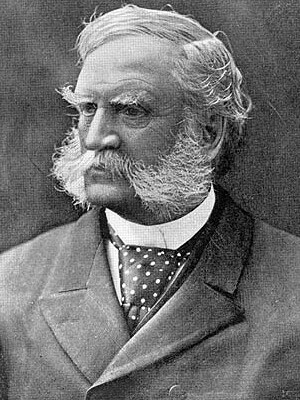
Historical · U.S. House · Ohio · District 13
George Morgan
Former U.S. Representative · Ohio District 13 · 1867–1873 · Democratic
George Morgan represented Ohio's District 13 in the United States House of Representatives (1867–1873) for the Democratic party. The page below collects sourced biographical facts, term history, committee roles, and provenance for Morgan.
Bioguide ID: M000950
Key facts
- Full name
- George Morgan
- State
- Ohio
- District
- District 13
- Party
- Democratic
- House service
- 1867–1873
- First House term
- 1867
- Status
- Left office
- Current term ends
- —
- Born
- 1820
- Bioguide ID
- M000950
- Committee assignments
- —
- Dataset version
- 1.20260606
Biographical narrative
949 words · sourced from the Wikipedia REST extract
George Morgan was an American soldier, lawyer, politician, and diplomat who served as a U.S. Representative for Ohio's 13th congressional district during the Reconstruction era. A member of the Democratic Party, he held office from 1867 until 1873, completing three terms in Congress. Before his political career, Morgan had a distinguished military background, having fought in the Texas Revolution, the Mexican-American War, and serving as a general in the Union Army during the American Civil War. His contributions to both military and public service reflect a life dedicated to his country through various roles.
Early life and career
George Morgan was born on September 20, 1820, in Washington County, Pennsylvania, into a family of notable standing. His grandfather, Colonel George Morgan, was recognized for providing critical information to President Thomas Jefferson regarding a conspiracy involving Aaron Burr. This legacy of public service likely influenced Morgan's own career path. He received his early education in local schools and later attended Washington College. However, at the age of 16, he left college in 1836 to enlist in a military company led by his older brother, Thomas Jefferson Morgan. This decision marked the beginning of a lifelong commitment to military service, as he traveled to Mexican Texas to participate in the fight for independence from Mexico.
Morgan's military career began in earnest when he received a commission as a lieutenant in the regular Texas Army under the command of Sam Houston. He quickly advanced to the rank of captain, taking command of the post at Galveston. His service included participation in Captain Robertson's rangers and Company B of the First Regiment of Texas Rangers. After resigning from the Texas Army in 1839, he returned to Pennsylvania and pursued a legal education.
In 1841, Morgan entered the United States Military Academy but left two years later due to academic challenges. He then relocated to Mount Vernon, Ohio, where he studied law, passed the bar exam, and established a legal practice in 1845. His legal career included serving as the prosecutor for Knox County. With the outbreak of the Mexican-American War, Morgan was appointed Colonel of the 2nd Ohio Volunteer Infantry and later became Colonel of the 15th U.S. Infantry. His leadership during the war earned him a brevet promotion to brigadier general for his bravery in battles such as Contreras and Churubusco, where he sustained severe injuries. Following his military service, he resumed his law practice and married Sarah H. Hall in 1851, with whom he had two children.
Morgan's diplomatic career began in 1856 when he was appointed by President James Buchanan as the United States Consul to Marseille, France. Two years later, he was promoted to Minister to Portugal, a position he held until the onset of the Civil War in 1861.
House tenure
Morgan's political career in the U.S. Congress began in 1866 when he was elected to the Fortieth Congress, representing Ohio's 13th District. He served on the Committee on Foreign Affairs and was notable for his opposition to the impeachment of President Andrew Johnson. His initial term was marked by political challenges, including a contested reelection in 1868 against Republican candidate Columbus Delano, who ultimately took his seat. However, Morgan's determination led him to campaign again in 1870, successfully regaining his position in the House of Representatives.
During his time in Congress, Morgan served on several committees, including those focused on foreign affairs, military affairs, and reconstruction. He was an outspoken critic of the Radical Republicans and their approach to Reconstruction policies, which he believed were excessively harsh. His tenure was characterized by a commitment to advocating for a more moderate approach to rebuilding the South after the Civil War.
Morgan's political ambitions extended beyond his role as a Congressman; he sought the position of Speaker of the House but was defeated by James G. Blaine. His legislative activities reflected his alignment with Democratic principles, and he often found himself at odds with the prevailing sentiments of his party during the Reconstruction era.
Legislative focus and committees
Throughout his congressional career, Morgan's legislative focus was shaped by his experiences in military service and his legal background. He was particularly engaged in issues related to foreign affairs, military policy, and the complexities of Reconstruction. His position on the Committee on Foreign Affairs allowed him to influence matters pertaining to U.S. diplomatic relations and international policy, reflecting his earlier experience as a diplomat.
Morgan's opposition to the impeachment of President Andrew Johnson highlighted his belief in a more lenient approach to governance during a tumultuous period in American history. He argued against the extreme measures proposed by some factions within his party, advocating instead for reconciliation and a more measured response to the challenges facing the nation.
His involvement in military affairs was also significant, given his extensive background as a soldier. Morgan's insights into military strategy and policy were informed by his firsthand experiences in various conflicts, including the Civil War. This expertise allowed him to contribute meaningfully to discussions on military readiness and the implications of military actions during his time in office.
Morgan's commitment to addressing the needs of his constituents in Ohio's 13th District was evident throughout his legislative career. He navigated the complexities of post-war politics while striving to represent the interests of his constituents, balancing national concerns with local priorities.
Following his final term in the House, which ended on March 3, 1873, Morgan's political career transitioned into retirement. His legacy as a soldier, lawyer, and public servant reflects a life dedicated to the principles of democracy and civic engagement. He passed away on July 26, 1893, leaving behind a multifaceted legacy that encompassed military valor, legal acumen, and political service.
Notable legislation
Sponsored and co-sponsored legislation for George Morgan is pending operator curation. The biographical narrative above carries the same provenance trail until per-bill rows are written.
Sources
- [1]https://en.wikipedia.org/wiki/George_W._MorganWikipedia · retrieved 2026-06-06
Notable quotes
Sourced quotes for George Morgan are pending operator curation. Narrative-scope provenance remains attached below.
Sources
- [1]https://en.wikipedia.org/wiki/George_W._MorganWikipedia · retrieved 2026-06-06
Key positions
Curated policy positions for George Morgan are pending operator review. The biographical narrative above carries the same provenance trail until per-topic positions are written.
Sources
- [1]https://en.wikipedia.org/wiki/George_W._MorganWikipedia · retrieved 2026-06-06
Terms served
- 1867–1869U.S. House · Term 1 · Democratic
- 1869–1871U.S. House · Term 2 · Democratic
- 1871–1873U.S. House · Term 3 · Democratic
Sources & provenance
Every attributable claim above carries a per-section [N] marker that resolves to the corresponding URL below. Each entry records the upstream provider, the canonical URL, and the timestamp at which the source was retrieved by the ingest pipeline.
Key facts
- https://bioguide.congress.gov/search/bio/M000950bioguide · retrieved 2026-06-06
- https://www.govtrack.us/congress/members/407918govtrack · retrieved 2026-06-06
Biographical narrative
- https://en.wikipedia.org/wiki/George_W._Morganwikipedia · retrieved 2026-06-06
Find your representative
Every U.S. state elects representatives by district. Browse Ohio’s delegation, the full former-representative roster, or explore the role and term length.
Related on The Candidate
- Preceded by John O’NeillEarlier holder of the Ohio District 13 House seat · Democratic.Open
- Succeeded by Milton SouthardLater holder of the Ohio District 13 House seat · Democratic.Open
- Aaron PerryFormer U.S. Representative · Ohio District 1 · RepublicanOpen
- Alexander DuncanFormer U.S. Representative · Ohio District 1 · DemocraticOpen
- Bellamy StorerFormer U.S. Representative · Ohio District 1 · WhigOpen
- Bellamy StorerFormer U.S. Representative · Ohio District 1 · RepublicanOpen