
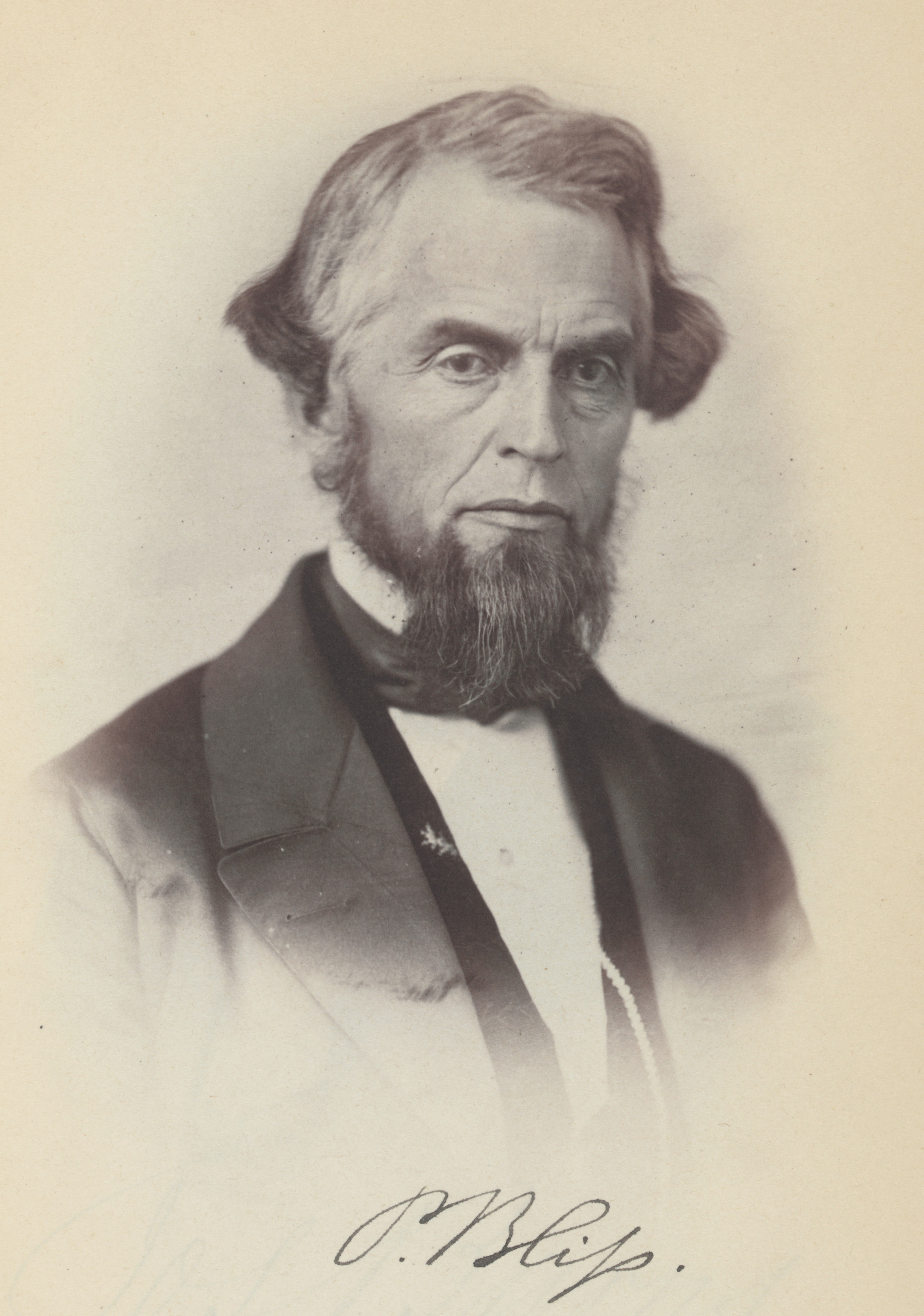
Historical · U.S. House · Ohio · District 14
Philemon Bliss
Former U.S. Representative · Ohio District 14 · 1855–1859 · Republican
Philemon Bliss represented Ohio's District 14 in the United States House of Representatives (1855–1859) for the Republican party. The page below collects sourced biographical facts, term history, committee roles, and provenance for Bliss.
Bioguide ID: B000560
Key facts
- Full name
- Philemon Bliss
- State
- Ohio
- District
- District 14
- Party
- Republican
- House service
- 1855–1859
- First House term
- 1855
- Status
- Left office
- Current term ends
- —
- Born
- 1813
- Bioguide ID
- B000560
- Committee assignments
- —
- Dataset version
- 1.20260606
Biographical narrative
985 words · sourced from the Wikipedia REST extract
Philemon Bliss was a prominent American lawyer and politician who served as a U.S. Representative from Ohio's 14th congressional district during the mid-19th century. Born on July 28, 1813, in Canton, Connecticut, he played a significant role in the political landscape of his time, particularly as a member of the Republican Party. Bliss's career extended beyond his congressional tenure, as he later became the first chief justice of the Supreme Court of the Dakota Territory and served as an associate justice on the Supreme Court of Missouri. His contributions to law and politics continued to be recognized long after his death on August 25, 1889.
Early life and career
Philemon Bliss was born to Asahel Bliss and Lydia Adams (Griswold) Bliss in a small town in Connecticut. His early education took place at Fairfield Academy, where he laid the groundwork for his future studies in law. He furthered his education at Hamilton College, a well-regarded institution that helped shape his legal career. After completing his studies, Bliss moved to Elyria, Ohio, where he continued his legal education under the guidance of his brother, Albert Bliss, who was already practicing law.
In 1840, Bliss successfully passed the bar examination, marking the beginning of his legal career. He initially practiced law in Cuyahoga Falls, Ohio, before relocating to Elyria, where he established a more permanent legal practice. His work in law not only involved representing clients but also engaging with the broader legal community, which would later influence his political aspirations. On November 16, 1843, he married Martha W. Thorpe, and together they had three children. His family life was an important aspect of his identity, providing him with a support system as he navigated his professional endeavors.
Bliss's legal career advanced significantly when he was appointed as the presiding judge of the 14th Judicial Circuit of Ohio, a position he held from 1848 to 1851. This role allowed him to gain valuable experience in the judiciary, further solidifying his reputation as a capable legal mind. His judicial responsibilities likely contributed to his understanding of the legislative process and the importance of law in governance, which would later inform his work as a congressman.
House tenure
Philemon Bliss's political career took a decisive turn when he decided to run for a seat in the United States House of Representatives. He was elected as a Republican to the 34th Congress, serving from 1855 to 1857. His election came during a tumultuous period in American history, marked by intense debates over issues such as slavery and westward expansion. Bliss was known as an Anti-Nebraska candidate, reflecting his opposition to the Kansas-Nebraska Act, which allowed for the possibility of slavery in territories that had previously been free.
During his first term in Congress, Bliss participated in discussions and legislative actions that were pivotal to the political climate of the time. His alignment with the Republican Party positioned him among those advocating for the abolition of slavery and the promotion of free soil policies. Following his initial term, he was re-elected to the 35th Congress, where he continued to serve until March 3, 1859. However, he chose not to seek re-election in 1858, concluding his time in the House after two terms.
Bliss's congressional tenure was characterized by his commitment to the principles of the Republican Party and his active engagement in legislative matters. While specific details of his voting record and legislative initiatives are not documented in the available references, it is evident that his role as a congressman was significant during a critical juncture in American history. The political environment of the 1850s was fraught with conflict, and Bliss's contributions were part of the broader narrative of the era.
Legislative focus and committees
Throughout his time in the House of Representatives, Philemon Bliss's legislative focus aligned with the key issues of his day, particularly those concerning the expansion of slavery and the rights of free men. As a member of the Republican Party, he was part of a growing movement that sought to challenge the status quo and advocate for a more equitable society. His work in Congress was influenced by the national debates surrounding the morality and legality of slavery, as well as the implications of territorial expansion for the nation.
While specific committee assignments during his congressional tenure are not detailed in the available references, it is common for members of Congress to serve on committees that align with their interests and expertise. Given Bliss's legal background, it is plausible that he may have participated in committees related to judiciary matters, land policies, or other areas pertinent to his experience and the pressing issues of the time.
After concluding his congressional service, Bliss continued to influence the legal landscape of the United States through various judicial appointments. In 1861, President Abraham Lincoln appointed him as the chief justice of the Supreme Court of the Dakota Territory, a role that underscored his legal acumen and commitment to public service. He later served as an associate justice on the Supreme Court of Missouri from 1868 to 1872, further solidifying his legacy in the judiciary.
In addition to his judicial roles, Bliss's contributions to legal education were significant. After retiring from the bench, he became the Law Dean at the University of Missouri, where he imparted his knowledge and experience to the next generation of legal professionals. His commitment to education and the law remained evident until his passing in Saint Paul, Minnesota, in 1889.
Philemon Bliss's legacy endures through various honors, including the establishment of the Philemon Bliss Scholarship at the University of Missouri School of Law, which recognizes his contributions to the field of law and education. His life and career reflect the complexities of American history during a time of significant change, and his work in both the legislative and judicial branches of government showcases his dedication to the principles of justice and governance.
Notable legislation
Sponsored and co-sponsored legislation for Philemon Bliss is pending operator curation. The biographical narrative above carries the same provenance trail until per-bill rows are written.
Sources
- [1]https://en.wikipedia.org/wiki/Philemon_BlissWikipedia · retrieved 2026-06-06
Notable quotes
Sourced quotes for Philemon Bliss are pending operator curation. Narrative-scope provenance remains attached below.
Sources
- [1]https://en.wikipedia.org/wiki/Philemon_BlissWikipedia · retrieved 2026-06-06
Key positions
Curated policy positions for Philemon Bliss are pending operator review. The biographical narrative above carries the same provenance trail until per-topic positions are written.
Sources
- [1]https://en.wikipedia.org/wiki/Philemon_BlissWikipedia · retrieved 2026-06-06
Terms served
- 1855–1857U.S. House · Term 1 · Ind. Republican-Democrat
- 1857–1859U.S. House · Term 2 · Republican
Sources & provenance
Every attributable claim above carries a per-section [N] marker that resolves to the corresponding URL below. Each entry records the upstream provider, the canonical URL, and the timestamp at which the source was retrieved by the ingest pipeline.
Key facts
- https://bioguide.congress.gov/search/bio/B000560bioguide · retrieved 2026-06-06
- https://www.govtrack.us/congress/members/401534govtrack · retrieved 2026-06-06
Biographical narrative
- https://en.wikipedia.org/wiki/Philemon_Blisswikipedia · retrieved 2026-06-06
Find your representative
Every U.S. state elects representatives by district. Browse Ohio’s delegation, the full former-representative roster, or explore the role and term length.
Related on The Candidate
- Preceded by Harvey JohnsonEarlier holder of the Ohio District 14 House seat · Democratic.Open
- Succeeded by Cyrus SpinkLater holder of the Ohio District 14 House seat · Republican.Open
- Aaron PerryFormer U.S. Representative · Ohio District 1 · RepublicanOpen
- Alexander DuncanFormer U.S. Representative · Ohio District 1 · DemocraticOpen
- Bellamy StorerFormer U.S. Representative · Ohio District 1 · WhigOpen
- Bellamy StorerFormer U.S. Representative · Ohio District 1 · RepublicanOpen