
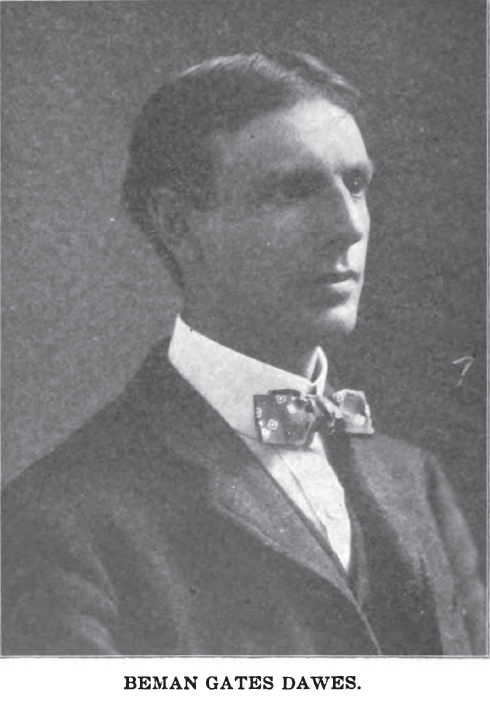
Historical · U.S. House · Ohio · District 15
Beman Dawes
Former U.S. Representative · Ohio District 15 · 1905–1909 · Republican
Beman Dawes represented Ohio's District 15 in the United States House of Representatives (1905–1909) for the Republican party. The page below collects sourced biographical facts, term history, committee roles, and provenance for Dawes.
Bioguide ID: D000146
Key facts
- Full name
- Beman Dawes
- State
- Ohio
- District
- District 15
- Party
- Republican
- House service
- 1905–1909
- First House term
- 1905
- Status
- Left office
- Current term ends
- —
- Born
- 1870
- Bioguide ID
- D000146
- Committee assignments
- —
- Dataset version
- 1.20260606
Biographical narrative
870 words · sourced from the Wikipedia REST extract
Beman Gates Dawes was a notable American politician and oil executive who served as a U.S. Representative for Ohio's 15th congressional district from 1905 to 1909. A member of the Republican Party, Dawes played a role in the legislative processes of the Fifty-ninth and Sixtieth United States Congresses. His career was marked by a blend of public service and private enterprise, reflecting the dynamic interplay between politics and business during the early 20th century. Dawes was born into a family with a rich historical legacy, being a descendant of William Dawes, a figure from the American Revolution, and the son of a Civil War general. His contributions to both his community and the nation are remembered through his political service and later endeavors in the oil industry and public education.
Early life and career
Beman Dawes was born on January 14, 1870, in Marietta, Ohio. His lineage included significant historical figures, as he was a direct descendant of William Dawes, who is best known for his role in alerting colonial militia of the approaching British forces during the American Revolution. Additionally, he was the son of Rufus R. Dawes, a Brevet Brigadier General in the Union Army during the American Civil War. This background likely influenced his early interests in public service and leadership.
Dawes received his education in the public schools of Marietta, where he laid the foundation for his future endeavors. He furthered his education at Marietta College, graduating with the Class of 1890. Following his graduation, he married Bertie Burr on October 3, 1894. The couple’s partnership would later extend into their philanthropic efforts, particularly with the establishment of the Dawes Arboretum.
In the years leading up to his congressional career, Dawes engaged in various professional pursuits. He worked in agriculture and engineering, fields that provided him with a practical understanding of the economic and infrastructural needs of his community. His involvement in public utilities also began during this time, reflecting a growing interest in the development of essential services that would benefit the public. In 1903, he became the President of The Ohio River Bridge & Ferry Company, a position that underscored his commitment to improving transportation and connectivity in the region, particularly with the construction of the Williamstown–Marietta Bridge.
House tenure
Beman Dawes entered the U.S. House of Representatives in 1905, representing Ohio's 15th District. His tenure in Congress spanned two terms, during which he participated in the legislative activities of both the Fifty-ninth and Sixtieth United States Congresses. As a member of the Republican Party, Dawes aligned with the political priorities of his time, which included issues related to economic development, infrastructure, and public utilities.
During his time in Congress, Dawes was involved in discussions and decisions that shaped the legislative landscape of the early 20th century. The period was marked by significant changes in American society, including industrialization and urbanization, which presented both challenges and opportunities for lawmakers. While specific details of his legislative actions and the bills he supported are not documented in the available references, it is understood that his background in engineering and public utilities likely informed his contributions to discussions on infrastructure and economic policy.
Dawes's congressional service concluded on March 3, 1909, after which he did not seek re-election. His decision to leave Congress may have been influenced by his growing interests in other sectors, particularly in the oil industry, where he would later make significant contributions.
Legislative focus and committees
Throughout his congressional career, Beman Dawes's legislative focus was likely influenced by his professional background and personal interests. Given his experience in engineering and public utilities, it can be inferred that he would have been engaged in discussions regarding infrastructure development, transportation, and the regulation of public services. These areas were critical during the early 1900s, as the nation was experiencing rapid growth and modernization.
Although specific committee assignments during his tenure are not detailed in the available references, it is common for representatives to serve on committees that align with their expertise and the interests of their constituents. Dawes's involvement in infrastructure-related projects prior to his congressional service would have positioned him as a knowledgeable voice on matters concerning public works and utilities.
After leaving Congress, Dawes transitioned into the oil industry, where he became involved in the production of oil and the development of electric railways. His experience in public utilities likely provided him with valuable insights into the energy sector, allowing him to contribute effectively to the evolving landscape of energy production and distribution.
In addition to his business pursuits, Dawes and his wife established the Dawes Arboretum, an institution dedicated to the education of youth and the promotion of environmental stewardship. This initiative reflects his commitment to community service and education, extending his legacy beyond his political career.
Beman Gates Dawes passed away on May 15, 1953, in Newark, Ohio. His contributions to public service, business, and education remain part of his enduring legacy. He was interred in a mausoleum at the Dawes Arboretum, a fitting tribute to his life’s work and dedication to the community. His family, including his brothers who also achieved prominence in various fields, continued to uphold the Dawes legacy in both public service and business.
Notable legislation
Sponsored and co-sponsored legislation for Beman Dawes is pending operator curation. The biographical narrative above carries the same provenance trail until per-bill rows are written.
Sources
- [1]https://en.wikipedia.org/wiki/Beman_Gates_DawesWikipedia · retrieved 2026-06-06
Notable quotes
Sourced quotes for Beman Dawes are pending operator curation. Narrative-scope provenance remains attached below.
Sources
- [1]https://en.wikipedia.org/wiki/Beman_Gates_DawesWikipedia · retrieved 2026-06-06
Key positions
Curated policy positions for Beman Dawes are pending operator review. The biographical narrative above carries the same provenance trail until per-topic positions are written.
Sources
- [1]https://en.wikipedia.org/wiki/Beman_Gates_DawesWikipedia · retrieved 2026-06-06
Terms served
- 1905–1907U.S. House · Term 1 · Republican
- 1907–1909U.S. House · Term 2 · Republican
Sources & provenance
Every attributable claim above carries a per-section [N] marker that resolves to the corresponding URL below. Each entry records the upstream provider, the canonical URL, and the timestamp at which the source was retrieved by the ingest pipeline.
Key facts
- https://bioguide.congress.gov/search/bio/D000146bioguide · retrieved 2026-06-06
- https://www.govtrack.us/congress/members/403279govtrack · retrieved 2026-06-06
Biographical narrative
- https://en.wikipedia.org/wiki/Beman_Gates_Daweswikipedia · retrieved 2026-06-06
Find your representative
Every U.S. state elects representatives by district. Browse Ohio’s delegation, the full former-representative roster, or explore the role and term length.
Related on The Candidate
- Preceded by Henry Van VoorhisEarlier holder of the Ohio District 15 House seat · Republican.Open
- Succeeded by James JoyceLater holder of the Ohio District 15 House seat · Republican.Open
- Aaron PerryFormer U.S. Representative · Ohio District 1 · RepublicanOpen
- Alexander DuncanFormer U.S. Representative · Ohio District 1 · DemocraticOpen
- Bellamy StorerFormer U.S. Representative · Ohio District 1 · WhigOpen
- Bellamy StorerFormer U.S. Representative · Ohio District 1 · RepublicanOpen