
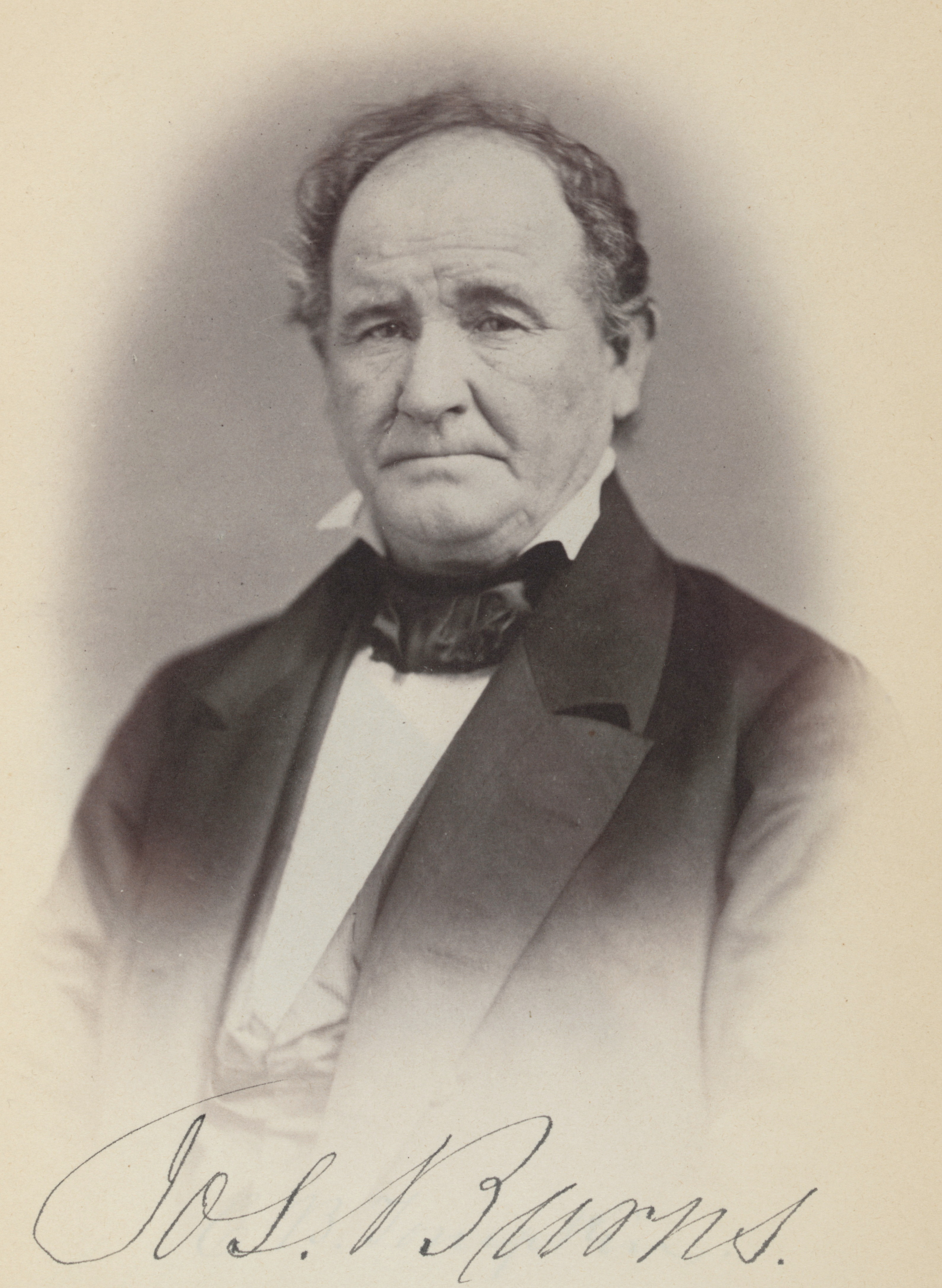
Historical · U.S. House · Ohio · District 15
Joseph Burns
Former U.S. Representative · Ohio District 15 · 1857–1859 · Democratic
Joseph Burns represented Ohio's District 15 in the United States House of Representatives (1857–1859) for the Democratic party. The page below collects sourced biographical facts, term history, committee roles, and provenance for Burns.
Bioguide ID: B001128
Key facts
- Full name
- Joseph Burns
- State
- Ohio
- District
- District 15
- Party
- Democratic
- House service
- 1857–1859
- First House term
- 1857
- Status
- Left office
- Current term ends
- —
- Born
- 1800
- Bioguide ID
- B001128
- Committee assignments
- —
- Dataset version
- 1.20260606
Biographical narrative
896 words · sourced from the Wikipedia REST extract
Joseph Burns was an American politician who served as a U.S. Representative for Ohio's 15th congressional district from 1857 to 1859. A member of the Democratic Party, Burns's political career was marked by his involvement in various local and state governmental roles prior to his election to Congress. His tenure in the House of Representatives was brief, lasting only one term, after which he returned to local pursuits in Ohio. Burns's life spanned a period of significant change in American history, and his contributions to his community and state reflect the political landscape of the mid-19th century.
Early life and career
Joseph Burns was born on March 11, 1800, in Waynesboro, Virginia. In 1815, when he was fifteen years old, his family relocated to Ohio, initially settling in New Philadelphia. The following year, they moved again to Coshocton, Ohio, where Burns would spend much of his life. His early education took place in urban schools, which provided him with a foundation for his future endeavors in both business and politics.
Burns engaged in various industrial pursuits, which likely included involvement in local businesses and the economy of Coshocton. His professional career began in earnest when he was appointed as the Auditor of Coshocton County, a position he held from 1821 until 1838. This role would have required him to manage the county's financial records and oversee fiscal responsibilities, providing him with valuable experience in governance and public service.
In addition to his role as auditor, Burns served in the Ohio State House of Representatives from 1838 to 1840. His time in the state legislature allowed him to gain further insight into the workings of government and the needs of his constituents. Following his legislative service, he took on the position of County Clerk from 1843 to 1851, where he was responsible for maintaining public records and managing county administration.
Burns also had a military career, serving as a major general in the Ohio State militia. This role would have involved leadership responsibilities and engagement in local defense matters, reflecting the importance of military organization during a time when the nation was experiencing internal strife leading up to the Civil War.
In 1848, Burns participated in the presidential election as a presidential elector for the Democratic candidates Lewis Cass and William Butler. This involvement in a national election further solidified his political connections and demonstrated his commitment to the Democratic Party.
House tenure
Joseph Burns was elected to the United States House of Representatives as a Democrat, representing Ohio's 15th congressional district. His term in the Thirty-fifth Congress began on March 4, 1857, and concluded on March 3, 1859. During this period, Burns participated in the legislative processes of the federal government, contributing to discussions and decisions that would shape the nation during a tumultuous time.
While specific details of his legislative activities are not documented in the available records, Burns's election to Congress came at a critical juncture in American history, as the nation was grappling with issues related to slavery, states' rights, and the impending conflict that would lead to the Civil War. His role as a congressman would have involved navigating these complex political landscapes and representing the interests of his constituents from Ohio.
Burns's time in Congress was relatively short-lived, as he was not successful in his bid for reelection in 1858 to the Thirty-sixth Congress. The reasons for this electoral defeat are not detailed in the historical records, but it reflects the challenges many politicians faced during a period of significant political realignment and social change in the United States.
Legislative focus and committees
While specific information regarding the committees on which Joseph Burns served during his congressional tenure is not available, it is reasonable to infer that, as a member of the Democratic Party during the late 1850s, he would have been involved in discussions pertinent to the political climate of the time. The Democratic Party was deeply divided over issues such as slavery and states' rights, and these divisions would have influenced the legislative priorities of its members.
As a representative from Ohio, Burns would have had to consider the interests of his constituents, which may have included agricultural concerns, economic development, and local governance issues. The mid-19th century was a time of significant growth and change in Ohio, and Burns's background in local government and his experiences as a county auditor and clerk would have informed his approach to legislation.
After concluding his term in Congress, Burns returned to Ohio, where he continued to engage in local business activities. He became involved in the drug business in Coshocton, contributing to the local economy and maintaining his presence in the community. Additionally, he served as the probate judge of Coshocton County, a role that would have involved overseeing legal matters related to estates and guardianships, further demonstrating his commitment to public service.
Joseph Burns passed away on May 12, 1875, in Coshocton, Ohio. His contributions to his community and his brief tenure in Congress reflect the complexities of American politics during a time of significant national upheaval. He was interred in Oak Ridge Cemetery, leaving behind a legacy tied to the political and social fabric of Ohio in the 19th century. His life and career illustrate the interconnectedness of local and national governance and the evolving role of public officials in addressing the needs of their constituents.
Notable legislation
Sponsored and co-sponsored legislation for Joseph Burns is pending operator curation. The biographical narrative above carries the same provenance trail until per-bill rows are written.
Sources
- [1]https://en.wikipedia.org/wiki/Joseph_Burns_(American_politician)Wikipedia · retrieved 2026-06-06
Notable quotes
Sourced quotes for Joseph Burns are pending operator curation. Narrative-scope provenance remains attached below.
Sources
- [1]https://en.wikipedia.org/wiki/Joseph_Burns_(American_politician)Wikipedia · retrieved 2026-06-06
Key positions
Curated policy positions for Joseph Burns are pending operator review. The biographical narrative above carries the same provenance trail until per-topic positions are written.
Sources
- [1]https://en.wikipedia.org/wiki/Joseph_Burns_(American_politician)Wikipedia · retrieved 2026-06-06
Terms served
- 1857–1859U.S. House · Term 1 · Democratic
Sources & provenance
Every attributable claim above carries a per-section [N] marker that resolves to the corresponding URL below. Each entry records the upstream provider, the canonical URL, and the timestamp at which the source was retrieved by the ingest pipeline.
Key facts
- https://bioguide.congress.gov/search/bio/B001128bioguide · retrieved 2026-06-06
- https://www.govtrack.us/congress/members/402072govtrack · retrieved 2026-06-06
Biographical narrative
- https://en.wikipedia.org/wiki/Joseph_Burns_(American_politician)wikipedia · retrieved 2026-06-06
Find your representative
Every U.S. state elects representatives by district. Browse Ohio’s delegation, the full former-representative roster, or explore the role and term length.
Related on The Candidate
- Preceded by William SappEarlier holder of the Ohio District 15 House seat · Ind. Republican-Democrat.Open
- Succeeded by William HelmickLater holder of the Ohio District 15 House seat · Republican.Open
- Aaron PerryFormer U.S. Representative · Ohio District 1 · RepublicanOpen
- Alexander DuncanFormer U.S. Representative · Ohio District 1 · DemocraticOpen
- Bellamy StorerFormer U.S. Representative · Ohio District 1 · WhigOpen
- Bellamy StorerFormer U.S. Representative · Ohio District 1 · RepublicanOpen