
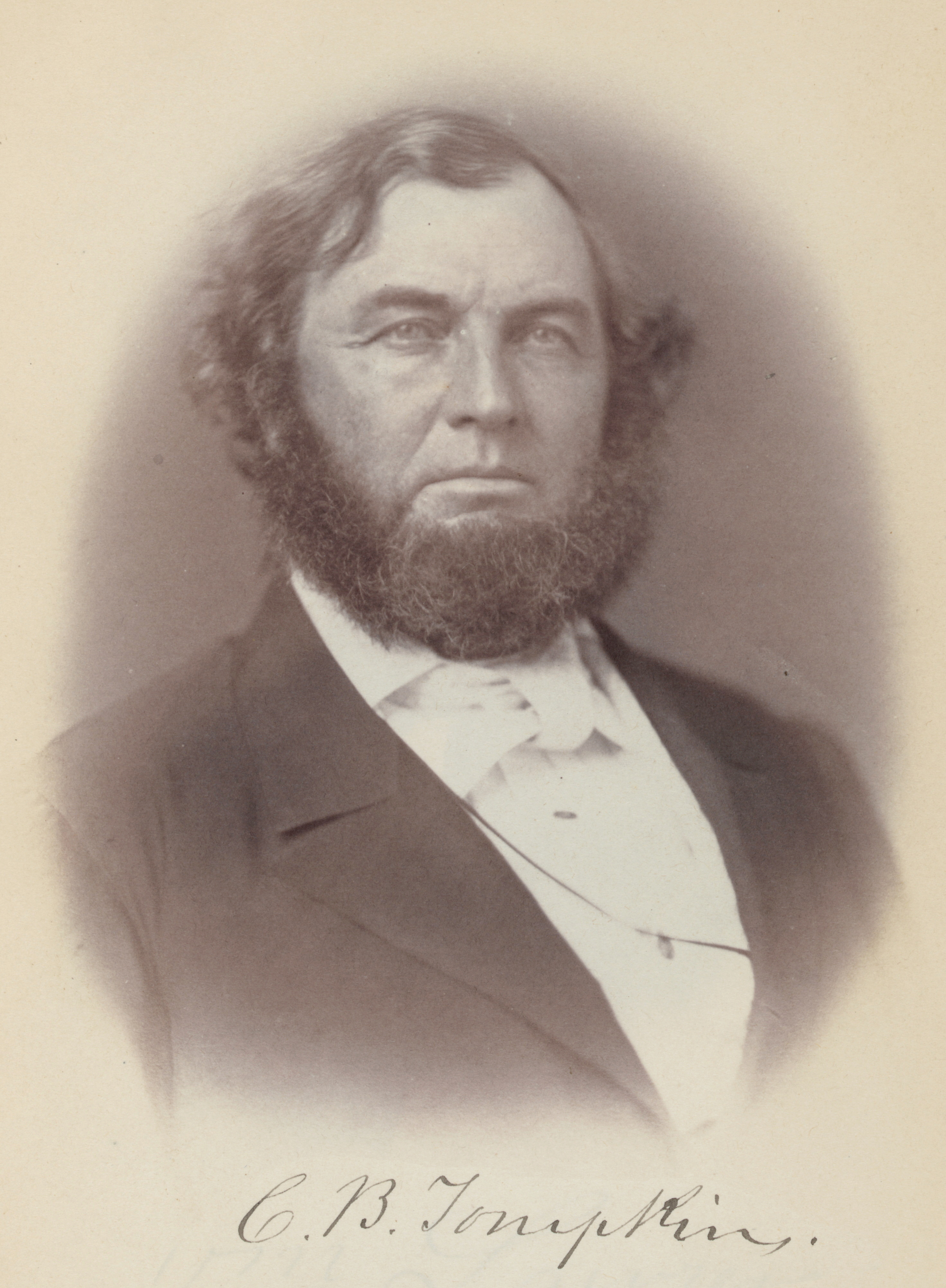
Historical · U.S. House · Ohio · District 16
Cydnor Tompkins
Former U.S. Representative · Ohio District 16 · 1857–1861 · Republican
Cydnor Tompkins represented Ohio's District 16 in the United States House of Representatives (1857–1861) for the Republican party. The page below collects sourced biographical facts, term history, committee roles, and provenance for Tompkins.
Bioguide ID: T000305
Key facts
- Full name
- Cydnor Tompkins
- State
- Ohio
- District
- District 16
- Party
- Republican
- House service
- 1857–1861
- First House term
- 1857
- Status
- Left office
- Current term ends
- —
- Born
- 1810
- Bioguide ID
- T000305
- Committee assignments
- —
- Dataset version
- 1.20260606
Biographical narrative
890 words · sourced from the Wikipedia REST extract
Cydnor Tompkins was an American lawyer and politician who served as a U.S. Representative from Ohio's 16th congressional district during the late 1850s and early 1860s. A member of the Republican Party, Tompkins was known for his strong opposition to the expansion of slavery in the United States. His legislative career spanned two terms in the House of Representatives, where he was actively involved in discussions surrounding the moral and political implications of slavery. After leaving Congress, he returned to his legal practice until his death in 1862.
Early life and career
Cydnor Tompkins was born on November 8, 1810, near St. Clairsville in Belmont County, Ohio. His family relocated to Morgan County in 1831, settling near the town of McConnelsville. Tompkins pursued his education through preparatory studies and graduated from Ohio University in Athens in 1835. Following his graduation, he studied law and was admitted to the bar in 1837, beginning his legal career in McConnelsville, where he established a practice.
In addition to his legal work, Tompkins engaged in local governance and public service. He served as the recorder of McConnelsville in 1840, a role that involved maintaining public records and documents for the municipality. His commitment to public service continued as he was elected as the prosecuting attorney for Morgan County from 1848 to 1851, a position that allowed him to oversee legal proceedings and represent the county in criminal cases. In 1850, he also took on the role of street commissioner in McConnelsville, overseeing the maintenance and development of the town's infrastructure.
Tompkins was active in the political landscape of Ohio, participating in the Republican State convention in 1855. This involvement reflected his alignment with the Republican Party, which was emerging as a significant political force in opposition to the expansion of slavery in the United States.
House tenure
Cydnor Tompkins was elected to the United States House of Representatives as a Republican, serving in the Thirty-fifth and Thirty-sixth Congresses from March 4, 1857, to March 3, 1861. His election to Congress came during a tumultuous period in American history, marked by intense debates over slavery and its implications for the nation. During his time in office, Tompkins was known for his vocal opposition to the spread of slavery into new territories and states.
In the Thirty-sixth Congress, Tompkins held the position of chairman of the Committee on Militia, where he was responsible for overseeing matters related to military organization and readiness. His leadership in this committee underscored his engagement with issues of national defense and the role of the military in the context of a nation grappling with internal divisions.
One of the highlights of Tompkins's congressional career was his address delivered on April 24, 1860, titled "Slavery: What It Was, What It Has Done, What It Intends to Do." This speech was widely circulated by the Republican Congressional Committee and articulated a historical and moral argument against the expansion of slavery. Tompkins drew upon the principles established during the Revolutionary era and the intentions of the nation's founders to assert that slavery was an evil sustained by local laws rather than a constitutional right. He emphasized that the Constitution did not recognize human beings as property and warned of the detrimental effects of slavery on society, politics, and education. Tompkins's address also highlighted the aggressive actions taken by pro-slavery factions, which he believed had destabilized the Union.
Despite his efforts and contributions, Tompkins was not successful in his bid for renomination in 1860, marking the end of his congressional tenure. His time in the House was characterized by a commitment to the principles of the Republican Party and a dedication to addressing the pressing moral and political issues of his time.
Legislative focus and committees
During his tenure in the House of Representatives, Cydnor Tompkins focused primarily on issues related to slavery and its expansion, reflecting the broader concerns of the Republican Party during the pre-Civil War era. His notable address on slavery exemplified his commitment to advocating for the containment of slavery and preserving the western territories for free men. Tompkins's arguments were rooted in a belief that the nation should draw a clear line against the spread of slavery, which he viewed as a threat to the nation's democratic ideals and social fabric.
As chairman of the Committee on Militia during the Thirty-sixth Congress, Tompkins played a role in shaping military policy and addressing issues related to national defense. This position allowed him to engage with matters of military organization and preparedness, which were increasingly relevant as tensions over slavery and states' rights escalated in the lead-up to the Civil War.
Tompkins's legislative focus was indicative of the broader Republican agenda during this period, which sought to limit the influence of slavery in American society and politics. His speeches and writings contributed to the national discourse on the moral implications of slavery and the responsibilities of the federal government in addressing this contentious issue.
After leaving Congress, Tompkins returned to his legal practice in McConnelsville, where he continued to be involved in the community until his death on July 23, 1862. He was interred in McConnelsville Cemetery, leaving behind a legacy as a politician who actively engaged with the pressing issues of his time and contributed to the ongoing debates surrounding slavery and its impact on the United States.
Notable legislation
Sponsored and co-sponsored legislation for Cydnor Tompkins is pending operator curation. The biographical narrative above carries the same provenance trail until per-bill rows are written.
Sources
- [1]https://en.wikipedia.org/wiki/Cydnor_B._TompkinsWikipedia · retrieved 2026-06-06
Notable quotes
Sourced quotes for Cydnor Tompkins are pending operator curation. Narrative-scope provenance remains attached below.
Sources
- [1]https://en.wikipedia.org/wiki/Cydnor_B._TompkinsWikipedia · retrieved 2026-06-06
Key positions
Curated policy positions for Cydnor Tompkins are pending operator review. The biographical narrative above carries the same provenance trail until per-topic positions are written.
Sources
- [1]https://en.wikipedia.org/wiki/Cydnor_B._TompkinsWikipedia · retrieved 2026-06-06
Terms served
- 1857–1859U.S. House · Term 1 · Republican
- 1859–1861U.S. House · Term 2 · Republican
Sources & provenance
Every attributable claim above carries a per-section [N] marker that resolves to the corresponding URL below. Each entry records the upstream provider, the canonical URL, and the timestamp at which the source was retrieved by the ingest pipeline.
Key facts
- https://bioguide.congress.gov/search/bio/T000305bioguide · retrieved 2026-06-06
- https://www.govtrack.us/congress/members/410878govtrack · retrieved 2026-06-06
Biographical narrative
- https://en.wikipedia.org/wiki/Cydnor_B._Tompkinswikipedia · retrieved 2026-06-06
Find your representative
Every U.S. state elects representatives by district. Browse Ohio’s delegation, the full former-representative roster, or explore the role and term length.
Related on The Candidate
- Preceded by Edward BallEarlier holder of the Ohio District 16 House seat · Ind. Republican-Democrat.Open
- Succeeded by William CutlerLater holder of the Ohio District 16 House seat · Republican.Open
- Aaron PerryFormer U.S. Representative · Ohio District 1 · RepublicanOpen
- Alexander DuncanFormer U.S. Representative · Ohio District 1 · DemocraticOpen
- Bellamy StorerFormer U.S. Representative · Ohio District 1 · WhigOpen
- Bellamy StorerFormer U.S. Representative · Ohio District 1 · RepublicanOpen