
Historical · U.S. House · Ohio · District 18
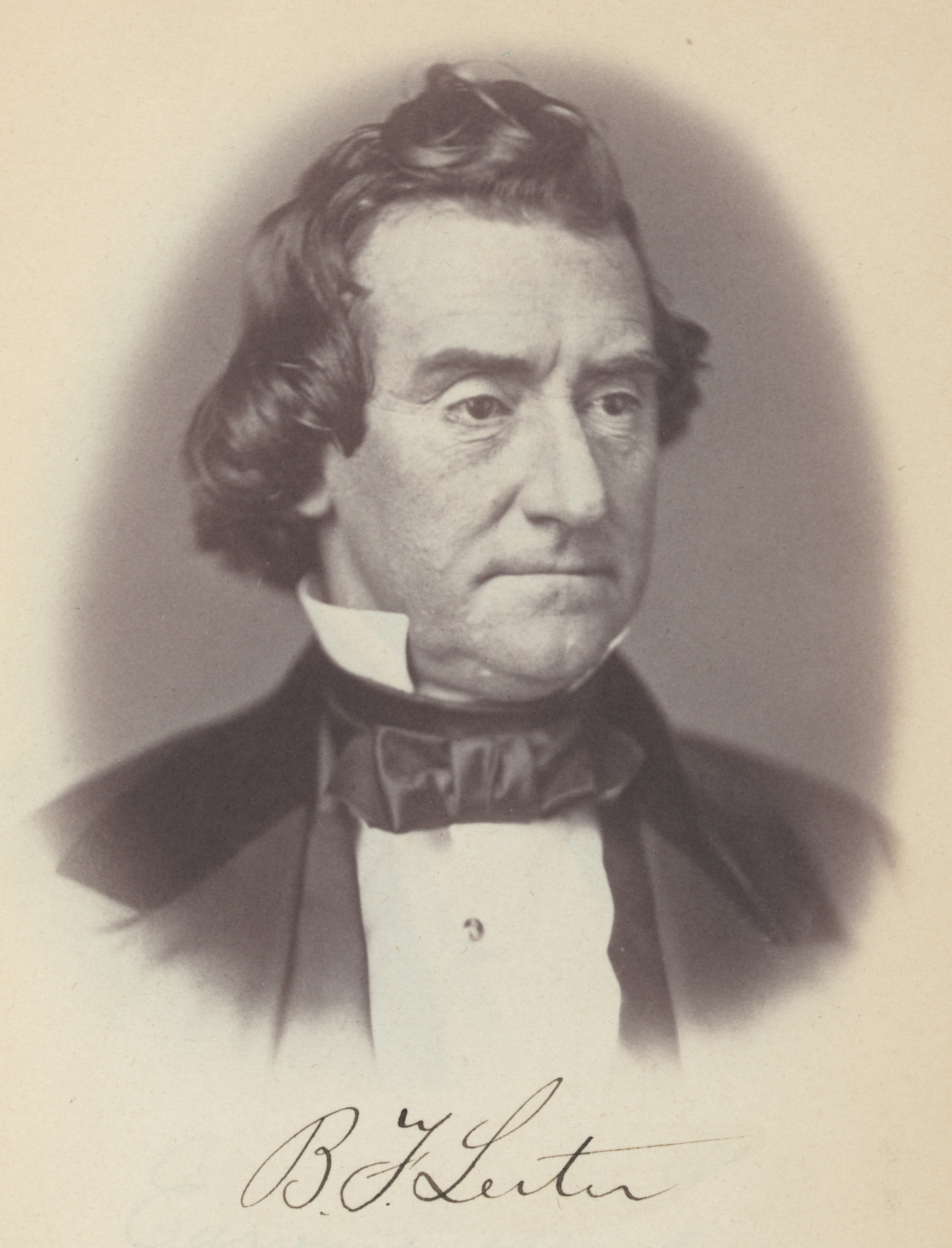
Benjamin Leiter
Former U.S. Representative · Ohio District 18 · 1855–1859 · Republican
Benjamin Leiter represented Ohio's District 18 in the United States House of Representatives (1855–1859) for the Republican party. The page below collects sourced biographical facts, term history, committee roles, and provenance for Leiter.
Bioguide ID: L000236
Key facts
- Full name
- Benjamin Leiter
- State
- Ohio
- District
- District 18
- Party
- Republican
- House service
- 1855–1859
- First House term
- 1855
- Status
- Left office
- Current term ends
- —
- Born
- 1813
- Bioguide ID
- L000236
- Committee assignments
- —
- Dataset version
- 1.20260606
Biographical narrative
961 words · sourced from the Wikipedia REST extract
Benjamin Leiter was a prominent figure in 19th-century American politics, serving as a U.S. Representative for Ohio's 18th congressional district. A member of the Republican Party, he held office during a transformative period in American history, marked by significant political and social changes. His tenure in the House of Representatives spanned from 1855 to 1859, during which he participated in the legislative processes that shaped the nation. Beyond his congressional service, Leiter had a multifaceted career as a lawyer, educator, and local government official, contributing to his community in various capacities.
Early life and career
Benjamin Leiter was born on October 13, 1813, in Leitersburg, Maryland. His early education was limited, reflective of the educational opportunities available at the time. Despite these constraints, he pursued a career in teaching, beginning his work as an educator in Maryland from 1830 to 1834. This initial foray into education laid the groundwork for his later teaching endeavors in Ohio after he relocated there in 1834. He continued to teach in Ohio until 1842, demonstrating a commitment to education that would influence his later political career.
In pursuit of further professional development, Leiter studied law under the guidance of David A. Starkweather. He was admitted to the bar in 1842, marking the beginning of his legal career in Canton, Ohio. His legal practice allowed him to engage with the community and gain a deeper understanding of the issues facing his constituents. In addition to his legal work, Leiter served as a justice of the peace, a role that involved overseeing local legal matters and contributing to the administration of justice at the community level. His involvement in local governance expanded when he became the mayor of Canton, a position he held for a decade. This experience in local politics provided him with valuable insights into the workings of government and the needs of the people he represented.
Leiter's political career took a significant turn when he was elected to the Ohio House of Representatives in 1848. He served two terms, during which he was elected Speaker of the House in 1849. This leadership role not only highlighted his political acumen but also positioned him as a key figure in Ohio's legislative processes. His tenure in the state legislature was characterized by his engagement with the pressing issues of the time, including debates surrounding slavery and westward expansion.
House tenure
Leiter's congressional career began when he was elected as an Anti-Nebraska candidate, a political movement that opposed the Kansas-Nebraska Act, which allowed for the possibility of slavery in territories where it had previously been prohibited. This act was a pivotal moment in American politics, contributing to the sectional tensions that would eventually lead to the Civil War. Elected to the United States House of Representatives in 1854, Leiter took office in 1855, representing Ohio's 18th congressional district.
During his time in Congress, Leiter served two terms, concluding his service in 1859. His legislative activities were shaped by the political climate of the era, which was marked by intense debates over slavery, states' rights, and the future of the Union. As a member of the Republican Party, which was founded on anti-slavery principles, Leiter was part of a growing movement that sought to address the moral and political challenges posed by slavery in America. His role in Congress allowed him to advocate for policies that aligned with his beliefs and the interests of his constituents.
While specific details regarding his voting record and the legislation he supported are not provided, it is understood that his participation in Congress occurred during a time of significant legislative activity. The period leading up to the Civil War was characterized by contentious debates and the introduction of various bills aimed at addressing the nation's divisions. As a representative, Leiter would have been involved in discussions that shaped the future of the United States, navigating the complexities of a rapidly changing political landscape.
Legislative focus and committees
Although specific information about the committees on which Benjamin Leiter served is not detailed, it can be inferred that his legislative focus would have been influenced by the pressing issues of his time. As a member of the Republican Party, he likely engaged with topics related to the expansion of slavery, civil rights, and the governance of newly acquired territories. The political environment of the mid-19th century was fraught with challenges, and legislators like Leiter were tasked with addressing these issues while representing the interests of their constituents.
Leiter's background as a lawyer and his experience in local government would have informed his approach to legislation. His legal training would have equipped him with the analytical skills necessary to navigate complex legal issues, while his experience as a mayor and state legislator would have provided him with a practical understanding of governance. This combination of skills and experiences would have been valuable in his role as a congressman, enabling him to contribute meaningfully to discussions and decisions that impacted the nation.
After concluding his service in the House of Representatives in 1859, Leiter returned to his community in Canton, Ohio. His post-congressional life included continued involvement in local affairs and a commitment to his family. He married Catherine Burger in 1836, and together they had seven children. Leiter's personal life, marked by his dedication to family and community, reflected the values of the time.
Benjamin Leiter passed away on June 17, 1866, in Canton, Ohio. His contributions to his community and the nation during a pivotal period in American history are remembered through his service in the U.S. House of Representatives and his various roles in local governance. He was interred in West Lawn Cemetery in Canton, leaving behind a legacy as a public servant who navigated the complexities of his time.
Notable legislation
Sponsored and co-sponsored legislation for Benjamin Leiter is pending operator curation. The biographical narrative above carries the same provenance trail until per-bill rows are written.
Sources
- [1]https://en.wikipedia.org/wiki/Benjamin_F._LeiterWikipedia · retrieved 2026-06-06
Notable quotes
Sourced quotes for Benjamin Leiter are pending operator curation. Narrative-scope provenance remains attached below.
Sources
- [1]https://en.wikipedia.org/wiki/Benjamin_F._LeiterWikipedia · retrieved 2026-06-06
Key positions
Curated policy positions for Benjamin Leiter are pending operator review. The biographical narrative above carries the same provenance trail until per-topic positions are written.
Sources
- [1]https://en.wikipedia.org/wiki/Benjamin_F._LeiterWikipedia · retrieved 2026-06-06
Terms served
- 1855–1857U.S. House · Term 1 · Ind. Republican-Democrat
- 1857–1859U.S. House · Term 2 · Republican
Sources & provenance
Every attributable claim above carries a per-section [N] marker that resolves to the corresponding URL below. Each entry records the upstream provider, the canonical URL, and the timestamp at which the source was retrieved by the ingest pipeline.
Key facts
- https://bioguide.congress.gov/search/bio/L000236bioguide · retrieved 2026-06-06
- https://www.govtrack.us/congress/members/406739govtrack · retrieved 2026-06-06
Biographical narrative
- https://en.wikipedia.org/wiki/Benjamin_F._Leiterwikipedia · retrieved 2026-06-06
Find your representative
Every U.S. state elects representatives by district. Browse Ohio’s delegation, the full former-representative roster, or explore the role and term length.
Related on The Candidate
- Preceded by David CartterEarlier holder of the Ohio District 18 House seat · Democratic.Open
- Succeeded by Sidney EdgertonLater holder of the Ohio District 18 House seat · Republican.Open
- Aaron PerryFormer U.S. Representative · Ohio District 1 · RepublicanOpen
- Alexander DuncanFormer U.S. Representative · Ohio District 1 · DemocraticOpen
- Bellamy StorerFormer U.S. Representative · Ohio District 1 · WhigOpen
- Bellamy StorerFormer U.S. Representative · Ohio District 1 · RepublicanOpen